 Advances in Engineering Advances in Engineering features breaking research judged by Advances in Engineering advisory team to be of key importance in the Engineering field. Papers are selected from over 10,000 published each week from most peer reviewed journals.

Significance Statement
A powerful and versatile tool such as the microfluidic device has been employed in generating highly monodisperse double emulsion with precision control of sizes of inner and outer droplets and number of encapsulated droplets which cannot be achieved using traditional bulk emulsification methods. Common microfluidic devices found today have been the capillary microfluidic device and polydimethyl siloxane PDMS devices.
Despite the advantages they offer, they however, face challenges in terms of difficulty to precisely set the positions and sizes of the tapered capillaries in case of capillary microfluidic device and difficulty to fabricate a device with flow channels in three dimensions in case of polydimethyl siloxane devices.
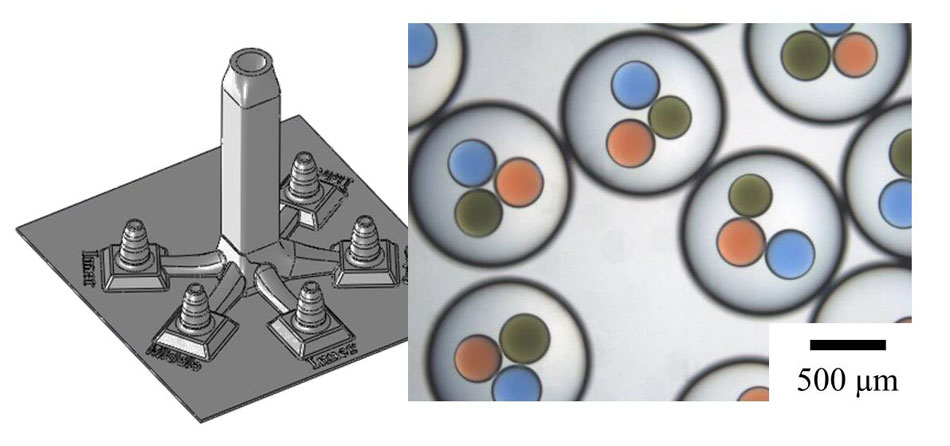
Dr. Toshimitsu Kanai and Ms. Masaki Tsuchiya from Department of Material Science and Engineering at Yokohama National University in Japan presented a three-dimensional device fabricated using stereolithography which generates monodisperse double emulsions thereby enabling precision control of sizes and number of encapsulated droplets. The work published in Chemical Engineering Journal further showed that monodisperse double emulsions with three different inner droplets can be generated in a device with different inner channels.
Kanai and Tsuchiya (2016) demonstrated fabrication of three-dimensional microfluidic devices using stereolithography which only facilitates construction of complex flow channels in three dimension but also fine-tunes channel position, size and redesigns easily and efficiently.
For implementation of design, a microfluidic device with three-dimensional flow channels for preparing double emulsions using CAD software (SolidWorks) was developed. The device has three coaxially aligned cylindrical channels perpendicular to the substrate with an accuracy less than 5μm. The size of the device was within 1cm2 and internal diameters of inner, middle and outer channels were set to 50, 500 and 1000μm respectively. The CAD data was converted into a rapid prototyping format, sliced into a set of thin layers before being transferred to a stereolithography machine which builds the design layer by layer on basis of the sliced data.
Double emulsions oil-in-water-in-oil O/W/O was prepared where the wettability of flow channels made of hydrophobic resin was controlled. Silicone oil (5 cSt, Sigma-Aldrich) and silicone oil (50 cSt, Sigma-Aldrich) containing a surfactant (2 wt.%, RSN-0749) were used as inner and outer oil phases respectively while ultrapure water containing red food dye, glycerol (10 wt.%) and surfactant (2 wt.% polyvinyl alcohol, Mw=31,000-50,000, Sigma-Aldrich) was used as a middle water phase.
From optical micrograph, formation of monodisperse oil-in-water-in-oil double emulsion in the microfluidic device of flow rates of inner oil, middle water and outer oil are 0.07, 1.0 and 5.0mLh-1 respectively. Even after collection, the core-shell structure remained stable where the oil-in-water-in-oil double emulsions exhibited high monodispersity as coefficient of variation CV values of sizes of the inner and outer droplets were less than 2%.
A monodisperse water-in-oil-in-water W/O/W double emulsions could also be obtained with a device with outer channel coated with a silica layer where optical micrograph showing flow rate of 0.06, 3.0 and 20mLh-1 for inner water, middle oil and outer water respectively. Coefficient of variation values was also less than 2%.
When flow rates of middle water and outer oil phases were held at 2.0 and 5.0mLh-1 respectively, number of encapsulated oil droplets increased from one to six as the flow rate of the inner oil phase increased from 0.1 to 0.7mLh-1. This result shows one attractive feature of microfluidic techniques in its ability to easily and precisely control the sizes of inner droplets, d1, outer droplets d2 and number of encapsulated droplets, N1. The experimentally obtained values of number of encapsulated droplets is also in good agreement with those calculated theoretically.
When water phases with dissolved red, green and blue dyes were injected into different inner channels, the three colored droplets remained separate even after collection because of the surfactants in the middle oil and outer water phases.
Stereolithograpic fabrication of microfluidic device can generate higher-order multiple emulsions easily with more compartments which serves as a great potential in drug delivery, food, cosmetics and materials science and application.

Journal Reference
Toshimitsu Kanai,, Masaki Tsuchiya. Microfluidic Devices Fabricated using Stereolithography for Preparation of Monodisperse Double Emulsions. Chemical Engineering Journal, Volume 290, 15 April 2016, Pages 400–404.
Department of Materials Science and Engineering, Yokohama National University, 79-5 Tokiwadai, Hodogaya, Yokohama, Kanagawa 240-8501, Japan.
Go To Chemical Engineering Journal
