 Advances in Engineering Advances in Engineering features breaking research judged by Advances in Engineering advisory team to be of key importance in the Engineering field. Papers are selected from over 10,000 published each week from most peer reviewed journals.

Significance
The ongoing trend of down-scaling of microelectronics has led to an exponential increase in the requirements for heat removal. As such, a global transition to liquid-based cooling in underway. Moreover, as heat-generating elements have decreased in size, so have the bounded cooling flows been downscaled, not only to match the heat sources but also due to the inherent gain in heat transfer suggested by classical theory. This is especially evident through the abundance of research on microchannels and microjets. This transition to high-speed micro-scale liquid flows, causes the effects of viscous dissipation to remerge even in these laminar flows, and counter the potential gains.
While traditionally dissipation is only considered non-negligible in very turbulent gas flows or flows of very viscous liquids, in this novel work its importance is shown at micro-scales as well. Although its importance was recognized already two decades ago in the literature, in the context of microchannel flows . However, this limit was not closely studied or quantified, despite the existing theory for channel flows with viscous dissipation. One of the reasons for this oversight, is the fact that the typically used dimensionless representation of the conservation laws, does not reveal the inherent limit.
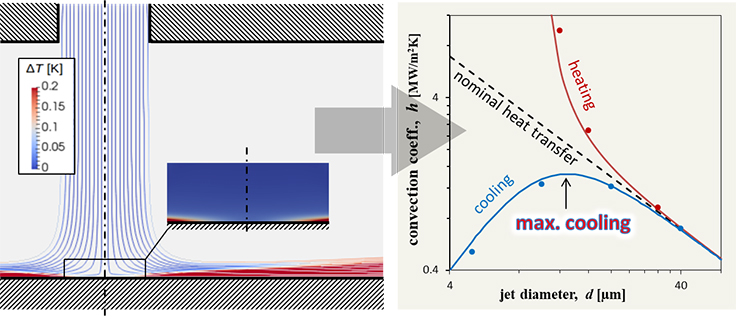
To this note, Tel Aviv University scientists: Dr. Barak Kashi and Dr. Herman D Haustein embarked on dimensional analysis of existing theory showed the existence of this limit, its quantification and its scaling with key flow parameters. These findings were generalized to canonical bounded flows, first by analyzing several channel configurations, using existing developed-flow theory, whereas new theory had to be formulated for the more complex, developing-flow case of impinging jets. Impinging jets are of special interest to micro-cooling as they are known to require lower driving pressures, remove higher heat fluxes, while also enabling the targeting of small hot spots. Within this generalization, a new dimensionless group was defined, which gives the location and magnitude of this limit at a critical value, common to all flow configurations. The research work is published in International Communications in Heat and Mass Transfer.
The novel analysis showed that viscous dissipation reduces the effective cooling as the maximum is approached, thereby breaking away from classical macro-scale heat transfer theory. This divergence is two-fold: first, the symmetry between the heating and cooling cases is broken, and second the heat transfer’s classical independence of heat-flux is lost. This means that one cannot just keep gaining in cooling by down-scaling these high-velocity flows, as beyond the limit losses overcome the down-scaling gains. Thereby, the heat transfer limit also sets an absolute limit to beneficial flow scale-down, even if sufficient driving pressures are available to generate such flows.
Even though cooling flows are just now approaching this domain, these limits are absolute, and effects are felt prior to the maximum already at several times the downscaling limit. By recognizing the inherent limitations and obtainable performance envelope, this study curbs the ongoing trend of cooling flows miniaturization.


Reference
Barak Kashi and Herman D Haustein. Microscale sets a Fundamental Limit to Heat Transfer. International Communications in Heat and Mass Transfer. Volume 104, May 2019, Pages 1-7
Go To International Communications in Heat and Mass Transfer