Advances in Engineering Advances in Engineering features breaking research judged by Advances in Engineering advisory team to be of key importance in the Engineering field. Papers are selected from over 10,000 published each week from most peer reviewed journals.

Significance
Hot-worked Al-Cu-Li alloys do not soften or refine in a simple way once deformation begins, because dislocation storage, recovery, boundary migration, and phase-related pinning all compete on the same length scale. That competition becomes even less straightforward in cast material, where dendritic segregation leaves behind local chemical gradients and second-phase heterogeneity that are usually treated as problems to be erased before serious thermomechanical processing starts. In a recent research paper published in Materials Science and Engineering: A, Dr. Chunnan Zhu, Professor Jin Zhang, and Professor Dongfeng Shi from the Central South University together with Professor Guoqing Wang from the China Academy of Launch Vehicle Technology, examined how retained segregation bands in as-cast 2195 Al-Cu-Li alloy influence hot deformation, grain refinement, and the final property balance. They showed that these retained bands affect how strain localizes, how refinement begins, and how the recrystallization mode changes as deformation proceeds. Instead of removing the cast heterogeneity before deformation, the authors kept it and examined how it shaped the deformation pathway itself.
Their starting point was that most prior work on Al-Li hot deformation had focused on homogenized ingots, even though real cast billets enter processing with segregation bands, eutectic remnants, and nonuniform local resistance to plastic flow. That gap matters, because dynamic recovery and dynamic recrystallization are both highly sensitive to the local distribution of solute and obstacles, not just to nominal temperature and strain rate. The researchers framed the problem around three distinct initial states of the same 2195 alloy: as-cast material retaining segregation bands and eutectic phases, a desegregation-annealed state that removed the Cu-rich bands while preserving much of the eutectic content, and a homogenized state that removed both the bands and most residual eutectic material. This comparison allowed the role of segregation bands to be distinguished from the more general effects of homogenization. In the as-cast billet, Cu-rich bands remained along dendritic boundaries, with local Cu concentration peaking around 3.8 wt% and dropping to about 1.0 wt% in adjacent regions. After desegregation annealing, those fluctuations were largely removed while eutectic content stayed comparable; after homogenization, both segregation bands and most eutectic phases were eliminated. In that setting, segregation bands are more than inherited casting artifacts. They influence dislocation storage, recrystallization behavior, and the grain structure retained after later processing.
The authors built the study around surface deformation, subsurface dislocation structure, evolving grain-boundary character, post-solution grain morphology, and final room-temperature strength and ductility. They hot deformed all three states under the same conditions, 330 °C and 10⁻⁴ s⁻¹, then tracked tensile and compressive strain evolution with SEM, EBSD, EDS, and TEM-based characterization. More importantly, the cast structure continues to matter during deformation, because it redistributes strain and changes how recrystallization proceeds.
Under hot tensile loading, the as-cast alloy behaved differently almost immediately. Its surface developed strong intragranular undulations, and the associated GND maps showed dense dislocation storage distributed through grain interiors. The desegregated and homogenized states, by comparison, remained much smoother inside the grains and concentrated their GND buildup near grain boundaries. EBSD analysis reinforced that contrast: in the as-cast material, low-angle boundaries formed and interconnected inside grains as strain rose, whereas the more chemically uniform states showed much weaker intragranular substructure development. This contrast indicates a different pattern of strain partitioning in the as-cast alloy. The retained segregation pattern drove plastic heterogeneity inside the grains rather than confining most of the accommodation to pre-existing boundary regions.
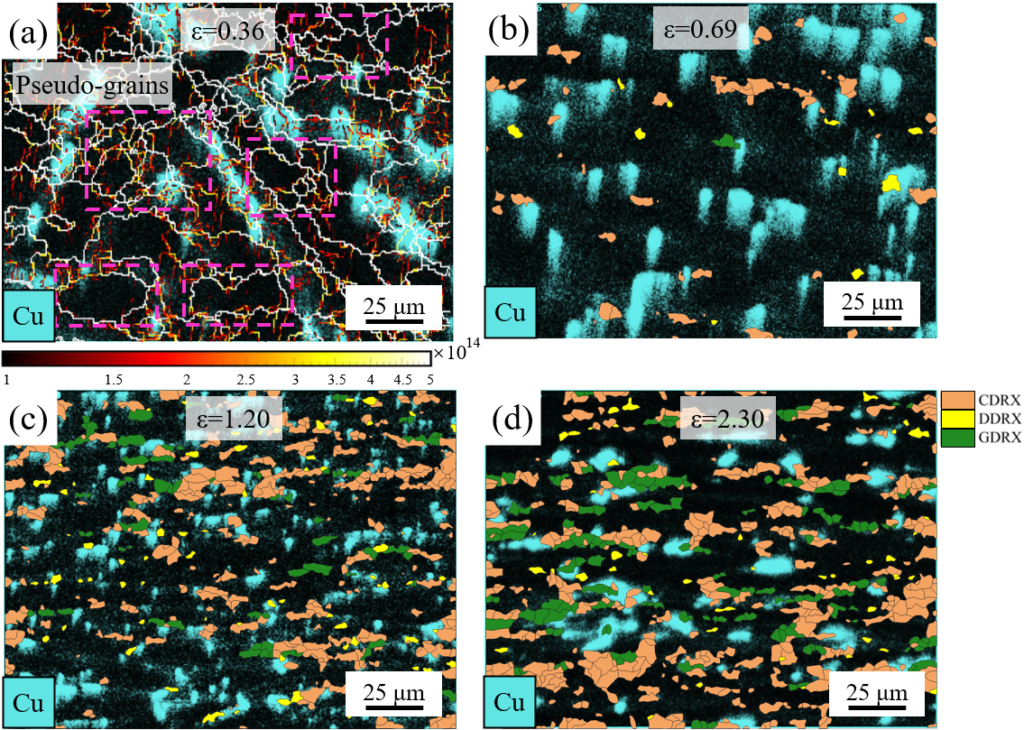
The same logic became clearer during progressive hot compression. At moderate strain, the as-cast alloy already showed abundant substructures and discontinuous high-angle boundaries inside parent grains, which the authors interpreted as a signature of continuous dynamic recrystallization. As strain increased, parent grains in the as-cast state thinned and broke down much more aggressively than in the desegregated and homogenized conditions. Above a true strain of about 1.0, the separation became sharp: grain refinement in DA and HT more or less stalled, while AC continued to refine. The quantitative grain-size data captured that split cleanly. The as-cast state reached an average deformed grain size of 7.57 μm, finer than the 12.86 μm reported for the homogenized-treated comparison and also under these conditions, the initial heterogeneity did not suppress refinement and actually it prolonged it.
The boundary statistics help explain why. In the as-cast material, continuous high-angle boundary density kept rising even beyond ε = 1.20, whereas the DA and HT conditions stabilized. Discontinuous high-angle boundaries in AC peaked earlier, around ε = 0.69, and the evolution of low-angle boundaries pointed to rapid conversion of substructure into higher-angle interfaces. The boundary statistics support the interpretation that the as-cast condition stored and reorganized dislocations in a way that favored subgrain rotation and boundary migration, so the material kept generating fresh high-angle interfaces instead of settling into the earlier saturation seen in the homogenized states. The banded starting structure therefore shifted the balance away from recovery alone and toward continued recrystallization-driven refinement.
TEM and HAADF-STEM observations added another layer. The authors found that in the compressed as-cast material, a spatially heterogeneous precipitation structure with precipitate-free interiors, transition regions containing coarse T1 phases near boundaries, and boundary-adjacent zones with precipitate-free zones plus mixed θ′/T1 clusters and residual eutectic particles. The desegregated and homogenized materials looked much more uniform. That matters because the study’s explanation is not simply “segregation exists.” It is that segregation bands create neighboring soft and hard regions. Solute-depleted pseudo-grains take strain readily and generate dense recovery substructures, while banded and precipitate-rich boundary regions resist slip, pin dislocations, and impose local gradients in stored energy and misorientation. The result is an internal map of differential plasticity that makes low-angle to high-angle boundary conversion easier in the as-cast state.
Early in deformation, the as-cast alloy refined through a gradual recrystallization process rather than by sudden formation of entirely new grains. Uneven strain near segregation bands produced many subgrains, and these subgrains slowly rotated until their boundaries developed into true recrystallized grain boundaries. The concentration of boundary angles around 15° supports that interpretation. At the highest strain, ε = 2.30, the misorientation distribution shifted toward 45°–50°, and the grain classification maps showed a growing contribution from geometric dynamic recrystallization. The authors argued that CDRX dominates the early refinement stage, while GDRX becomes more important once the grains have been sufficiently thinned. DDRX remained a minor contributor throughout. After solution treatment, the microstructural inheritance remained very clear. The as-cast-derived material coarsened to an average grain size of about 31 μm and stayed relatively uniform. The desegregated condition reached about 65 μm. The homogenized state coarsened far more severely, averaging about 116 μm and developing a broad, heterogeneous distribution associated with abnormal grain growth. After T8 aging, all three conditions showed similar precipitation populations dominated by T1 with minor θ′, so the major remaining distinction was grain morphology rather than a different age-hardening response.
The room-temperature tensile data then closed the argument. In the W condition, the as-cast-derived specimens exceeded the homogenized-derived ones by about 6 MPa in yield strength, 11 MPa in tensile strength, and 4.4 percentage points in elongation. In the T8 condition, the gap widened further to roughly 18 MPa in yield strength, 20 MPa in ultimate tensile strength, and 1.8 percentage points in elongation. The ranking stayed consistent: AC outperformed DA, and DA generally outperformed HT. These numbers are important because they indicate better strength did not come at the expense of ductility under the tested conditions. The finer and more uniform grain structure retained after direct deformation of the as-cast billet translated into a better strength-ductility balance after downstream treatment. For Al-Cu-Li processing, the results challenge the usual assumption that cast heterogeneity must be removed before effective thermomechanical refinement can occur. Segregation bands are commonly treated as features to remove before controlled thermomechanical refinement can even begin. Professor Dongfeng Shi and co-workers show that, under the tested conditions, those bands can instead serve as internal drivers of microstructural change. They create local incompatibility in deformation resistance, push dislocations into specific storage patterns, accelerate continuous dynamic recrystallization, and later support a shift toward geometric dynamic recrystallization at very large strain. For alloys like 2195, where processing cost, thermal history, and microstructure retention all matter, that is a meaningful shift in processing strategy. Within the tested alloy and thermomechanical window, the results make a clear case that cast heterogeneity can sometimes be used constructively rather than erased reflexively.


Reference
Chunnan Zhu, Jin Zhang, Dongfeng Shi, Guoqing Wang, A novel approach to tailoring microstructure and enhancing performance in Al-Cu-Li alloys: Grain refinement driven by segregation bands, Materials Science and Engineering: A, Volume 944, 2025, 148948,