Advances in Engineering Advances in Engineering features breaking research judged by Advances in Engineering advisory team to be of key importance in the Engineering field. Papers are selected from over 10,000 published each week from most peer reviewed journals.

Significance Statement
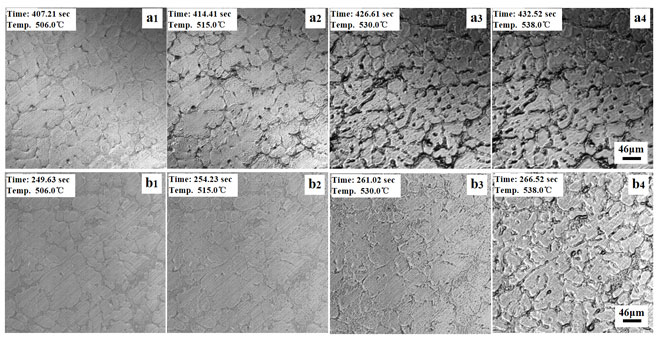
There have been a lot of works published on the effect of heating temperature and soaking time on microstructural evolution during isothermal re-melting process [e.g. H.V. Atkinson, D. Liu, Mater. Sci. Eng. A 496 (2008) 439]. However, the heating rate, which plays an essentially important role for grain structural evolution during re-melting, has rarely been discussed. In addition, the coarsening of silicon particles, which will reduce mechanical property of subsequently made parts, has rarely been studied during re-melting of typical semi-solid alloys produced from Al-Si alloys, such as A356, 357, 319s. In this study, we aim to characterize both the microstructural evolution mechanisms during partial melting of semi-solid 319s alloy and subsequent thixoformability. The impact of heating rate on re-melting was investigated in this study using in-situ observation of microstructural evolution in re-melting experiments.
Re-melting of semi-solid billets is the critical stage in thixocasting for obtaining a good thixotropic slug, which in turn determines formability of the slug and finally quality of the parts. Parameters such as the re-heat temperature, heating rate and soaking time strongly affect the structural evolution, and thus the thixotropic behavior. Maximizing heating rate and minimizing the soaking time in the semi-solid state is always desired expected to avoid coarsening of microstructure (primary grains and also Si particles), which may cause poor mold-filling capacity for thin sections and mechanical properties of the parts. This study indicates, however, over maximizing heating rate may induce over superheating and rapid melting of eutectics, which may result in narrowing the process window of thixocasting. Usually, heating temperature is only controlled for a desired liquid fraction. As a conclusion, an appropriate heating rate and soaking time shall be determined by theoretical analysis and experiments based on the alloy and billet size.


Journal Reference
Journal of Alloys and Compounds, Volume 649, 15 November 2015, Pages 204-210.
X.G. Hu1,2, Zhu1, H.X. Lu1, Zhang1,D.Q. Li1, S.P. Midson1
[expand title=”Show Affiliations”]- General Research Institute for Nonferrous Metals, Beijing, China
- University of Science and Technology Beijing, Beijing, China
Abstract
The aim of this paper is to characterize both microstructural evolution and thixoformability during partial melting of semi-solid 319s alloy. The thixoformability criteria of 319s was initially investigated by thermodynamic analysis. In-situ observation of partial re-melting was performed by a Confocal Laser Scanning Microscope to determine the effect of heating rate on melting characteristics. Meanwhile, the microstructural evolution of 319s alloy at extremely low heating rate was also investigated in order to understand the mechanism of re-melting process. The studies demonstrated that 319s alloy is suitable for thixocasting because of the controllable liquid fraction in the operating window of 15 °C. The process window was effected by both temperature and heating time. The primary particles evolution in 319s alloy can be divided into four stages, and the coarsening rate during isothermal test is 227 μm3/s. The effective method to obtain desirable microstructure is to manage the time in the semi-solid state by controlling heating rate and soaking time.
Go To Journal of Alloys and Compounds