Advances in Engineering Advances in Engineering features breaking research judged by Advances in Engineering advisory team to be of key importance in the Engineering field. Papers are selected from over 10,000 published each week from most peer reviewed journals.

Significance
Polypropylene has quietly established itself as a foundational material in modern manufacturing. Whether in packaging, automotive parts, or consumer goods, it’s relied upon because it does what it’s supposed to: it’s cheap, durable, chemically stable, and easy to process. But that same resilience becomes a liability once these materials are discarded because unlike biodegradable alternatives, polypropylene sticks around—on beaches, in waterways, and buried in landfills—largely unchanged for years. The environmental cost of that longevity is now impossible to ignore, and there’s a growing urgency to rethink how we design these polymers from the inside out. The central challenge is one of balance. On the one hand, the material has to perform—resist moisture, retain its shape, survive heat—and on the other, it should eventually degrade, ideally in a way that’s both predictable and uniform. But this is easier said than done. Most of what we know about how polypropylene degrades comes from studies that look at surface oxidation or bulk averages. These methods don’t capture what’s happening beneath the surface, especially in molded plastics where internal structure varies significantly from one region to the next. The cooling rates and shear forces during injection molding create a skin-core gradient, with oriented crystals at the surface and more relaxed structures toward the center. These regions respond differently to environmental stress, but that complexity is rarely explored in detail. Add to this the influence of chemical structure. Introducing ethylene into the polypropylene chain which forms random copolymer interferes with the regular packing of the chains, which affects how the material crystallizes. That, in turn, could influence how it degrades under UV light, though surprisingly little work has been done to unpack that connection. It’s not just about chemical composition; it’s also about how that composition shapes microstructure and, by extension, degradation behavior.
To this account, a new research paper published in the Nano Select Journal and conducted by PhD student Marta Chiapasco, Michele Valsecchi, Dr. Gavin Hill, Dr. Christopher Wallis, Professor Alexandra Porter, and Professor Finn Giuliani from Imperial College London, the authors developed a new spatially resolved analytical approach that integrates Raman spectroscopy and nanoindentation across the cross-sections of polypropylene samples to track microstructural and mechanical changes during photooxidation. This was combined with traditional bulk techniques like FTIR, DSC, XRD, and GPC to correlate chemical degradation with local crystallinity, phase distribution, and hardness.
The research team started by exposing both polypropylene homopolymer (PPH) and its random copolymer counterpart (PPRC) to UV-A light over a 28-day aging period. To track oxidation, the authors used FTIR which uses the carbonyl index as an indicator of oxidative stress. They observed the in the case of PPH, carbonyl groups began appearing fairly early—by around two weeks in, there was a clear rise. That wasn’t seen in PPRC until about a week later, which suggests some initial resistance, possibly due to the ethylene comonomer disrupting chain regularity. Still, by the end of the test period, both materials had reached roughly the same level of oxidation, which indicates that PPRC’s early advantage didn’t hold up in the long term.
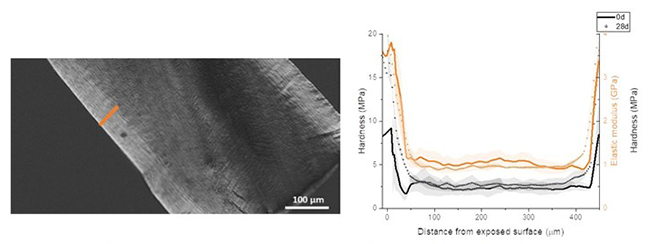
The researchers then used thermal behavior, measured through DSC and as expected, PPH consistently showed higher melting temperatures, which pointed to the presence of thicker, more stable crystalline structures. In contrast, PPRC exhibited broader melting transitions and a clear shoulder around 120°C, which is usually associated with polyethylene-like sequences. Early on in the aging process, both materials actually became more crystalline. This increase is likely the result of chemi-crystallization—when chain scission creates new segments that have the mobility to reorganize. But that trend reversed after about three weeks, particularly in PPRC. The drop in crystallinity there might reflect the onset of crystal fragmentation or structural fatigue under sustained UV exposure. To investigate how degradation varied across the depth of the samples, the authors used Raman spectroscopy on their cross-sections and found significant differences between the two polymers with the unaged PPH had a sharply defined internal structure: a relatively amorphous outer skin, a transitional region, and a more crystalline core. PPRC, in contrast, was more uniform from surface to center. After aging, PPH’s skin layer saw a steep loss in amorphous content, while the core remained largely intact. PPRC showed a smoother, more gradual shift across its cross-section, with changes in helical chain content suggesting internal reordering rather than localized breakdown. Finally, nanoindentation confirmed these patterns mechanically. PPH started off with a clear stiffness gradient, soft at the surface and firm in the core. PPRC had a flatter mechanical profile throughout. After UV exposure, both stiffened at the surface—but PPH’s change was sharp and uneven, while PPRC’s was more modest and evenly distributed. That consistency reinforces the idea that PPRC’s finer, more uniform microstructure helps buffer against localized degradation.
What makes the new study by Professors Alexandra Porter, Finn Giuliani, and their team significant and unique is its attention to the physical realities of how polypropylene materials age—not just chemically, but also spatially. It’s easy to assume that degradation is a surface phenomenon, or that bulk measurements tell the whole story. But when polymers are processed by injection molding, they’re anything but uniform. Actually, the internal structure—formed during cooling, shaped by flow—matters. A lot. The degradation process unfolds differently across depth, and this spatial variability has largely been ignored until now. Moreover, the introduction of ethylene comonomers turns out to be more than just a tweak in formulation because the presence of these units disrupts the regularity of the crystalline lattice, and as the authors data show, this has far-reaching consequences. In PPH, degradation begins at the skin and then pushes inward. It’s uneven and localized. But in PPRC, with its finer and more evenly distributed crystallites, the breakdown is smoother—almost as if the material is letting go more gracefully. It doesn’t resist as aggressively, but it also doesn’t fragment chaotically. That distinction, while modest in structure, is powerful in effect. This has practical implications that go well beyond the lab. If we want packaging materials that won’t persist for decades—or conversely, won’t fall apart in ways that worsen the microplastics problem—then being able to guide how degradation happens is just as important as controlling when it starts. Structurally tuned materials like PPRC might offer a route toward that kind of precision. Not by accelerating degradation blindly, but by shaping it so it’s uniform, predictable, and ultimately less harmful.

Reference
Chiapasco, Marta & Valsecchi, Michele & Hill, Gavin & Wallis, Christopher & Porter, Alexandra & Giuliani, Finn. (2024). Impacts of Photooxidation on Commercially Available Homo and Copolymers of Polypropylene on Their Microstructure and Mechanics: A Cross‐Sectional Analysis. Nano Select. 6. 10.1002/nano.202300082.