Advances in Engineering Advances in Engineering features breaking research judged by Advances in Engineering advisory team to be of key importance in the Engineering field. Papers are selected from over 10,000 published each week from most peer reviewed journals.

Significance
The ability of a metal workpiece to undergo plastic deformation into desired shapes is known as formability. However, the formability of metallic materials is limited to a given point beyond which the material may experience fracture or breakage. Different metals experience different formability properties depending on how they respond to large amounts of strains. To date, several methods for improving the formability of metals have been proposed. Among them, electrically assisted forming (EAF) has been widely applied in different manufacturing processes. It is a hybrid manufacturing process useful in modifying metal properties when electricity is applied during deformation. However, the underlying mechanism on the effects of electricity on the metal properties is underexplored despite its potential implication on the practical manufacturing process.
Generally, EAF provides a simple and effective method for improving material’s formability, thus attracting significant research attention. Nevertheless, the majority of the research focuses on minimizing the flow stress of the materials with little attention on the influence of plasticity that also plays a key role in the formability of materials. Copper metal is one material whose formability has been improved through EAF. Electroplasticity based studies have demonstrated a decrease in the flow stress and elongation of copper with an increase in pulse frequency. And considering the potential negative impact of a decrease in plasticity under electropulse, it is important to understand the underlying mechanisms. This is particularly important in optimizing the EAF parameters for better application of the EAF method.
On this account, a team of researchers: Jing He, Zhi Zeng, Huabing Li and led by Professor Shuai Wang from Southern University of Science and Technology investigated the microstructure evolution and mechanical behavior of copper materials under electrically assisted tension. Their aim was to understand the underlying mechanism of electrically assisted copper deformation for improved copper processing using the EAF technique. The research is currently published in the journal, Materials and Design.
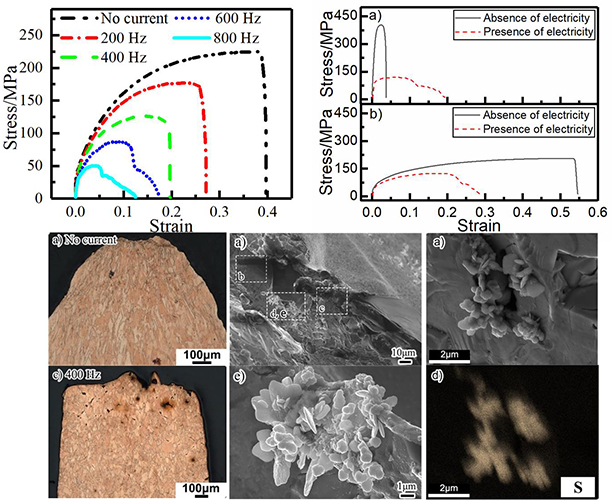
In their approach, the authors utilized an oxygen-free high conductivity copper wire for experimentation. The wire was first straightened and cut into different specimens, each 100 mm long. After annealing the specimens at 600 °C and cooling them in a furnace, tensile tests were conducted at different pulse frequencies. Moreover, different techniques such as scanning electron microscopy and ion channeling imaging by using focused ion beam were used to characterize the morphology of the fractured surfaces. Based on the fracture morphology and tensile test results, the effects of pulse frequency on the material’s behavior: the temperature, elongation, fracture mode, and flow stress were discussed.
Results showed a linear decrease in the elongation and flow stress, an increase in the grain size and tensile strength, and a brittle to ductile transformation of the fracture mode with an increase in the pulse frequency. This was largely attributed to the temperature decrease due to the application of the electropulse. Furthermore, the electricity-induced embrittlement was believed to result from the formation of copper sulfide on the fracture surface and could occur without deformation. However, for heavily deformed copper, the localized recrystallization inhibited the embrittlement process, thus improving the material plasticity.
In a nutshell, the study investigated the underlying mechanism of the microstructural changes and mechanical behavior of copper wire formed via the EAF technique. The pulse frequency exhibited a remarkable influence on the mechanical behavior of the material. Based on the results, it was evident that electrically assisted forming decreased the plasticity of undeformed copper. In contrast, it improved the plasticity of heavily deformed copper by reducing the flow stress. In a statement to Advances in Engineering, Professor Shuai Wang noted that the study insights would provide the desirable theoretical guidance for improved EAF application in processing copper and other metals.



Reference
He, J., Zeng, Z., Li, H., & Wang, S. (2020). The microstructure and mechanical properties of copper in electrically assisted tension. Materials & Design, 196, 109171.