Advances in Engineering Advances in Engineering features breaking research judged by Advances in Engineering advisory team to be of key importance in the Engineering field. Papers are selected from over 10,000 published each week from most peer reviewed journals.

Significance
Currently, crude oil is the major global energy resource whose reserves can be located either inland or in deep sea. During crude oil production in subsea conditions, several challenges are encountered where precipitation of wax from the crude oil is the most pronounced shortcoming globally, as it causes costly downtimes and its mitigation solutions are expensive. Paraffin wax formation is caused by low temperatures (around the crude oil container or pipe) that fall below the wax appearance temperatures thereby inducing solidification of paraffin components in the crude oil. Several solutions are commercially available but at exorbitant costs. Therefore, the prevention of the immobile wax formation for the ease of transportation in liquid phase becomes a daunting challenge. Recent advances in thermal energy storage technology and lattice Boltzmann method have triggered intense research in this field. Unfortunately, most of the research work undertaken only focuses on other phase change materials excluding the most basic highly conductive metals, as part of the thermal energy storage medium. Furthermore, little has been done on metallic fins inserts as a thermal energy storage system to retard wax formation.
Dr. Yao Hong Yip, Professor Ai Kah Soh and Dr. Ji Jinn Foo at Monash University in Malaysia proposed a study on retardation of wax solidification using thermal energy storage fins. They hypothesized that a significant amount of thermal energy could be stored and dissipated through metallic components immediately after complete melting or heating process, that is, sensible-heat driven thermal energy storage-fins. They purposed to report on the numerical investigation of transient heat transfer in a solidifying paraffin wax contained in a bench-scale compartmented subsea storage tank with embedded thermal energy storage-fin(s). Their work is now published in the research journal, Chemical Engineering Research and Design.
Their studies involved employing the two-dimensional enthalpy-based lattice Boltzmann method that was capable of naturally capturing the innate propagation of mushy solid-liquid interface and explore the possibility of using thermal energy storage fins in reducing the paraffin solidification process within a storage tank. The research team observed the effects of cold wall cooling on compartment walls, selected adiabatic material as well as thermal energy storage-fin(s) positions and the corresponding aspect ratios to slow down paraffin solidification.
The authors also observed that their optimized thermal energy storage-fin configuration system was capable of prolonging paraffin solidification by 94% immediately after complete melting. Interestingly, they noted that the mushy interface zone propagation rate during the paraffin wax solidification was reduced to a minimum, once the dimensionless length-to-width aspect ratio of thermal energy storage-fin approached 1.15 and most importantly, it was seen to be strongly position dependent.
Monash University researchers has successfully employed a direct model that utilizes the lattice Boltzmann technique to investigate the possibility of retarding paraffin wax solidification process, as a natural manifestation of changes in local enthalpy states within a compartmented stainless steel enclosure induced by thermal energy storage metallic fin(s). The presented findings may serve as guidance for the long-term sustainable development in addressing the existing logistic issues on sustainable crude oil shipment from oil platforms.
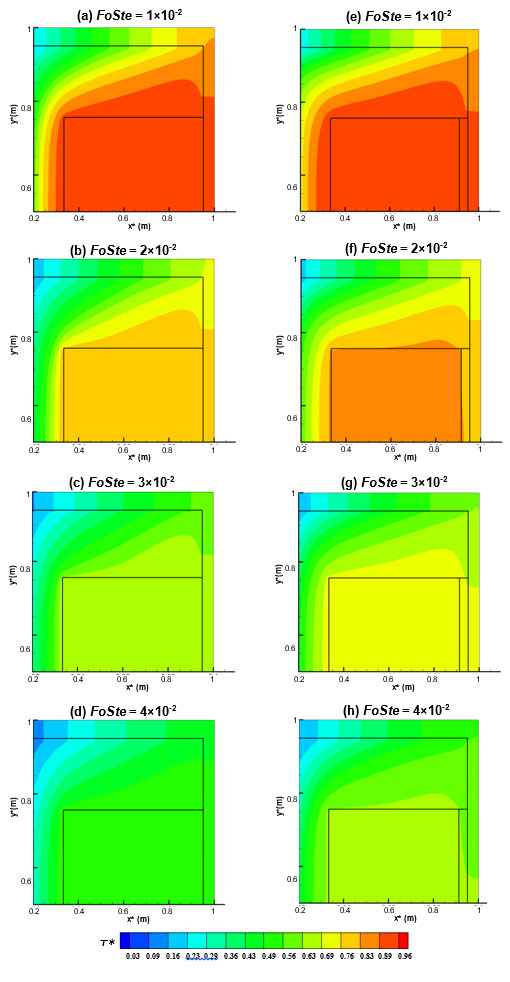
Temperature distribution of a composite system for a TES fin made up of (a-d) bare aluminum and (e-h) aluminum with an insulation of thickness Δx/lcprt,x = 0.038. Horizontal and vertical axes start from x* = 0.2 and y* = 0.5 respectively, in order to accentuate the thermal energy transfer within the TES fin in which the top and bottom halves are symmetrical.



Reference
Yao Hong Yip, Ai Kah Soh, Ji Jinn Foo. Mitigation against crude oil wax solidification using TES fin. chemical engineering research and design, volume 126 (2017) pages 172–187
Go To chemical engineering research and design