Advances in Engineering Advances in Engineering features breaking research judged by Advances in Engineering advisory team to be of key importance in the Engineering field. Papers are selected from over 10,000 published each week from most peer reviewed journals.

Significance Statement
A Nafion ionomer is a polymer that comprises sulfonic acid groups covalently bonded to the tetrafluoroethylene backbone as pendant group moieties. The ionomer is an essential material for proton transport in catalyst layers of polymer electrolyte fuel cells (PEFC) while excess amount of ionomer inhibits gas transport and electrochemical reaction. The optimization of a function of the ionomer in catalyst layers has been a substantial challenge for years.
Tetsuya Mashio, Atsushi Ohma from Nissan Motor and Takashi Tokumasu from Tohoku University in Japan carried out a research on ionomer adsorption at the surface of a graphite sheet in a solvent-saturated environment using molecular dynamic simulations. The study published in Electrochimica Acta aimed to reveal the mechanism of ionomer structure formation during the fabrication process of catalyst layers so as to reduce the cost of commercialization of PEFC as power source for automotive use.
The control of ionomer structure in catalyst layers has been a difficult task despite its importance. The structure of ionomer is formed through a fabrication process which includes an ink preparation process and a coating process. The researches focused attention on ionomer morphology in the catalyst ink as an intermediate state of the structure formation process of ionomer.
Although there are various options for solvents for the catalyst ink but a mixture of water and the simplest alcohol, methanol MeOH, was used in their study. When comparing the structure in the bulk solution, ionomer of equivalent weight (EW) 760 had aggregated structure with the size ranging from 2.0 to 2.5mm in diameter in water rich solvent which is smaller than EW 1560 ionomer. The difference in both ionomer structure is attributed to the variation in the concentration of sulfonic acid groups at the surface of aggregated ionomer. The ionomer dispersivity was drastically improved in alcohol rich solvent for both cases.
On calculating the molar percentage of fluorine atoms of ionomer and oxygen atoms of the sulfonic acid groups at the surface of graphite sheet, the ratios of backbones were found to be higher than the ionomer bulk value. This confirms the morphology features discussed earlier in the journal, the ionomer adsorbed on the graphite sheet predominantly through the backbone with side chains pointing away from the graphite sheet. This basic structural feature of adsorbed ionomer at the surface of the graphite sheet was not affected by alcohol content. This may be due to the strong affinity of backbones to the graphite surface.
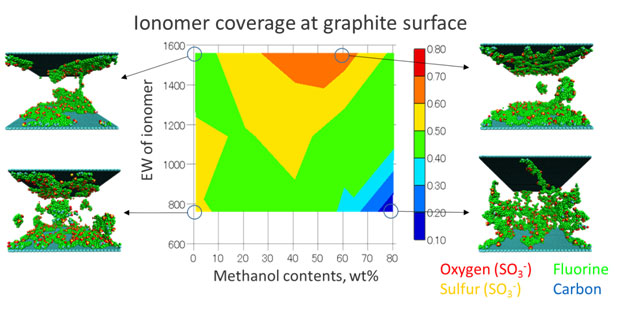
The amount of ionomer adsorbed on the graphite surface depends on the EW of the alcohol content. By increasing the alcohol content, the coverage of EW 760 ionomer significantly decreases while the coverage of EW 1560 ionomer increases with increasing alcoholic content from 0 to 60wt%, then decreases for 80wt%. The significantly low coverage of EW 1560 ionomer in water rich solvent is considered to be derived from strong aggregation of oligomers.
To investigate the effect of alcohol on the ionomer adsorption at the surface of the graphite, the amount of MeOH at the surface of the graphite sheet exposed to the solvent was evaluated. MeOH having smaller surface tension than water, the adsorption of MeOH on the graphite sheet will lead to the reduction of the interfacial energy between the graphite sheet and solvent. In water rich solvent, the interfacial energy between the graphite sheet and solvent was reduced by the adsorption of ionomer with hydrophilic side chains at the surface of adsorbed ionomer film, resulting in the high ionomer coverage.
They also considered the effect of ionized surface functional group and were able to established that ionomer coverage on the graphite sheet with ionized surface functional groups are significantly lower than that of the bare graphite sheet. That is more pronounced in low EW ionomer, indicating a strong contribution of electrostatic repulsive interaction.
Although a simple interfacial model was employed in their study, the findings provides valuable insights into the structure formation of ionomer in catalyst ink. The correlation with the various experimental observations is discussed in the journal. For the optimum design of catalyst layers, the composition solvent must be well tuned and the configuration and the surface properties of the materials must be thoroughly considered.



Journal Reference
Tetsuya Mashio1,2, Atsushi Ohma1, Takashi Tokumasu3, Molecular Dynamic Study of Ionomer Adsorption at a Carbon Surface in Catalyst Ink, Electrochimica Acta 202, 2016, 14-23.
[expand title=”Show Affiliations”]- Research Division, Nissan Motor Co., Ltd., 1 Natsushima-cho, Yokosuka-shi, Kanagawa 237-8523, Japan.
- Graduate School of Engineering, Tohoku University, 2-1-1 Katahira, Aoba-ku, Sendai, Miyagi 980-8577, Japan.
- Institute of Fluid Science, Tohoku University, 2-1-1 Katahira, Aoba-ku, Sendai, Miyagi 980-8577, Japan.
Go To Electrochimica Acta