 Advances in Engineering Advances in Engineering features breaking research judged by Advances in Engineering advisory team to be of key importance in the Engineering field. Papers are selected from over 10,000 published each week from most peer reviewed journals.

Significance
Ionic liquids possess various functionalities such as electrochemical stability, high charge density, tunable polarity and low volatility. These exemplary attributes enable their wide spread application in supercapacitors, fuel cells and in electrochemical actuators. However, a formidable challenge is encountered in that they are hygroscopic thereby making complete water removal a challenge. It is necessary to remove water in such ionic liquids as it enhances energy efficiency. Additionally, the effects of such polarizable polar molecules on the energy efficiency of electrochemical devices remain elusive. Therefore, it is imperative that these challenges regarding the understanding of the dielectric nature of water-containing ionic liquids between charged surfaces be resolved.
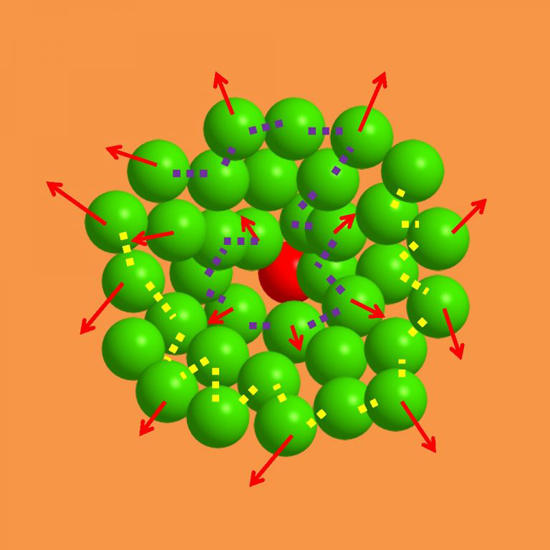
Recently, a team of researchers led by Professor Issei Nakamura from the Department of Physics at Michigan Technological University investigated the adsorption mechanism of water dissolved in ionic liquids between electrodes. In addition, they focused on assessing the capacitance of nanoscale capacitors. Specifically, they thoroughly assessed the electric polarization, especially where the cation and anion possess substantially different dielectric responses. Their work is currently published in the research journal, Molecular Systems Design & Engineering.
Briefly, the research method employed entailed application of the coarse-grained mean-field theory, where the dielectric contrast between the species can be a primary factor in enhancing the adsorption and capacitance. Next, they devised a strategy to drive the water only to the positively (or negatively) charged plate based on the difference in the dielectric response among the water, cation, and anion. The effects of electronic polarization on the water adsorption and capacitance were then investigated. Lastly, they proceeded to show that the effect of the dielectric inhomogeneity competed with that of charge screening, but the strong electrostatic correlation further complicated the feature.
The authors observed that water could be adsorbed onto electrodes primarily because of the dielectric contrast between the species. Moreover, they noted that their results were able to give a justifiable prediction that the linear-dielectric theory was inadequate to account for the correlation between the capacitance and dielectric contrast, which could be fitted by exponential functions. The research team also noted that the higher-dielectric component preferentially solvated the electrodes, but its effect competed with that of the charge screening.
In summary, their study highlighted on the significance of the dielectric responses of the cation, anion, and water near electrodes by developing a dipolar self-consistent field theory for ionic liquids. Generally, the applied theories considered both the permanent (intrinsic) and induced dipole moments of the species, as well as the reorientation of the dipoles under electrostatic fields. Altogether, the study showed that the type of adsorption observed could be driven primarily by the large difference in the dipole moment between the cation and anion hence polymerized ionic liquids could be anticipated.


Reference
Hongbo Chen, Lijia An, Issei Nakamura. Water dissolution in ionic liquids between charged surfaces effects of electric polarization and electrostatic correlation. Molecular Systems Design & Engineering 2018, volume 3, page 328.
Go To Molecular Systems Design & Engineering