Advances in Engineering Advances in Engineering features breaking research judged by Advances in Engineering advisory team to be of key importance in the Engineering field. Papers are selected from over 10,000 published each week from most peer reviewed journals.

Significance
Both fundamental and application physics demand the complete comprehension of fluid behavior under confinement in porous material. This can be attributed to the fact that confining a fluid, leads to immense alteration of its dynamic and structural attributes when compared to those of bulk fluids. Furthermore, the orientational structure and dynamics of molecules is known to be affected by confinement in space comparable in size to the molecule itself. Such intriguing attributes have attracted much research attention, where a number of already published studies have focused particularly on investigating hydrocarbons confined in zeolites. Diffusive properties of hydrocarbons in zeolites are dependent on several factors thereby making them a popular choice of study. Zeolite Socony Mobil–5 (ZSM-5) has already been identified as a good candidate in studying the confinement effect on the rotational motion of different hydrocarbons. An important aspect that affects the behavior of confined fluids is the molecular shape of the confined component. Several studies highlighting the importance of molecular shape have been reported in literature but none considers the effects of confinement especially on orientational structure and dynamics. This can be studied by using ZSM-5 zeolite as the confining medium as with its narrow pores, it can put a severe restriction on motion and thus greatly influence the orientational structure and dynamics of the confined molecules.
Ohio State University (OSU) researchers in collaboration with scientists at Oak Ridge National Laboratory (ORNL) assessed the effect of molecular shape on the orientational structure and dynamics of molecules under strict geometrical confinement imposed by ZSM-5 zeolite. They focused on the influence of molecular shape on the rotational dynamics of confined molecules. Dr. Siddharth Gautam from OSU observed “Normally under confinement, the translational motion of molecules gets affected while their rotational motion remains relatively unaffected. ZSM-5 is a unique and interesting confining medium with channels so narrow that they can influence even the rotational properties of the confined molecules. For this I have been exploring molecular rotation of several molecules in this medium”. In the current work, he along with his colleagues extended this exploration1,2 to include the effect of molecular shape on rotation under confinement in ZSM-5. Their work is currently published in the research journal, Chemical Engineering Science3. A follow up work on the translational behavior has been recently accepted in Chemical Physics and has been published online4.
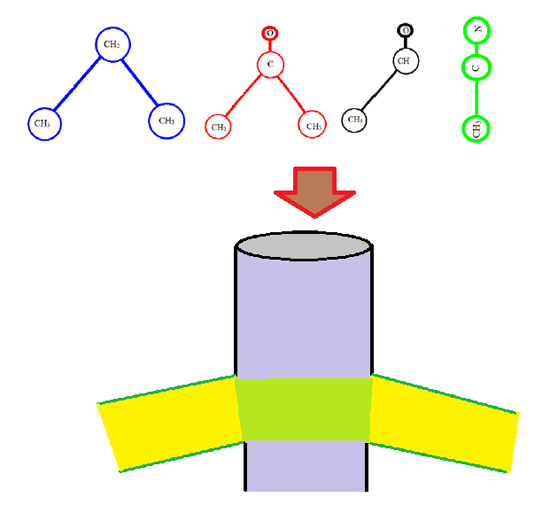
The research technique employed the application of TraPPE-UA force field formalism for simulating hydrocarbon molecules in a simpler united atom approach, which was computationally less expensive compared to an all atom simulation. Dr. Debsindhu Bhowmik who ran those simulations with Dr. Gautam, said “these types of intelligent computer simulations are effective in answering many of those questions that generally are difficult to tackle by other available techniques.” They started by selecting four molecules: propane, acetaldehyde, acetonitrile and acetone, of comparable kinetic diameters and confined in ZSM-5, and had their orientational structure and dynamics assessed. The studied attributes included probing the differences in the orientational distribution of molecules in the ZSM-5 channels, and extracting time scales of the decay of correlation functions related to rotational motion. “Detecting the effect of molecular shape in the confined alleys and subsequently quantifying them have been our goals and we believe our work has shed light on that fundamental question.” Bhowmik continued.
The authors observed that the orientational correlation functions of all the four molecules exhibited two regimes of rotational motion. In addition, they also noted that the short time regime represented free rotation of the molecules before they collided with the pore walls, while as the long time orientational jumps driven by inter-channel migrations give rise to a very slow varying second regime. Moreover, the longtime inter-channel driven rotational motion was noted to be highly restricted in the case of acetone and acetaldehyde. “Our work provides the molecular level picture of the behavior of these molecules under severe confinement, which is difficult to visualize from the experimental techniques. We have also calculated the observables that can be assessed from experiments such as neutron scattering for a direct comparison.” Dr. Shrestha emphasized the significance of the work.
In a nutshell, Dr. Gautam and his colleagues Prof. David R. Cole from OSU and Dr. Indu Dhiman, Dr. Shrestha and Dr. Bhowmik from ORNL have successfully presented an in-depth assessment of the effects of confinement on the orientational structure and dynamics of four guest molecules with similar kinetic diameters but different shapes in the channels of all silica analogue of ZSM-5 zeolite. In general, orientational structure and dynamics of propane was found to be least affected by confinement under ZSM-5, whereas charge and shape asymmetry of other molecules made their inter-channel migration-driven rotation slow. Altogether, charge asymmetry plays a dominant role in the rotational dynamics of molecules under confinement.





References
1. S. Gautam, V. K. Sharma, S. Mitra, R. Mukhopadhyay, Rotational Dynamics of Propylene in ZSM-5 zeolite frameworks.. Chemical Physics Letters, volume 501 (2010) page 345-350.
Go To Chemical Physics Letters
2. S. Gautam, T. Liu, S. Patankar, D. Tomasko, D. R. Cole. Location dependent orientational structure and dynamics of ethane in ZSM-5.. Chemical Physics Letters, volume 6.<8 (2016) 130-136.
Go To Chemical Physics Letters
3. I. Dhiman, D. Bhowmik, Utsab R. Shrestha, D. R. Cole, S. Gautam. Effect of molecular shape on rotation under severe confinement.. Chemical Engineering Science, volume 180 (2018) page 33–41.
Go To Chemical Engineering Science
4. I. Dhiman, U. R. Shrestha, D. Bhowmik, D. R. Cole, S. Gautam. Influence of molecular shape on self-diffusion under severe confinement: A molecular dynamics study. . Chemical Physics, volume 516 (2019) 92-102.
Go To Chemical Physics