 Advances in Engineering Advances in Engineering features breaking research judged by Advances in Engineering advisory team to be of key importance in the Engineering field. Papers are selected from over 10,000 published each week from most peer reviewed journals.

Significance
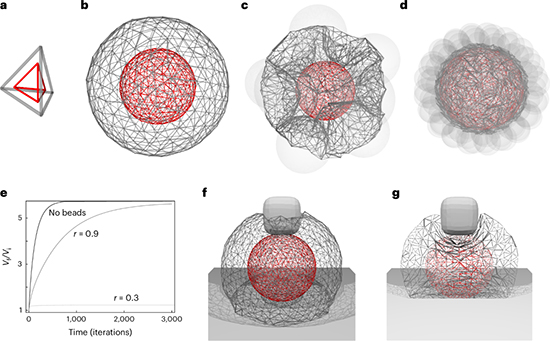
Soft materials, by their very nature, resist simple mathematical encapsulation. Whether we’re dealing with a droplet of complex fluid, a filament under strain, or a gel that swells nonuniformly in a solvent, the governing equations of motion and the associated boundary conditions are usually nonlinear, often involve multiple coupled fields (e.g., elastic displacement, electric potential, concentration), and must obey constraints dictated by geometry and topology. Traditionally, solving such systems required highly specialized code or bespoke algorithms tailored for a narrow class of problems. This fragmentation of approaches significantly hampered progress, as knowledge and code were not easily transferrable across domains. To this account, a new research paper published in Nature Computational Science and led by Professor Timothy Atherton from the Tufts University and conducted by Chaitanya Joshi, Daniel Hellstein, Cole Wennerholm, Eoghan Downey, Emmett Hamilton, Samuel Hocking, Anca Andrei, James Adler, the researchers developed Morpho, an open-source, programmable simulation environment designed for solving general shape-optimization problems in soft materials. It enables users to define energy functionals and boundary conditions to predict the equilibrium shapes of systems such as swelling gels, complex droplets, membranes, and filaments. Morpho stands out for its accessibility, modularity, and versatility, offering a transformative tool for both fundamental research and applied soft-matter design. Enter Morpho, the central innovation of this study. Atherton and his team recognized the urgent need for a general-purpose, open-source simulation platform that could handle the wide diversity of shape-optimization problems in soft matter physics. More than just a software tool, Morpho represents a conceptual framework: it treats the shape of a system as a dynamic degree of freedom, rather than a static backdrop. Within this framework, the shape evolves according to the minimization of an energy functional, which itself can incorporate mechanical strain, surface tension, electromagnetic effects, swelling behavior, or any other physical contribution that can be expressed mathematically. This elegant reframing converts the often intractable forward problem—what shape will this soft object take?—into a tractable inverse one: what shape minimizes the total energy under the imposed constraints?
One of the most compelling aspects of Morpho lies in its accessibility and the authors built an intuitive and programmable environment that invites broader participation from physicists, engineers, chemists, and even artists interested in form and structure. The use of a simple, user-friendly language in Morpho lowers the barrier for adoption, democratizing access to advanced simulation capabilities. It is rare, and refreshing, to see such a tool that is simultaneously powerful, versatile, and comprehensible. To validate Morpho’s utility, the researchers applied it to a set of problems that collectively represent a wide swath of the soft matter landscape. In each case, the simulation environment was used to derive or predict equilibrium shapes by minimizing relevant energy functionals. Consider the example of swelling hydrogels—a system wherein water absorption leads to volumetric expansion that is typically non-uniform due to spatial gradients in chemical potential, mechanical confinement, or heterogeneous material composition. By encoding the swelling energy into the optimization routine, Morpho was able to reproduce experimentally observed buckling patterns and wrinkled morphologies, offering insight into how geometry couples with mechanics in these systems. In another application, the team modeled the shape of droplets formed by complex fluids. Unlike the idealized spherical droplets considered in introductory physics, these droplets often adopt asymmetric forms due to internal compositional heterogeneity or the influence of surface-active agents. By constructing a free energy functional that accounts for both interfacial energy and bulk elasticity, Morpho could generate droplet shapes that closely mimic those seen in confocal microscopy or other high-resolution imaging techniques. Notably, the tool allowed for systematic exploration of parameter space. It is worth to mention that the study also investigated the minimal surface problem, exemplified by soap films and membranes. These structures naturally minimize surface area while spanning a given boundary, a phenomenon governed by mean curvature flow and often appearing in architectural design and materials science. Morpho’s ability to handle such variational problems demonstrates its geometric flexibility. Similarly, simulations involving filaments under tension or bending constraints illustrated how the software can accommodate one-dimensional manifolds embedded in three-dimensional space, solving for equilibrium shapes under constraints such as fixed endpoints, torsion, and external loads. Moreover, the team emphasized Morpho’s modularity. Users are not restricted to a narrow set of pre-defined physical models; rather, they can construct new energy terms, apply custom boundary conditions, and experiment with mesh topologies. This makes the software not only a modeling tool but a sandbox for hypothesis generation. In an age where data-driven methods dominate the scientific conversation, it is invigorating to witness a project that doubles down on the value of first-principles modeling, offering a kind of computational laboratory where theory and simulation converge with remarkable clarity. The significance of the Tufts University new study stretches far beyond the individual case studies and by introducing a unified language for expressing and solving shape-optimization problems, Morpho may serve as a Rosetta Stone for interdisciplinary collaboration. A physicist studying active matter, a materials scientist developing programmable matter, and a biologist investigating morphogenesis could all, in principle, use Morpho to approach their respective problems. This convergence has the potential to foster cross-pollination of ideas, accelerating innovation at the boundaries of traditional disciplines. Moreover, the project stands as a powerful example of what open-source science can achieve when properly executed. The availability of the codebase, coupled with extensive documentation and examples, ensures that Morpho can evolve organically with community input. The authors’ decision to make their tool freely available signals a commitment to reproducibility, transparency, and collaborative science—values that are increasingly essential in the modern research ecosystem. In summary, Professor Timothy Atherton and his research group successfully articulated a vision for how we might computationally engage with one of nature’s most elusive qualities—softness. By anchoring this vision in a robust and versatile computational tool, they have empowered the scientific community to explore form and function in a new light. Their work serves as both an invitation and a challenge: to model not only what is, but what could be, if we learn to harness the potential of soft matter with precision and creativity.

Reference
Chaitanya Joshi, Daniel Hellstein, Cole Wennerholm, Eoghan Downey, Emmett Hamilton, Samuel Hocking, Anca S. Andrei, James H. Adler, Timothy J. Atherton. A programmable environment for shape optimization and shapeshifting problems. Nature Computational Science, 2024; 5 (2): 170 DOI: 10.1038/s43588-024-00749-7