Advances in Engineering Advances in Engineering features breaking research judged by Advances in Engineering advisory team to be of key importance in the Engineering field. Papers are selected from over 10,000 published each week from most peer reviewed journals.

Form-finding and imperfection sensitivity
Significance
Throughout history, the building and construction industry has undergone tremendous transformations by introducing new innovative architectural designs to meet different needs like internal distribution flexibility. For example, free forms have been widely used for large span roofing constructions in double-curved shells and domes. Consequently, grid shells – structural components with a single thin layer and relatively smaller thickness, also offer unique results in terms of aesthetic and structural requirements. With the rapid advances in building technology, novel structural designs have attracted a combination of new shapes and free-form architectures coupled with effective structural optimization methods.
The design of grid shell structures has positively influenced the contributions of designers and structural engineers for ages. Over the past decades, different physical and mathematical-based methods have been used to find the optimal shapes of shallow grid shells and minimize some inherent design challenges like internal stresses and bending moments inside the resisting elements. Today, however, the focus is on computer simulation and modelling. The available commercial software is suited for structural analysis and shape optimization of grid shell structures. Nevertheless, the solution to problems related to large displacements and structural-form finding has not been fully achieved. This becomes more challenging in situations where a discrete number of nodes and continuous shapes have to be determined.
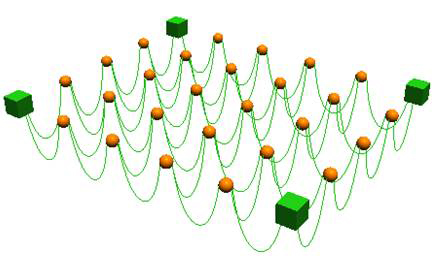
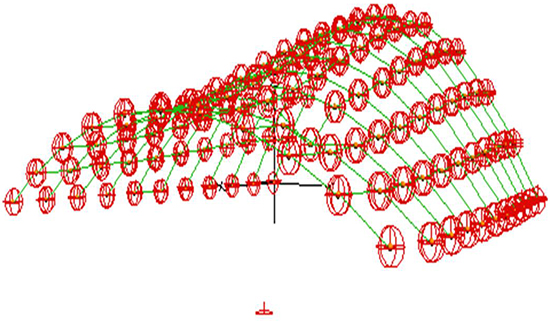
To address this issue, Professor Amedeo Manuello from Politecnico di Torino in Italy proposed an original approach for the form-finding of quadrangular grid shells. The multi-body rope approach (MRA) consisted of masses connected by extensive ropes with a slack coefficient (sc) and degree of constraint conditions. This is an extension of the original idea previously presented by the author. His main objectives were to obtain different shapes and evaluate the effects of imperfection sensitivity. The work is published in the research journal, Engineering structures.
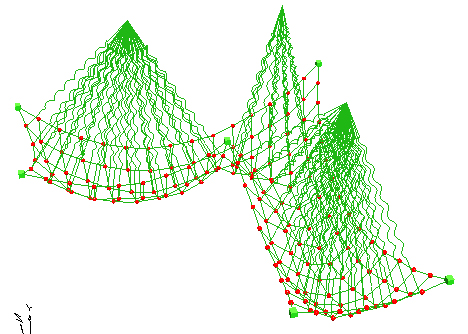
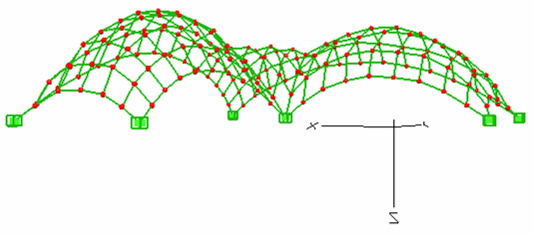
In his approach, loads were considered input of a step-by-step analysis for both the two- and three-dimensional systems. The static configuration of the hanging masses constituted a large number of variables, which were numerically solved through Runge-Kutta’s solution method, allowing the definition of the structural configuration as a reversed model corresponding to the final step of the hanging net. Additionally, a calculation procedure based on a combination of the dynamic numerical model and geometric model built using non-uniform rational basis-splines (NURBS) surfaces was presented for roofs with a larger number of nodes. Three circular grid shells were defined by varying the slack coefficient and analyzed in the absence and presence of the geometrical imperfections. Finally, the numerical results were experimentally validated.
The author found that the combined procedure was more accurate, less time-consuming, and allowed obtaining good results than simulations of complex forms where form-finding was obtained for grids with initial conditions very far away from the optimal shape. At lowering degrees (R/h) of 3.3 and Eulerian slenderness (λ) of 100, the structure exhibited snap-through collapse behavior without imperfections and nonlinear bifurcation under the effect of asymmetric imperfection pattern. For the same λ and R/h of 5, the structure exhibited tension stiffness and snap-back instability behaviors in the absence and presence of imperfections, respectively. For further increase in the R/h ratio to 10, the influence f shallowness ratio on the structural behavior was evidenced.
In summary, Professor Manuello study successfully reported an original multi-body model approach based on dynamic numerical simulation for form-finding and evaluation of imperfection sensitivity. The problem of coupled instability was also analyzed for different lowering degrees. Through the models, grids with different heights were achieved, and their stability conditions were successfully evaluated. Due to the coupled instability and effects of the imperfection sensitivity, the collapse was considered a potential possibility. Numerical results agreed with the experimental results. In a statement to Advances in Engineering, Professor Manuello stated that the study insights would enable further research into form-finding that would lead to the innovation of new architectural designs for modern society.

Reference
Manuello, A. (2020). Multi-body rope approach for grid shells: Form-finding and imperfection sensitivity. Engineering Structures, 221, 111029.