Advances in Engineering Advances in Engineering features breaking research judged by Advances in Engineering advisory team to be of key importance in the Engineering field. Papers are selected from over 10,000 published each week from most peer reviewed journals.

Significance
There are serious engineering challenges that arise during the designing and fabrication of the actuation systems owing to the complexity of necessary molds, and the process is time-consuming. Moreover, a combination of multiple materials is required for the actuator to perform a given task which contributes to recurring failures due to the use multicomponent in interfacing and construction. The 3D printing technology provides a customized and time-saving process of creating sophisticated objects yet at a low-cost.
Zhongying Ji, Changyou Yan, Professor Bo Yu, Professor Xiaolong Wang, and Professor Feng Zhou from the State Key Laboratory of Solid Lubrication, Lanzhou Institute of Chemical Physics at the Chinese Academy of Sciences focused on the development of a magnetic driving soft actuator through use of magnetic Fe3O4 nanoparticles. Actuators and micro-motors have been advanced to achieve various objects with lifelike motions such as artificial muscles and thermo-responsive films. The research team came up with, a stimuli-responsive and versatile printable material, Fe3O4 nanoparticles contained in a light curing acrylic resin employed to generate magnetic driving soft actuators that combine magnetic and nonmagnetic segments by switching ink tank on-demand in 3D printing. Due to the soft nature of the matter, the actuators allow locomotion under magnetic field that is free from noise, have an additional degree of freedom and capable of mimicking biological behaviors.
In their studies a mixture of Genomer 1122, acryloyl modified glycol, cyclic trimethylolpropane formal acrylate and IRGACURE 819 formed the photo-curing resin after which the nanoparticles of magnetic Fe3O4 were added to prepare the magnetic resin with uniform dispersion. The resulting matrix portrayed good stability meeting the requirements for 3D printing. The addition of the Fe3O4 nanoparticles with 69.34 emu g−1 magnetization value to the resin reduced the resulting value to 52.62 emu g−1 which is an excellent paramagnetic property. The curing performance of the resin was not affected by the adding the Fe3O4 nanoparticles. The mechanical properties of the resin such as the tensile strength were also investigated. The tensile strength of the magnetic resin without Fe3O4 particles up to 0.75 wt% was comparative to the resin without the particles. However, the stress and strain dramatically reduced when 1 wt% of the Fe3O4 nanoparticles were used. The limitation assembling both the responsive and nonresponsive segment of most actuators through mechanical means was addressed through the combination of magnetic resin and nonmagnetic resin concept to generate soft actuator.
Through the use of digital light processing technology in 3D printing, it was possible for the authors to develop actuators and various magnetic devices using the magnetic and nonmagnetic resins as segments. The method reported by State Key Laboratory of Solid Lubrication researchers provides a one-step process of manufacturing the soft actuators, unlike the ordinary ways that require assembling. Varying the content of the Fe3O4 nanoparticles in the resin enabled exploring the different properties that it offers regarding precision and feasibility. The printing performance of the resulting resin was excellent for 3D printing. The resulting structure is profoundly affected when the Fe3O4 nanoparticles were increased indicating a severe influence on surface roughness. The soft actuators built from multi-material 3D printing offers stimuli response which increases the capability of fabricating devices with a wide range of applications while enhancing controllable delivery. This is a boost to medical, robotic and biological fields through remote magnetic control.
Prof. X. Wang and Prof. B. Yu are grateful for the financial supports from NSFC (51573199, 21434009, and 51775538) and the West Light Program of CAS.
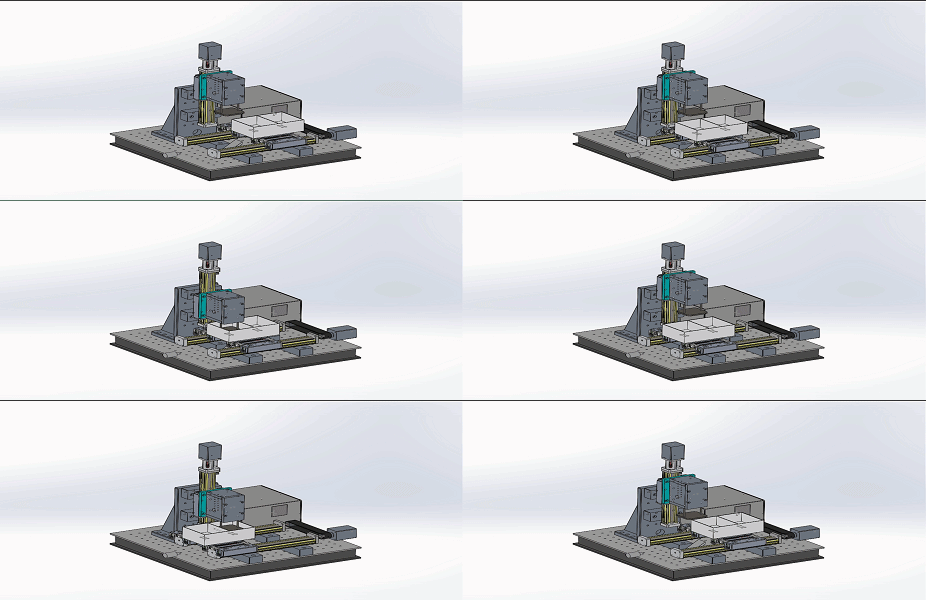

Figure 1. Schematic illustration of multimaterials 3D printing and resultant magnetic driving match-like array and gripper.



Reference
Zhongying Ji, Changyou Yan, Bo Yu, Xiaolong Wang, and Feng Zhou, Multimaterials 3D Printing for Free Assembly Manufacturing of Magnetic Driving Soft Actuator, Journal of Advanced material Interfaces. (2017), 6:1700629.
Go To Journal of Advanced material Interfaces