Advances in Engineering Advances in Engineering features breaking research judged by Advances in Engineering advisory team to be of key importance in the Engineering field. Papers are selected from over 10,000 published each week from most peer reviewed journals.

Significance
Mother nature provides a diverse range of structural components that can be applied in light manipulation. The best example is the leaf which, as simple as it is, possesses the most efficient light utilization systems. The leaf is characterized by an integrated multiscale structure that consists of large chloroplasts embedded with small thylakoids. In recent times, light manipulation has attracted much attention owing to its wide range of application such as in photovoltaics, optical sensing and smart lighting. Unfortunately, advanced light management in bulk optical materials still poses a noteworthy challenge. Impressively, the exploitation of the leafs multiscale geometry has been observed to create a unique opportunity for simultaneous control of light propagation and photon conversion. Classic optical glass for mirror and lens systems may benefit from the distinctive features of the glass state such as chemical and structural homogeneity at large length scales. However, this has restricted the applicability of these systems for local light management.
Researchers led by professor Shifeng Zhou from the State Key Laboratory of Luminescent Materials and Devices at South China University of Technology proposed a study on advanced light management on multiscale structured optical glass fabricated through relaxation control. They hoped to demonstrate how the control of multiscale structure could be effectively applied to tune the propagation and spectral modification of light in bulk glass. Their work is now published in Journal of Materials Chemistry C.
Briefly, the research team commenced their study by constructing material which was then characterized by rich microstructures spanning the nano-micrometer scales range, which was seen to enable the discovery of a previously unrealized optical behavior. They then employed a distinct strategy for synthesizing multiscale structured glass combined high-temperature melting so as to obtain super-cooled, metastable materials with subsequent thermal treating in a bid to induce relaxation.
The authors observed that through rational control of the relaxation of multicomponent glass, the multiscale configurations could be achieved and simultaneously, the chemical state and local chemical environment of the incorporated dopant could be deliberately tuned. This in-turn allowed the researchers to generate color-switchable emission with intense brightness and build a colorimetric temperature sensor.
The study has successfully presented a multiscale strategy for glass design for the first time. More so, a novel experimental multiscale structured glass through relaxation control has been developed. From the experiment undertaken, the materials used have been seen to combine excellent optical transparency and internal scattering. Owing to the unique configurations and rich light matter interaction processes in the developed multiscale structured glass, it is believed that this breakthrough progress will provide new directions, not only, for in-depth analyses into the fundamental topics such as glass structure, glass relaxation and disordered photonics, but also for significant applications in optical amplification, optical sensing, displays and even lasing.
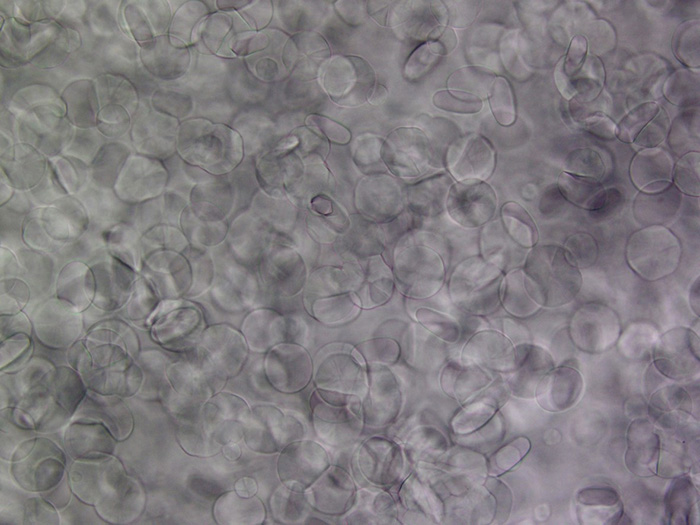
Example for glass-ceramic with multiple crystalline phases spaning the multiscales from nano- (down to ~50 nm) to micrometer (up to ~70 μm). The micrometer sized BaAl2Si2O8 crystals are embedded with nanometer sized LaF3. Optical microscope image of a 20 BaO – 20 LaF3 – 15 Al2O3 – 45 SiO2 (mol%) base glass heat treated at 840 °C for 2 h. For details see Ref. [J. Chen, S. Zhou, N. Jiang, S. Lv, and J. Qiu, Multiscale structured glass for advanced light management, J. Mater. Chem. C 5 (2017) 8091-8096.].
Reference
Jiejie Chen, Shifeng Zhou, Nan Jiang, ShichaoLv and Jianrong Qiu. Multiscale structured glass for advanced light management. J. Mater. Chem. C, 2017, volume 5, pages 8091-8096.
Go To Journal of Materials Chemistry C