Advances in Engineering Advances in Engineering features breaking research judged by Advances in Engineering advisory team to be of key importance in the Engineering field. Papers are selected from over 10,000 published each week from most peer reviewed journals.

Significance
Intensive studies to explore the nanotechnology properties of materials have resulted in the creation of various high-performance materials. The idea has been to change the materials’ structural make up with the hope to enhance their properties deemed fit for desired applications. In that regard, carbon nanotubes nanostructures have resulted in materials with better mechanical properties. Presently, their use in the fabrication of biomedical materials has attracted significant attention of researchers due to the increasing demand for better medical care.
Among the available biomedical materials, thermoplastic polyurethanes are widely preferred owing to their excellent properties such as biodegradability, flexibility, biocompatibility and ease of fabrication. Polyurethanes are largely produced from polyesters diols. Generally, these functional polyesters are fabricated by the ring opening polymerization of cyclic esters. However, the use of polyurethanes in the manufacture of medical devices is sometimes limited by their constraints in mechanical performance. Surface-modified carbon nanotubes have high superficial areas that enables them to be used in for polymer reinforcement. Functionalization increases the interaction between carbon nanotubes and matrices through the formation of covalent bonds, improving the reinforcement process.
Unfortunately, the use of polyurethanes as in polymer matrix nanocomposites has not been fully addressed. This is irrespective of the fact that enhanced thermal properties and high-performance behaviors depend highly on the nature of the interaction between the filler and polyurethanes domains including the soft and hard segments. Considering the fact that morphology of the nanocomposites depends on the organic groups used for nanofiller modification, the hydrophobicity of both the hard and soft segments also play a significant role due to the difference in interactions. To this end, it is possible to independently reinforce hard segments and soft segments taking into consideration the number and nature of the functional groups in the carbon nanotubes.
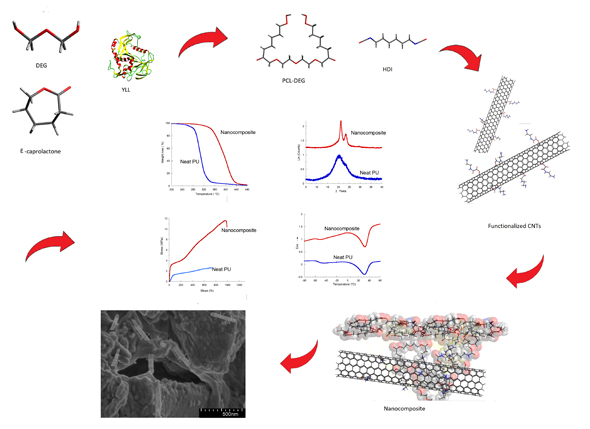
As a result of collaborative research between two different departments, one at Universidad de Guadalajara and the other at Universidad de Guanajuato (both located in Mexico), a study on the preparation of polyurethanes and their nanocomposites using functionalized carbon nanotubes was recently reported in Polymer Composites. The investigation was led by Professor Antonio Martinez-Richa and Professor Sergio Nuño-Donlucas; Dr. Victor Antolín-Cerón, MSc. Karla Barrera-Rivera and Chemical Engineering student M.A. Fuentes-García also participated. The nanocomposites were synthesized using four different functionalized carbon nanotubes types. The polyurethanes were produced via one-step reaction between PCL diol (produced by lipase biocatalysis) and hexamethylene diisocyanate. Also, different techniques including X-ray diffraction were used to characterize them. Eventually, they investigated their effects on the mechanical and thermal properties of the resulting nanocomposites.
Among the studied nanocomposites, the authors observed significantly improved thermal and mechanical properties in samples prepared using 0.5wt% of carbon nanotubes. This was attributed to enhanced interfacial adhesion with the filler as compared to that of the neat polyurethanes. Furthermore, different functionalized carbon nanotubes had a preferred location in the soft and hard segments in the polyurethane’s matrices due to the influence of the hydrophilic and hydrophobic effects, as well as interactions with the chemical groups found in the matrix. This was the reason for the varying properties. For instance, nanocomposite containing carbon nanotubes functionalized with ethylenediamine exhibited the highest ultimate strength and toughness while nanocomposites containing carbon nanotubes functionalized with 4-amino benzoic acid 4 showed the highest Young’s modulus.
According to the authors, the presence of carbon nanotubes does not restrict the molecular mobility of the amorphous domains because carbon nanotubes are embedded in the soft segment of the polyurethane’s matrix. Therefore, their study will advance the fabrication of materials with enhanced thermal and mechanical properties suitable for various applications.



Reference
Antolín-Cerón, V., Barrera-Rivera, K., Fuentes-García, M., Nuño-Donlucas, S., & Martinez-Richa, A. (2016). Preparation and characterization of nanocomposites made from chemoenzymatically prepared polyester urethanes and functionalized multiwalled carbon nanotubes. Polymer Composites, 39(S2), E697-E709.
Go To Polymer Composites