Advances in Engineering Advances in Engineering features breaking research judged by Advances in Engineering advisory team to be of key importance in the Engineering field. Papers are selected from over 10,000 published each week from most peer reviewed journals.

Significance Statement
Over the past few years, significant efforts have been put to research of p-type semiconductors, which find diverse industrial applications. Among them, cobalt oxide has drawn unique attention in gas-sensing, solar power systems, and in the manufacture of electrochromic gadgets. Its excellent performances in some of the applications stem from its considerably large surface area to volume ratio. In order to realize the desired functionality of devices, cobalt oxide should be prepared by synthesis approach, which allows for control over morphology, valence state and structure.
Researchers from Jozef Stefan Institute in Slovenia and Tuebingen University in Germany presented the relationship between the morphology of Nano-crystalline cobalt oxide and the combustion reaction initiated by the exothermic reaction of cobalt nitrate-glycine solution. They demonstrated the formation mechanism of the single phase cobalt oxide, Co3O4 powder with porous morphology by exploring the synthetic chemistry from solution combustion reaction of cobalt nitrate and glycine. Their work is published in peer reviewed journal, Advanced Powder Technology.
The authors synthesized cobalt oxide Nano-powders by solution combustion synthesis of the cobalt nitrate hexahydrate as an oxidizer and glycine as the fuel. The oxidizer was mixed with a little amount of deionized water and glycine and stirred for a few minutes to obtain clear solutions. The authors heated the solutions to raise the viscosity. They obtained deep-purple gels, which were auto-ignited by further heating at 150 0C to form black powders. The authors prepared film sensors by drop-coating the powders with 1,2-propanediol.
The researchers analyzed the sensing properties by recording the change in resistance of the sensors in presence of different gases at different physical conditions. A controlled gas mixing system with mass flow controllers regulated the test gas concentrations.
The authors exposed the prepared cobalt oxide gas sensors to varying concentrations of carbon-monoxide, ethane, and acetone gases between 100 and 200 0C. This was in a bid to record the operating temperate at which an optimum sensor responded.
They analyzed the exothermicity of the nitrate-glycine combustion in order to have a better understanding of how the concentration of glycine affected the thermal decomposition of the samples. From the analysis of the results from the thermogravimetric-differential thermal analyzer, a high exothermic reaction between nitrous oxide and ammonia gasses initiated the combustion process. The exothermicity of the process was responsible for the formation of the powders with varying morphologies. The authors confirmed this from the analysis of the results from scanning and transmission electron microscopies.
In the stoichiometric reaction, cobalt oxide particles formed hard agglomerates while 50% fuel lean reaction was the principle cause of weak bonds between cobalt oxide particles and the formation of loose cauliflower-like particles. At the same time, the proper balance between nitrous oxide and ammonia gasses, reached in the 50% fuel lean reaction system, resulted in the single phase Co3O4 powder. The authors applied the latter powder with a mean crystalline size of 11 nm and surface area of 64.4 m2/g to prepare drop-coated sensors. They recorded an excellent sensor response toward 20 ppm of acetone at 150 0C and 25% humidity for film sensors annealed at 600 0C. The results confirmed that combustion synthesis method can be applied for the preparation of Nano-sized powder meeting sensor criteria.
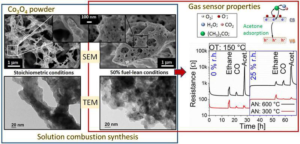 FE-SEM and TEM micrographs of the cobalt oxide Co3O4 powders with different morphologies prepared by the solution-combustion synthesis under stoichiometric and 50% fuel-lean conditions (panels within the blue rectangle). Schematic representation of acetone adsorption, and DC resistance outputs of sensors annealed at 300 and 600 oC, to ethane, CO, and acetone at operation temperature (OT) 150 oC in dry and humid conditions (red rectangle).






Reference
Katarina Vojisavljevic1, Susanne Wicker2, Inci Can2, Andreja Bencan1, Nicolae Barsan2, and Barbara Malic1. Nano-crystalline cobalt-oxide powders by solution-combustion synthesis and their application in chemical sensors. Advanced Powder Technology, volume 28 (2017), pages 1118–1128.
[expand title=”Show Affiliations”]- Jožef Stefan Institute, Electronic Ceramics Department, Jamova cesta 39, 1000 Ljubljana, Slovenia
- Tuebingen University, Faculty of Science, Department of Chemistry, Institute of Physical and Theoretical Chemistry, Auf der Morgenstelle 15, 72076 Tübingen, Germany
Go To Advanced Powder Technology