Advances in Engineering Advances in Engineering features breaking research judged by Advances in Engineering advisory team to be of key importance in the Engineering field. Papers are selected from over 10,000 published each week from most peer reviewed journals.

Significance Statement
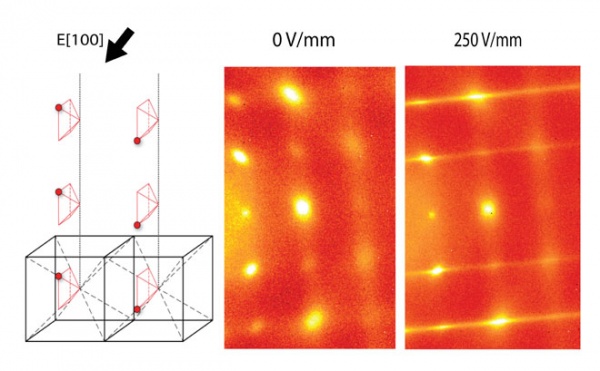
Nanoscale ordering of atomic displacements could be an effective parameter for enhancing piezoelectric susceptibility in lead-free ferroelectrics, as shown by A. Pramanick and co-workers in Advanced Materials. The increased degree of ordering for Nb displacements in a single-crystal of prototypical KNbO3 under applied electric fields is revealed from in situ measurements of synchrotron diffuse X-ray scattering profiles. As a result of formation of such nanoscale ordered regions, the instability of the crystal lattice towards mechanical deformation is increased, which was demonstrated from inelastic neutron scattering measurements of acoustic phonons. The critical insight regarding a strong correlation between changes in nanoscale atomic displacements and increased lattice instability could be a key for enhancing functional properties of many lead-free ferroelectrics compounds.
Journal Reference
Adv Mater. 2015;27(29):4330-5.
Pramanick A1, Jørgensen MR2, Diallo SO3, Christianson AD4, Fernandez-Baca JA4, Hoffmann C3, Wang X3, Lan S3, Wang XL1.
[expand title=”Show Affiliations”]- Department of Physics and Materials Science, City University of Hong Kong, Kowloon, Hong Kong SAR.
- Center for Materials Crystallography, iNano & Department of Chemistry, Aarhus University, Aarhus, Denmark.
- Chemical and Engineering Materials Division, Oak Ridge National Laboratory, Oak Ridge, TN, 37831, USA.
- Quantum Condensed Matter Division, Oak Ridge National Laboratory, Oak Ridge, TN, 37831, USA.
Abstract
In situ synchrotron X-ray diffuse scattering and inelastic neutron scattering measurements from a prototype ABO3 ferroelectric single-crystal are used to elucidate how electric fields along a nonpolar direction can enhance its piezoelectric properties. The central mechanism is found to be a nanoscale ordering of B atom displacements, which induces increased lattice instability and therefore a greater susceptibility to electric-field-induced mechanical deformation.
© 2015 WILEY-VCH Verlag GmbH & Co. KGaA, Weinheim.
Go To Adv Mater