 Advances in Engineering Advances in Engineering features breaking research judged by Advances in Engineering advisory team to be of key importance in the Engineering field. Papers are selected from over 10,000 published each week from most peer reviewed journals.

Modeling and Theoretical Characterization
Significance
Nanostructured materials are gaining popularity as the material of choice for the design of new electrochemical sensors, catalytic devices, capacitors etc. Consequently, nanostructured electrochemical interfaces (NECI) are frequently being encountered in practice. Recent reports have revealed that for various NECI applications, the location of the active sites cannot be controlled thus leading to disordered surface structures referred as random arrays of active sites. Theoretically, random arrays are complicated by the fact that taking into account exact positions of the active sites with respect to each other is either difficult or impossible. Nonetheless, the electrochemical response of the system can be modeled employing statistical information about active sites dispersal.
In this view, scientists from the CNRS – Ecole Normale Superieure, PSL Research University – Sorbonne University in France: Dr. Alexander Oleinick, Dr. Oleksii Sliusarenko, Professor Irina Svir and Professor Christian Amatore provided expert opinion on modelling of non-ordered electrochemical systems and statistical characterization of active sites distribution from electrochemical measurements. They aspired to unravel the main principles underlying the theoretical description of the behavior of regular and random arrays of nanometric active sites and introduced efficient and precise approaches for modeling and predicting the electrochemical behavior of nanostructured electrodes with active sites of identical sizes. Their work is currently published in Journal of The Electrochemical Society.
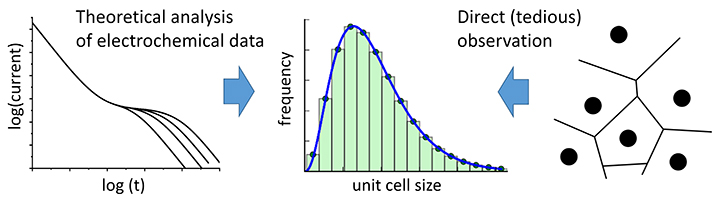
In their review, the authors presented the main principles governing behavior of regular and random arrays of nanometric active sites and how these principles can be used for theoretical description of these systems. In their approach, the researchers first studied electrochemical behavior of single electrodes within unit cells of various shapes. Insights obtained from these studies allowed the team to address significantly more complex electrode assemblies. Remarkably, they showed further that the presented concepts could be applied for establishing efficient and accurate semi-analytical approximation of ordered as well as non-ordered arrays responses under diffusion limited conditions when they involve the common situation of active sites with identical sizes.
In summary, the approach reviewed was seen to allow for an efficient modeling and prediction of the electrochemical behavior of nanostructured electrodes with active sites of identical sizes dispersed onto an inert substrate as well as for extracting statistical spatial information from electrochemical signature of an array. In fact, the researchers noted that their approximation was general and, as exemplified for different type of arrays, could be employed for describing the behavior of any array involving arbitrary distributions of their active sites onto the substrate surface. In a statement to Advances in Engineering, Professor Christian Amatore, one of the corresponding authors highlighted that their work demonstrated an efficient approach which allows statistical characterization of active sites distributions of any array based on chronoamperometric data. The further research on characterization of random arrays under more complex and experimentally relevant situations is in process in the team.
Reference
Alexander Oleinick, Oleksii Sliusarenko, Irina Svir, Christian Amatore. Review—Nanostructured Electrodes as Random Arrays of Active Sites: Modeling and Theoretical Characterization. Journal of The Electrochemical Society, 2020, volume 167: 013530.
