Advances in Engineering Advances in Engineering features breaking research judged by Advances in Engineering advisory team to be of key importance in the Engineering field. Papers are selected from over 10,000 published each week from most peer reviewed journals.

Significance
Reliable and affordable construction materials are an essential ingredient for achieving affordable housing; particularly in developing countries. Therefore, the use of indigenous renewable resources in construction materials development are vital for the construction industry. Recent research has shown that on a global scale, the construction industry is responsible for more than 40% of global energy consumption and as much as 33% of carbon dioxide equivalent emissions. Consequently, efforts to develop sustainable and renewable construction materials have gained momentum. Ideally, a considerable saving can be achieved by substituting synthetic fibers with natural fibers. Recent research has shown that plant-based natural fibers for making construction materials and products, significantly reduces material handling costs and heat transfer in buildings. Specifically, thin cement bonded natural fiber reinforced (NFR) composites have been explored for uses such as sound and thermal insulation. In most propositions involving the use of natural fibers, workability of the concrete composite remains the main challenge. This has been shown to be mainly due to the high-water absorbability of the fiber. As a result, in the spirit of developing novel and affordable materials, there is need to improve the interfacial bonding between natural fibers and cement paste.
Bearing this in mind, researchers from the Brunel University London in the United Kingdom: Professor Seyed Ghaffar’s research group proposed to investigate the interfacial bonding of natural fiber reinforced (NFR) cementitious composites by exploring the incorporation of 20–30 mm strands of uncoated and resin coated flax/wool twine into various cementitious matrices. Their aim was to develop composites with well-balanced properties that could achieve a homogeneous dispersion of the fibers in the matrix with strong interfacial bonding between the cement matrix and the fibers. Their work is currently published in the research journal, Construction and Building Materials.
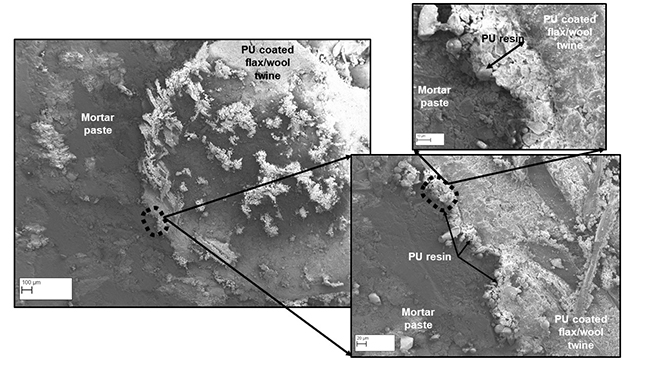
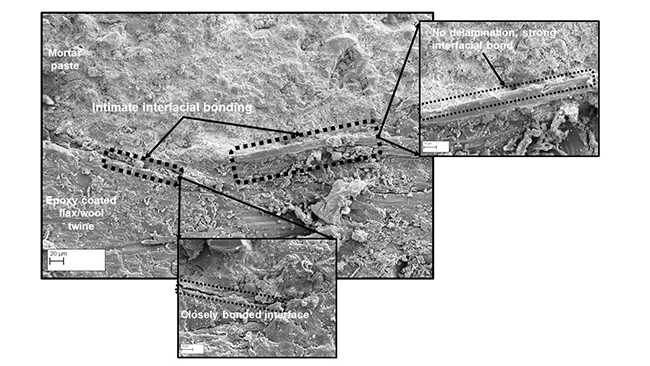
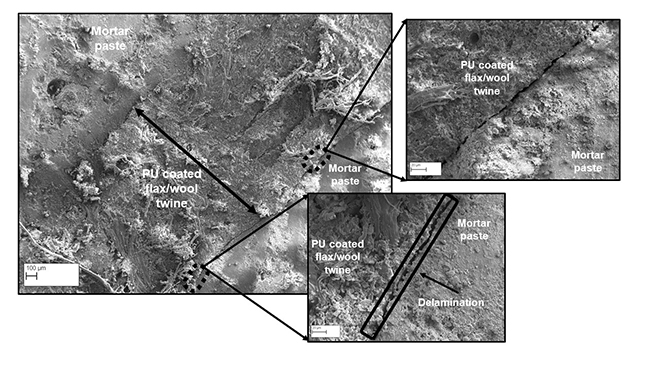
In their approach, cementitious matrices consisting of pulverized fly-ash, ground granulated blast furnace slag and ordinary Portland cement in various ratios were tested with the addition of flax/wool twine (1% volume ratio). The mechanical properties of these samples were assessed at 7 and 28 days. The researchers used epoxy and polyurethane resin to coat the flax/wool twine prior to their inclusion in various cementitious pastes.
The authors found a reduction in the flexural and compressive strength of uncoated NFR samples compared to unreinforced counterparts due to weak interfacial bonding between the uncoated fibers and the cementitious paste, therefore, formation of voids. Remarkably, improvements in both flexural and compressive strengths exhibited at 7 and 28 days compared to unreinforced and uncoated NFR samples were reported.
In summary, Professor Seyed Ghaffar and his colleagues carefully evaluated the mechanical, physical and interfacial bonding properties of various cementitious matrices reinforced with uncoated and resin coated flax/wool twine. The influence of different parameters and the synergetic effect of resin coated reinforcement on mechanical properties of cementitious composites were assessed. The morphology of the resin coated NFR samples showed an intimate interfacial bond to surrounding cementitious paste, which explained the increased mechanical performance. In a statement to Advances in Engineering, Professor Seyed Ghaffar highlighted that enhanced mechanical performance of resin coated NFR cementitious composites was achieved. He further mentioned that regardless of the excellent observations made in their work, a new approach for utilizing the water retention capacity of natural fibers to produce high performance cementitious composites via the internal curing technology ought to be explored.

Reference
Seyed Hamidreza Ghaffar, Mazen Al-Kheetan, Perry Ewens, Tao Wang, Jiandong Zhuang. Investigation of the interfacial bonding between flax/wool twine and various cementitious matrices in mortar composites. Construction and Building Materials, volume 239 (2020) 117833.