 Advances in Engineering Advances in Engineering features breaking research judged by Advances in Engineering advisory team to be of key importance in the Engineering field. Papers are selected from over 10,000 published each week from most peer reviewed journals.

Significance Statement
Despite the fact that implications of oxidized lipids in a variety of chronic diseases are well recognized, the actual contribution of oxidized lipids coming from the diet has not yet been established because their nature and, especially, their contents in foods have not yet been defined. This is due to the great analytical complexity involved in the analysis of a myriad of compounds with different chemical structures and relatively high reactivity. In this respect, our studies focus on the development of analytical strategies to determine the contents of lipid oxidation products in foods so that they can be the starting point to get to know whether their quantities are sufficient for the so claimed negative nutritional effects.
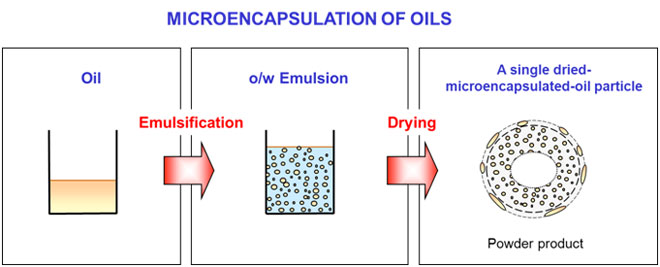
In the present study, formation of the main oxidation products of linoleic acid, i.e. hydroperoxy-, keto- and hydroxy- dienes, is evaluated in microencapsulated lipids by a novel analytical approach based upon HPLC-UV that enables the simultaneous quantification of these compounds. The method has already been validated using model lipid systems like oxidized samples of FAME and has been applied to blends of FAME obtained from oils with different degree of unsaturation and real samples of edible vegetable oils. In the present work, the method is applied for the first time to evaluate the formation of these compounds in dried microencapsulated samples in which the lipids constitute a disperse phase in the inner of solid particles. Lipids or oils microencapsulated in a matrix of, normally, proteins and carbohydrates are powder foods or food ingredients elaborated by drying of o/w emulsions. Milk powder, dried infant formulas and functional food ingredients containing w-3 long-chain polyunsaturated fatty acids are a few examples of this type of product.
Oxidation in dried microencapsulated oil is extremely complex. There is a minor lipid fraction in the surface of the particle that when this is oxidized rancidity is clearly perceived. When this fraction is analyzed the concentration of oxidized lipids is high. Nevertheless, when the total oil fraction is analyzed instead, the oxidation compounds are diluted in the major oil fraction, which is not altered, giving rise to low contents of oxidation products.
The encapsulated oil fraction can also be oxidized and sometimes faster than the surface oil; especially, when the headspace is protected with an inert gas like nitrogen due the air occluded in the inner of the particle. When oxidation proceeds in the inner, rancidity is not directly perceived due to the entrapment of the volatite oxidation products in the encapsulation matrix. Even though rancidity is not first detected, the levels of oxidation compounds can be elevated.
The main contributions of this research to the field are the following:
The different distribution of the compounds analyzed found in the dried microencapsulated lipids compared to lipids in continuous phase has shown that oxidation in such products develops in a discontinuous fashion. The lipids extracted come from lipid droplets with very different oxidation states. When a single droplet is oxidized, oxidation cannot be propagated to the rest of the lipid phase because the matrix acts as a physical barrier. The lipid fraction is formed by droplets that oxidize at different rates. Substantial formation of secondary oxidation products and even polymerization compounds can occur in these products even when the level of global oxidation is low. Therefore, the results of this study evidence the importance of applying complementary methods to those assessing only the primary oxidation products in dried microencapsulated lipids or other similar foods.
From an analytical point of view, the study contributes with a method that tackles for the first time simultaneous quantitation of primary and secondary oxidation products in a model for a number of foods in which the lipids constitute a disperse phase.


Journal Reference
Journal of the American Oil Chemists’ Society, December 2015, Volume 92, Issue 11, pp 1601-1607.
Arturo Morales1, Susana Marmesat1, Mª Victoria Ruiz-Méndez1, Gloria Márquez-Ruiz2,Joaquín Velasco1
[expand title=”Show Affiliations”]- . Instituto de la Grasa, Consejo Superior de Investigaciones Científicas (CSIC), Campus Universidad Pablo de Olavide E46, Ctra. de Utrera km 1, 41013, Seville, Spain
- . Instituto de Ciencia y Tecnología de Alimentos y Nutrición, Consejo Superior de Investigaciones Científicas (CSIC), c/José Antonio Novais, 10, 28040, Madrid, Spain
Abstract
Formation of hydroperoxy-, keto- and hydroxy- dienes was studied at 40 ºC in fatty acid methyl esters (FAME) microencapsulated in a dairy-like matrix formed by lactose and sodium caseinate. The FAME were obtained from conventional sunflower oil and the microcapsules were prepared by freeze-drying of an oil-in-water emulsion. For comparative purposes a neat sample of FAME was also tested. Results showed that for a given content of hydroperoxydienes much more elevated amounts of secondary products were detected in the microencapsulated sample compared to the neat sample of FAME. The contents of keto- and hydroxy- dienes found in the microencapsulated FAME ranged as a whole between 6 and 31 wt% of the analyzed compounds, while the neat sample showed values lower than 1.5%. Along with the fact that relatively higher contents of polymers were also found in the encapsulated sample, these results can be attributed to lipid droplets with very different oxidation states. On the one hand, the extract would be formed from droplets in early stages of oxidation containing hydroperoxides and very low contents of secondary products and, on the other, from droplets in advanced stages with decreased hydroperoxides and substantial contents of secondary products. Unlike the neat sample, hydroxydienes formed at significantly higher amounts than ketodienes in the microencapsulated FAME, suggesting a possible chemical role of the encapsulation matrix.
Go To Journal of the American Oil Chemists’ Society