 Advances in Engineering Advances in Engineering features breaking research judged by Advances in Engineering advisory team to be of key importance in the Engineering field. Papers are selected from over 10,000 published each week from most peer reviewed journals.

Significance
Plastic pollution is a major environmental problem, and one of the primary ways to combat it is by finding alternatives to traditional plastic materials. One such alternative is natural polymer derivatives, such as azobenzene cellulose-based materials. Azobenzene is a molecule that can undergo a reversible photochemical reaction when exposed to light, causing it to change shape. This property makes it useful for a variety of applications, including in the development of low-impact plastic alternatives. Azobenzene cellulose-based materials are attractive for several reasons. Firstly, they are derived from natural sources, which means they are biodegradable and compostable. Unlike traditional plastics, which can take hundreds of years to break down, these materials can decompose in a matter of months or years. Secondly, azobenzene cellulose-based materials can be designed to be responsive to light which can be advantageous for applications such as light-controlled drug delivery, as well as for optical data storage and sensing. In addition, azobenzene cellulose-based materials can be used to create a range of products, including packaging, textiles, and even medical implants. For example, these materials can be used to create flexible and transparent films that can be used for food packaging or to create sterile medical packaging.
Layer-by-layer (LbL) self-assembly method has attracted significant research attention as a promising method for developing high-value materials. Compared to other film production methods, LbL self-assembly offers numerous advantages like increased reproducibility and homogenous and uniform films and allows easy assembling of more complex systems. Additionally, attaching a photo switch to one of the polymers can make LbL films more photo-responsive, an important property for practical applications. Azobenzene is an example of the most commonly studied photo-switches due to their wide characteristic absorption band. Isomerization of azobenzene produces large structural disruptions that result in significant changes in the entire material structure. This is one of the reasons for developing azobenzene-containing materials for many shape-changing applications like drug delivery. Generally, most of these materials are produced out of synthetic polymers, contributing to adverse environmental impacts.
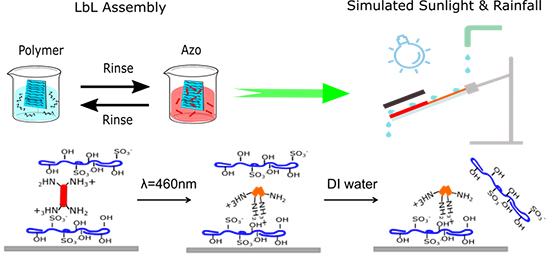
To address these concerns, researchers are exploring ways to mitigate the environmental impact of azobenzene-containing materials. One approach is to design materials that are biodegradable and can break down into non-toxic compounds. Another approach is to develop more sustainable production methods that minimize the use of toxic solvents and reduce waste. To this note, Dr. Kayrel Edwards, Mikhail Kim, Dr. Tristan Borchers and led by Professor Christopher Barrett from McGill University reported a water-resistant self-assembled biobased cellulose material whose disassembly and re-solubility could be triggered by irradiation with visible blue light. The thin polymer multilayer films were synthesized by LbL assembly of water-soluble biobased and biodegradable polymer sodium cellulose sulfate (NaCS), Bismarck Brown Y and water-soluble azo dye photo-switch. Their main objective was to design self-assembled materials that can be disassembled with ease to avoid the destruction of materials components during disassembling as well as to minimize waste at the end of life. The work is currently published in the peer-reviewed journal, Materials Advances.
The research team showed that irradiation of the visible blue light in the running water triggered and controlled the disassembly of the films, making them ready for reuse in the process. The photo-disassembly was triggered at remarkable rates of up to 0.007 absorbance units per hour. The obtained multilayer thin films were held together by electrostatic interactions between polymeric sulfate groups and the amino groups of the photoswitch to form stable and robust materials with excellent water resistance properties. Moreover, the reservable soft-bonded materials could be easily and inexpensively fabricated to produce a new class of materials to replace artificial plastics currently in use for different applications. The disassembly mechanism, including the role of trans-to-cis geometric isomerization of Bismarck Brown Y, was supported by optical pump-probe experiments and confocal Raman spectroscopy.
In summary, it is crucial to develop and implement sustainable approaches to the production and use of these materials to minimize their potential negative impact on the environment. Kayrel Edwards’s study is the first investigation to report the development of a new cellulose-based material, held together by light-reversible azo dye cross-linkers in soft ionic bonds. The 2 water-soluble components formed a stable, strong, and water-proof material once combined together, yet when irradiated with visible light, the azo dye isomerizes, breaks apart the cross-link soft ionic bonds, and the material then reverts reversibly back to water-soluble components without any damage, so in principle is 100% recyclable and 100% recoverable. The study findings demonstrated using natural fibers to fabricate dynamic, visible light-reversible materials. The presented method could facilitate the recovery of reusable components for use as next-generation sustainable materials for different applications. Professor Christopher Barrett told Advances in Engineering, “We view this as a candidate reversible green material, that could replace some oil-based plastics, that can be reversibly dis-assembled under environmental conditions of ‘sunlight and rainfall’. He added that the presented novel approach would contribute to developing alternative plastics with low environmental impacts.

Reference
Edwards, K. E., Kim, M., Borchers, T. H., & Barrett, C. J. (2022). Controlled disassembly of azobenzene cellulose-based thin films using visible light. Materials Advances, 3(15), 6222-6230.
