Advances in Engineering Advances in Engineering features breaking research judged by Advances in Engineering advisory team to be of key importance in the Engineering field. Papers are selected from over 10,000 published each week from most peer reviewed journals.

Recently, the use of Ni-rich lithium-nickel-cobalt-manganese oxides as cathodes in lithium-ion batteries has attracted significant attention amongst researchers. They exhibit high energy density, discharge capacity and relatively low cost. Unfortunately, nickel ions in these oxides exist as divalent or trivalent states. During synthesis and storage, the presence of unstable cation in the solid state may result in the reduction of trivalent ions to divalent ions thus leading to an increase in the cation ratio which may, in turn, reduce their electrochemical performance. To that note, researchers have been looking for efficient ways of controlling the Ni2+/Ni3+ ratio during the synthesis and storage phases.
X-ray photoelectron spectroscopy(XPS) technique has been widely used in the compositional and chemical state analysis. It has been of great importance in the evaluation of the crystal structure and electrochemical performance of the lithium-nickel-cobalt-manganese oxides. Owing to high uncertainty degree in chemical states quantification, numerous fitting methods and interpretations of X-ray photoelectron spectroscopy spectra have been proposed. However, the Ni2+/Ni3+ ratio has not been fully explored.
In a previously published literature, the Ni2+/Ni3+ ratio has been approximated using the Gaussian/ Lorentzian curves. This method, however, faces numerous challenges among them being lack of reference standards which compromises on its reproducibility and effectiveness. As such, non-linear least square fitting technique have been identified as a promising alternative solution to address the challenges of XPS based Gaussian/ Lorentzian peak fitting method. It enables effective fitting of complex spectra that are difficult to describe using unambiguous function models.
Recently scientists at Yunnan Tin Group (Holding) Co. Ltd Ziwei Fu, Juantao Hu, Wenlong Hu, Shiyu Yang, and Yunfeng Luo developed a non-linear least square fitting method to analyses the Ni2+/Ni3+ ratio in the NMC samples. They developed an effective technique with enhanced reproducibility for quantitative analyses of Ni ions and chemical states in Ni-rich lithium-nickel-cobalt-manganese oxides. The work is published in the journal, Applied Surface Science.
Briefly, the authors commenced their experiment by synthesizing standard sample so of Ni2+ and Ni3+ as well as NMC samples with different nickel doping levels, which were used to estimate the initial parameters. The Ni2+/Ni3+ ratio was used to determine the peak position and sharpness. They assumed that the Ni in chemical states resulted in the changes in the Ni 2p XPS of the various NMC samples. Eventually, they compared the results to those obtained using the Gaussian/ Lorentzian peak fitting method.
From the comparison of the residual standard deviation, the authors observed that the fitting quality of non-linear least square fitting was superior to that of Gaussian/ Lorentzian peaks. Consequently, it exhibited significantly improved reproducibility. This was because it required no parameter adjustments thus free from operator interference.
The study has successfully confirmed the reproducibility and effectiveness of the non-linear least square fitting technique in the X-ray photoelectron spectroscopy quantitative analysis of the Ni2+/Ni3+ ratio in lithium-nickel-cobalt-manganese oxides cathode materials. Therefore, the study will advance various application such as developing high-performance lithium-ion batteries.
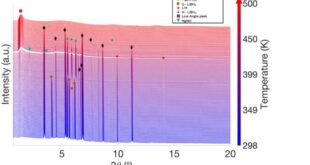
![Quantitative analysis of Ni2+/Ni3+ in Li[NixMnyCoz]O2 cathode materials: Non-linear least-squares fitting of XPS spectra - Advances in Engineering](https://advanceseng.com/wp-content/uploads/2018/12/related-figure-2.jpg)





Reference
Fu, Z., Hu, J., Hu, W., Yang, S., & Luo, Y. (2018).Quantitative analysis of Ni2+/Ni3+ in Li[NixMnyCoz]O2 cathode materials : Non-linear least-squares fitting of XPS spectra. Applied Surface Science, 441, 1048-1056.
Go To Applied Surface Science