Advances in Engineering Advances in Engineering features breaking research judged by Advances in Engineering advisory team to be of key importance in the Engineering field. Papers are selected from over 10,000 published each week from most peer reviewed journals.

Significance Statement
Precipitation and crystal growth are normally affected by properties such the solvent attributes, impurities, cathodic current density, and substrate grain orientation. For corroding systems, these features can lead to a non-uniform corrosion film growth thus affecting the corrosion damage distribution.
Sulfide is found to destabilize copper at negative corrosion potentials in aqueous solutions, leading to its corrosion and subsequent deposition of copper sulfide films on copper surface. In previous studies, it has been observed that the corrosion process is rapid resulting in the deposition of chalcocite. The layer is observed to form at the chalcocite-electrolyte interfaces accompanied by complete consumption of sulfide. However, under both stagnant and convective conditions, the film growth morphology was majorly affected by transport processes.
In a recent paper published in Corrosion Science Western University researchers led by Professor David Shoesmith described a number of experiments in a bid to determine the particulars of the corrosion process with an aim of understanding how distribution in crystal growth rates occurs. Understanding how the wide distribution in crystal growth rates occurs would help them know its importance in assessing damage distribution across the corroded interface.
In this study, the authors cut copper electrodes from a plate material. They connected the disks to a steel shaft and applied a non-conductive lacquer to avoid contact of the junction with the solution. To ensure anoxic conditions, the researchers performed the experiments in an anaerobic chamber purged with argon. The electrodes were then placed in sulfide solutions under natural corrosion environment and left for various exposure periods. In addition, the authors also adopted a three-electrode cell with a platinum electrode and a calomel reference electrode.
These electrodes were then removed from this solution and surface analyzed after an interim storage period of no more than 30 minutes. The authors also analyzed the copper content in the solutions.
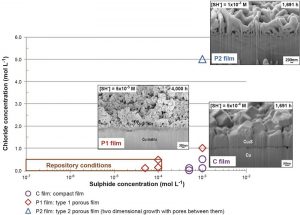
The authors observed that a copper sulfide film was deposited on the copper surface after an immersion period of 1691 hours. Most parts of the surface were covered with a uniform deposit but a few areas had excessive crystal growth.
At low sulfide flux, the films developed cellular structures and copper sulfide growth was mainly controlled by the diffusive flux of sulfide in the solution. However, at high sulfide flux, the authors observed film deposits with well-formed crystal structures. Also, as the sulfide flux increased the distribution in film thickness increased. This was an indication that excessive crystal growth was more pronounced at high sulfide flux.
Corrosion products grew non-uniformly leading to a potential difference between the areas covered with the thin films and those covered with thick films. The potential difference led to a variation in the observed corrosion rates. Corrosion of copper in an aqueous sulfide solutions necessitates little overpotential. Therefore, some areas accumulated thick protective films where the corrosion rate was low, while other areas were covered only with thin porous deposits and experienced a high corrosion rate. This led to the development of micro galvanic couples with patches covered by corrosion products that acted as the net cathodes while other unprotected areas acted as the net anodes.
Therefore, copper transport from anodic to cathodic locations via surface and solution transport was necessary to sustain the excessive film growth at the net cathodes.


Reference
J. Chen, Z. Qin, T. Martino, and D.W. Shoesmith. Non-uniform film growth and micro/macro-galvanic corrosion of copper in aqueous sulphide solutions containing chloride. Corrosion Science, volume 114 (2017), pages 72–78.
Department of Chemistry and Surface Science Western, Western University, London, Ontario N6A 5B7, Canada.
Go To Corrosion Science