Advances in Engineering Advances in Engineering features breaking research judged by Advances in Engineering advisory team to be of key importance in the Engineering field. Papers are selected from over 10,000 published each week from most peer reviewed journals.

Significance
The remarkable regulatory and mechanical properties as well as their ability to produce many configurations, make honeycomb structures potential candidates for numerous applications. With the development of new materials, the carrying capacity of these materials has been significantly improved. However, existing honeycomb-based structures such as aluminum and composite honeycomb structures exhibit limitations such as buckling failures and low compressive strength that compromise their usability in specific fields such as deep-sea submersibles. Recently, carbon fiber composite honeycomb structures have been identified as promising candidates for applications in such fields. This, however, requires further strengthening of their mechanical properties.
Presently, the two most efficient methods for improving the mechanical properties of composite honeycombs are optimal topology configuration and high-quality manufacturing process. The two have been extensively studied in the literature. For instance, the low-bearing efficiency of the lightweight composite honeycombs due to buckling failure can be solved by hierarchical design. Due to the promising results, the concept of hierarchical structure has been studied both theoretically and experimentally to provide more insights into its role in strengthening the mechanical properties of honeycomb structures. Consequently, research findings have revealed that hybrid materials effectively enhance the mechanical performance of honeycombs. Nevertheless, despite the good progress, the above design methods experience several shortcomings that must be addressed for the easy fabrication of high-performance honeycomb structures without introducing external materials.
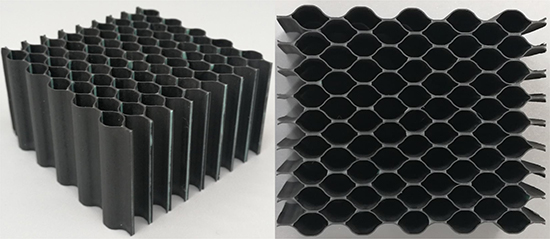
Carbon fiber composite curved honeycombs (CCCHs) provides relatively higher strength and high resistance to buckling failures than other lightweight materials. Besides, they are easy to design and fabricate. Equipped with this knowledge, researchers at Harbin Engineering University: Mr. Xiaojian Chen, Associate Professor Guocai Yu, Mr. Zengxian Wang and Dr. Lijia Feng led by Professor Linzhi Wu focused on strengthening the mechanical properties of CCCHs. In particular, the study aimed at enhancing their out-of-plane compressive performance. Their work is currently published in the research journal, Composite Structures.
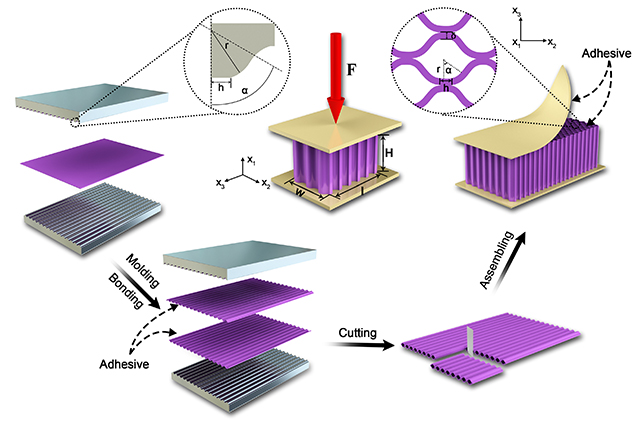
In brief, the CCCHs used in this research were fabricated using molding and bonding processes. The authors commenced their experimental work by measuring and analyzing the out-of-plane compressive properties of the unidirectional and woven laminated CCCHs. The compressive strengths were predicted using two collapse mechanisms, namely, crushing failure and elastic buckling, based on the theory of mechanics of composites. It was necessary to describe the failure mechanism using finite element analysis to provide more insights into the CCCHs failure modes. Also, the effects of wall thickness and curvature radius on the compressive strengths were investigated. Lastly, the obtained compressive strengths were compared to those of existing lightweight structures.
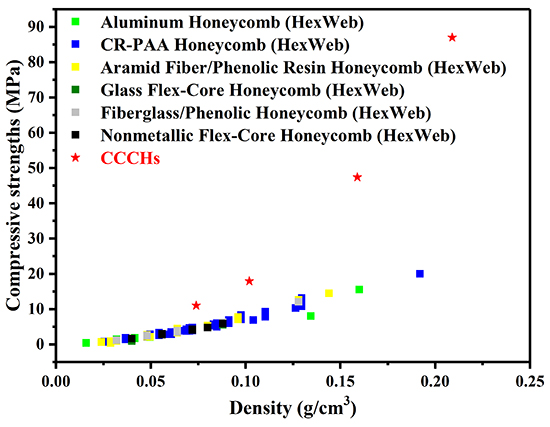
Results showed that the curved wall topology design effectively improved the buckling resistance of the structures. Compared with other honeycomb structures, the out-of-plane compressive strength and specific out-of-plane compressive strength of the CCCHs are 2-4 times and 3-4 times, respectively. Moreover, the out-of-plane compressive strengths increased with either an increase in the wall thickness or decreased curvature radius. And the predictions agreed well with the measurement results. Additionally, the out-of-plane compressive strengths of the laminated CCCHs were notably superior to those of the available lightweight honeycombs.
In summary, the design and manufacturing of CCCHs with enhanced out-of-plane compressive performance were reported. Most importantly, the two variables affecting the buckling strength of these materials were studied experimentally. The study results also demonstrated the superiority of the reported out-of-plane compressive strengths compared to competitive lightweight materials. Therefore, CCCHs are promising candidates for competitive lightweight sandwich structures. In a statement to Advances in Engineering, Professor Linzhi Wu explained their study provides more opportunities for applications of honeycomb structures, like load-bearing and anti-collision components.

Reference
Chen, X., Yu, G., Wang, Z., Feng, L., & Wu, L. (2021). Enhancing out-of-plane compressive performance of carbon fiber composite honeycombs. Composite Structures, 255, 112984.