Advances in Engineering Advances in Engineering features breaking research judged by Advances in Engineering advisory team to be of key importance in the Engineering field. Papers are selected from over 10,000 published each week from most peer reviewed journals.

Significance Statement
Damping capacity is the ability of a material to absorb energy by converting mechanical energy into heat. A high damping capacity can be mainly attributed to mobility of internal boundaries, such as magnetic domain boundaries, twin boundaries and phase boundaries. Alloying and heat treatment process are said to have a significant influence on damping capacity and usage temperature.
Professor Wenbo Liu and colleagues from Sichuan University in collaboration with researchers at The Hong Kong Polytechnic University and Beijing Institute of Technology recently developed a novel cast-aged MnCuNiFeZnAl alloy with good damping capacity and high usage temperature, and meanwhile systematically investigated the heat treatment process dependency of its damping capacity and usage temperature. According to the team, a lot of work has been done on damping alloys in the past decades, especially as-forged M2052, a typical Mn-Cu based high-damping alloy with relatively low Mn content. Compared to the forging technique, one-step molding casting had exhibited distinct advantages of simple manufacturing process, low integrated cost and high production efficiency. However, they observed that the M2052 alloy to be defective in castability. The research work is now published in the journal Materials and Design.
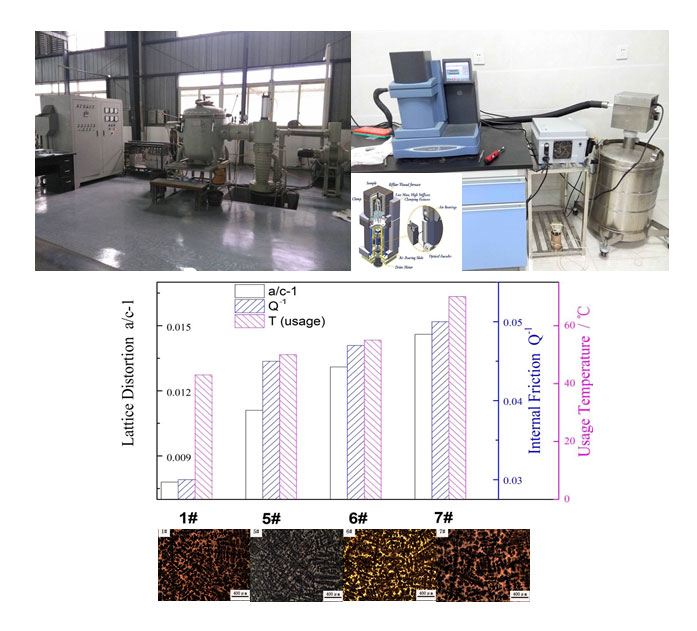
To solve this issue, the research team suggested to introduce Zn and Al elements into the M2052 alloy matrix, they were able to come up with MnCuNiFeZnAl alloy. The alloy was prepared by vacuum induction melting with pure metals in an inert argon atmosphere and X-ray diffraction was used to identify phase structure and lattice parameter of specimens. The team said, it is first to report the novel as-cast MnCuNiFeZnAl high-damping alloy and systematically research their damping capacity by dynamic mechanical analysis under different heat treatment conditions using a test frequency of 1 Hz.
The researchers noted an evident positive correlation in the specimen internal friction with increase of strain amplitude, indicative of the strain-amplitude-dependent damping capacity.
According to their findings, the optimal damping capacity (Q-1=5.0×10⁻² at ε=2×10⁻⁴) of the as-cast MnCuNiFeZnAl alloy can be achieved by ageing at 435°C for 2 h (just a very simple heat treatment process), much higher than those obtained in the conventional as-forged M2052 high-damping alloy. In this case, the maximal nanoscale Mn segregation can be formed in Mn dendrites by spinodal decomposition. They also found out that the usage temperature has very similar change tendency with the lattice distortion and internal friction, which critically depends on the Mn content in Mn-Cu based alloys.
The results of this study indicated that good damping capacity and high usage temperature can be obtained simultaneously in the novel cast-aged MnCuNiFeZnAl alloy, implying that the newly developed MnCuNiFeZnAl alloy system is a promising candidate of Mn-Cu based high-damping alloys toward engineering applications.
This study developed a kind of novel as-cast MnCuNiFeZnAl high-damping alloy system and provided profound understanding of damping mechanism of as-cast Mn-Cu based alloys.
Acknowledgements
This work was financially supported by the National Natural Science Foundation of China (11076109), the “Hong Kong Scholars Program” Funded Project (XJ2014045, G-YZ67), and the Talent Introduction Program of Sichuan University (YJ201410).




Journal Reference
Wenbo Liu1,2, Ning Li1, Zhenyu Zhong1, Jiazhen Yan1, Dong Li1, Ying Liu3, Xiuchen Zhao3, Sanqiang Shi2, Novel cast-aged MnCuNiFeZnAl alloy with good damping capacity and high usage temperature toward engineering application, Materials and Design 106 (2016) 45 –50.
[expand title=”Show Affiliations”]- School of Manufacturing Science and Engineering, Sichuan University, Chengdu, 610065, PR China
- Department of Mechanical Engineering, The Hong Kong Polytechnic University, Hung Hom, Kowloon, Hong Kong
- School of Materials Science and Engineering, Beijing Institute of Technology, Beijing 100081, PR China
Go To Materials & Design