 Advances in Engineering Advances in Engineering features breaking research judged by Advances in Engineering advisory team to be of key importance in the Engineering field. Papers are selected from over 10,000 published each week from most peer reviewed journals.

Significance
Recently, the use of fossil fuels has experienced stringent mitigation measures in an effort to minimize carbon emissions. This has favored the development of sustainable alternative renewable energy sources. In particular, hydrogen gas has attracted significant attention of researchers as a clean energy carrier owing to its zero emissions. However, the production of hydrogen gas has been hindered by several challenges.
Presently, considering the increasing population growth especially in town and city centers, production of manifold wastes has been on the rise with sewage sludge being at the forefront. Considering the high pollutant nature of sewage sludge, effective methods for proper treatment, use, and disposal of these wastes are highly desirable. In the recently published literature, thermochemical conversion of sludge to energy has been identified as an alternative and effective way of using the sewage sludge.
Among the available methods for converting sludge waste into energy, pyrolysis is widely preferred due to high production value and minimal emissions. It is generally used to convert sludge into hydrogen that can be used for the production of electric power. Even though present highly scale hydrogen production is done through coal gasification and natural gas steam reforming, current climatic changes and unpredictable fuel prices have shifted the focus to the development of non-fuel technologies for large scale hydrogen production. Currently, sludge pyrolysis has been identified as a promising solution despite its low efficiency. As such, various improvements are needed to unleash the full potential of sludge pyrolysis in production of hydrogen.
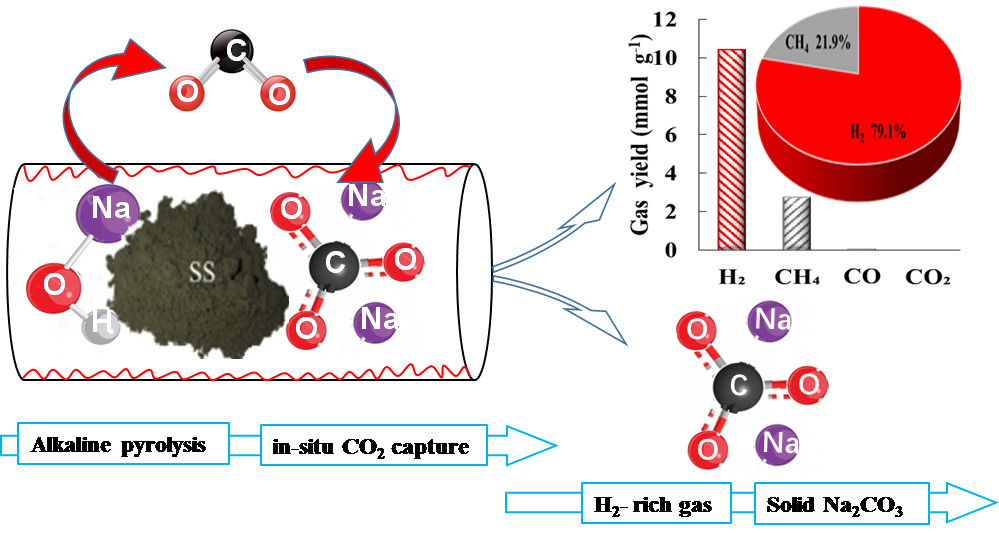
To this note, researchers from School of Environment, Tsinghua University (China): Dr. Ming Zhao, Fan Wang (Ph.D. candidate), Dr. Yiran Fan, Abdul Raheem (Ph.D. candidate), and researcher from Department of Mechanical and Process Engineering, ETH Zürich (Switzerland) Dr. Hui Zhou proposed the enhancing hydrogen gas production through sludge pyrolysis with carbon capture. It is the first time that alkaline pyrolysis of sewage sludge is investigated. This technology has the advantages of high carbon conversion, high H2 production, low COx production, and low tar formation, which has great potential in hazardous sludge management industry.
Additionally, based on the alkaline thermal treatment of sewage sludge, they investigate the effects of the following parameters: temperature, heating rate, and sodium hydroxide ratio on hydrogen production. Their main aim was to improve solid waste management through waste reduction, recycling, treatment and recovery, the work is currently published in the journal, International Journal of Hydrogen Energy.
The authors observed that sodium hydroxide significantly enhanced hydrogen production by suppressing carbon dioxide and carbon monoxide production. On the other hand, the high temperature was responsible for breaking down the bonds. For instance, the maximum hydrogen yield, that is, 10.3 mmol g-1 was achieved at a temperature of 500 °C. Furthermore, an optimum heating rate of 100 °C min-1 was noted to favor high hydrogen yield. To actualize their study, they performed solid residue analysis using the X-ray diffraction method and confirmed the existence of sodium carbonate in the solid.
In summary, the team proposed alkaline pyrolysis of sewage sludge in enhancing hydrogen production and verified the feasibility . According to their study, alkaline pyrolysis of sludge proved a promising solution for enhancing sludge management and beneficial use in producing hydrogen that will advance sustainable and carbon-free fuel development.





Reference
Zhao, M., Wang, F., Fan, Y., Raheem, A., & Zhou, H. (2019). Low-temperature alkaline pyrolysis of sewage sludge for enhanced H2 production with in-situ carbon capture. International Journal of Hydrogen Energy, 44(16), 8020-8027.
Go To International Journal of Hydrogen Energy