 Advances in Engineering Advances in Engineering features breaking research judged by Advances in Engineering advisory team to be of key importance in the Engineering field. Papers are selected from over 10,000 published each week from most peer reviewed journals.

Significance
Unsteady flows are often exploited to enhance heat removal in single-phase cooling systems by disrupting the hydrodynamic and thermal boundary layers, the near-wall gradients and the overall thermal resistance to heat transfer. However, an understanding of the explicit conditions that deliver heat transfer enhancement has yet to be achieved. This owes in part to a high variability in a large parameter space, that contains a variety of flows with complex boundary conditions and geometric dissimilarities, including for example developing flows in short minichannel heat sinks, and pulsating and synthetic jets. Furthermore, heat transfer studies have often chased time- and space-averaged heat transfer enhancement, while convective heat transfer is often unsteady and spatially non-uniform. Hence, the problem should be characterised on a space- and time-dependent basis in order to exploit any potential for heat transfer optimisation.
In a collaboration between the Fluids and Heat Transfer Research Group of Trinity College Dublin and the Thermal Management Research Group of Bell Labs Ireland, Richard Blythman, Tim Persoons, Nick Jeffers, Kevin Nolan and Darina Murray have employed a bottom-up approach to investigate the local time-dependent coupling of the velocity and temperature fields for the simple case of a rectangular channel geometry and fully-developed sinusoidally-pulsating flow using complementary analytical, experimental and numerical techniques. Since the thermal problem is intrinsically dependent on the hydrodynamic problem, the first in a series of articles analyses the decoupled unsteady velocity profile and its derivatives to understand the underlying physical mechanisms that may effect a change in heat transfer. Their research work is published in the International Journal of Heat and Fluid Flow.
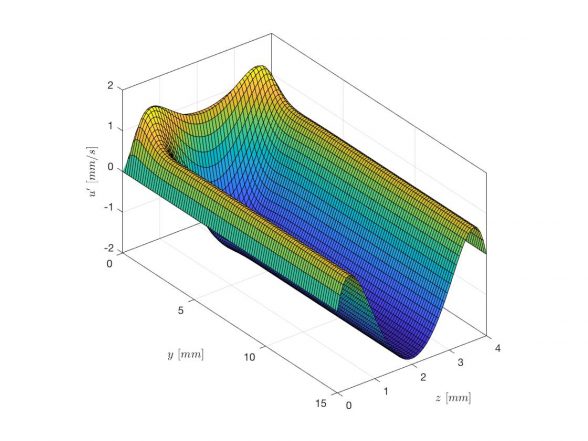
The study analyses the velocity profiles and wall shear stresses for a wide range of actuation frequencies (up to Womersley number Wo = 7.0) using particle image velocimetry (PIV) measurements. The experimental data are in excellent agreement with the values predicted by the analytical solution, which is conveniently reorganised in terms of amplitude and phase values. Hence, these measurements constitute the first verification of the analytical theory for a pulsating flow in a rectangular channel geometry. Furthermore, the local instantaneous amplification of wall shear stress with respect to steady flow is presented as a key thermal indicator to be coupled with future wall heat flux measurements. It is found that the local amplitude and phase alterations of the wall shear stress parameters are caused by the evolving interplay of viscous and inertial effects with frequency.
Although more research is needed for this cooling technology to reach full maturity, these new insights may form the basis of a novel adaptive thermal management strategy for next-generation photonics integrated circuits for high-speed telecommunication systems.





Reference
R. Blythman, T. Persoons, N Jeffers, K.P. Nolan, D.B. Murray. Localised dynamics of laminar pulsatile flow in a rectangular channel. International Journal of Heat and Fluid Flow, Volume 66 (2017), Pages 8–17.
Go To International Journal of Heat and Fluid Flow