Advances in Engineering Advances in Engineering features breaking research judged by Advances in Engineering advisory team to be of key importance in the Engineering field. Papers are selected from over 10,000 published each week from most peer reviewed journals.

Ammonia occupies a singular position at the intersection of energy systems, industrial chemistry, and food security. It is simultaneously a cornerstone of modern agriculture, a dense hydrogen carrier, and an emerging vector for low-carbon energy storage and transport. Yet despite its centrality, ammonia production remains overwhelmingly dependent on fossil fuels, with the Haber–Bosch process tethered to natural gas reforming and responsible for substantial global carbon emissions. Efforts to decarbonize ammonia have therefore become emblematic of the broader challenge facing industrial energy transitions: how to reconcile the scale, reliability, and economics of mature processes with the imperative for low-carbon operation. In parallel, nuclear microreactors have emerged as a distinct class of energy systems designed to address deployment barriers associated with conventional nuclear power. Unlike gigawatt-scale reactors, microreactors emphasize modularity, transportability, reduced construction timelines, and the capacity for distributed operation. Their relatively high outlet temperatures further distinguish them from other low-carbon energy sources, enabling direct coupling to industrial processes that require sustained thermal input. Despite these advantages, the economic viability of microreactors remains uncertain, particularly in grid-connected environments where natural gas and renewables exert strong cost pressure. Recovering capital investment within acceptable timeframes has thus become a central concern shaping microreactor deployment strategies. One promising route to improving microreactor economics lies in moving beyond electricity-only operation and leveraging reactor heat to produce high-value commodities. Among candidate products, ammonia is particularly attractive. Its market is mature, demand is relatively stable, and pricing has exhibited pronounced upward volatility in recent years. Unlike hydrogen, ammonia benefits from existing transport and storage infrastructure and avoids the extreme compression requirements associated with gaseous fuels. These features create the conditions for continuous baseload operation, aligning well with the operational characteristics of nuclear systems. To this end, new research paper published in Progress in Nuclear Energy and conducted by Dimitri Kalinichenko, Alvin Lee, Timothy Grunloh, and led by Professor Caleb Brooks from the University of Illinois Urbana-Champaign, the authors developed an integrated thermodynamic and economic modeling framework to evaluate ammonia production driven by nuclear microreactors at distributed scales. They coupled detailed process energy balances for natural gas reforming and high-temperature electrolysis with an amortization-based financial metric that links commodity revenue directly to recoverable reactor capital. This approach reveals how reactor size, hydrogen pathway, interest rates, and market volatility jointly shape economic viability. The study offers one of the most rigorous quantitative assessments to date of how microreactors can be repositioned as industrial enablers rather than electricity-only assets.
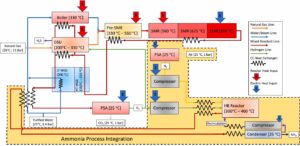
The research team evaluated two hydrogen generation pathways. In the first, natural gas reforming combined steam methane reforming and water-gas shift reactions, followed by hydrogen purification and integration with a Haber–Bosch synthesis loop. Reactor heat was used extensively to drive endothermic reactions and preheat reactants, while electrical input was minimized to compression and auxiliary operations. Carbon dioxide produced during reforming was separated and assumed to be captured, allowing the system to approach near-zero operational emissions. The second pathway relied on high-temperature electrolysis using solid oxide electrolysis cells. Steam electrolysis was carried out at elevated temperatures to reduce electrical demand, with reactor heat supplying a portion of the reaction energy. Hydrogen produced in this manner was similarly routed into a Haber–Bosch loop, enabling a direct comparison between the two hydrogen sources under otherwise comparable ammonia synthesis conditions. In both configurations, heat recovery played a central role, with exothermic ammonia synthesis contributing thermal energy back into upstream process steps.
The authors performed thermodynamic analysis which revealed marked differences in performance. Natural gas reforming exhibited substantially higher ammonia output per unit of reactor thermal power, benefiting from the chemical energy stored in methane. High-temperature electrolysis, while fully carbon-free, produced significantly less ammonia per megawatt-thermal and generated excess recoverable heat that could not be fully utilized within the process. These differences translated directly into economic outcomes. Afterward, the authors employed an achievable principal loan framework, inverting standard amortization relations to estimate the maximum loan that could be serviced by ammonia sales over specified operating periods. Historical ammonia and natural gas price data were used to construct realistic revenue ranges, capturing both recent price spikes and more conservative pre-2021 market conditions. Known costs for hydrogen production units and ammonia synthesis loops were subtracted, isolating the portion of revenue available to recover microreactor capital and operating costs. The results demonstrated that scale and pathway choice were decisive. Microreactors below roughly ten megawatts thermal struggled to generate sufficient revenue under either configuration. At capacities between ten and twenty megawatts thermal, natural gas reforming coupled systems achieved netback within approximately eight years under favorable market conditions and within seventeen years under more conservative pricing assumptions. High-temperature electrolysis systems required longer payback periods and were more sensitive to assumptions about electricity costs and interest rates. Importantly, increases in reactor process heat temperature benefited reforming systems but offered little advantage for electrolysis-based configurations.
In conclusion, the new work of Professor Caleb Brooks and colleagues carries significance that extends beyond the specific case of ammonia production. At a conceptual level, it reframes nuclear microreactors not as marginal contributors to electricity supply, but as versatile industrial energy platforms capable of anchoring distributed chemical production. By demonstrating that ammonia synthesis can materially improve the economic profile of microreactors under realistic market conditions, the study provides a concrete pathway for aligning nuclear deployment with pressing decarbonization goals in industry. One of the most consequential insights lies in the comparative performance of hydrogen production routes. While high-temperature electrolysis is often framed as the gold standard for green ammonia, the analysis underscores a more nuanced reality at small scales. Without sufficiently flexible heat integration or low-cost electricity, electrolysis struggles to capitalize on the thermal advantages offered by nuclear reactors. In contrast, natural gas reforming with carbon capture, though imperfect, emerges as a pragmatic transitional solution capable of delivering competitive economics with substantially reduced emissions. This finding challenges binary narratives that position fossil-derived pathways as inherently incompatible with low-carbon futures. The implications for policy are equally salient. Carbon pricing thresholds identified in the study provide quantitative benchmarks for when nuclear-assisted reforming becomes competitive with conventional ammonia production. Such benchmarks can inform the design of carbon markets, tax credits, and industrial decarbonization incentives. Moreover, the sensitivity of outcomes to interest rates highlights the importance of financing structures, particularly for capital-intensive nuclear technologies whose viability depends as much on cost of capital as on thermodynamic efficiency.
From an energy systems perspective, the study illustrates how baseload nuclear heat can mitigate challenges associated with variable renewable energy in chemical production. Continuous operation avoids the need for large hydrogen storage buffers and stabilizes process conditions within the Haber–Bosch loop. This reliability may prove increasingly valuable as ammonia demand expands beyond fertilizers into energy storage and maritime fuel applications.

Reference
Dimitri Kalinichenko, Alvin Lee, Timothy P. Grunloh, Caleb S. Brooks, Coupling and economic analysis of nuclear microreactor enabled ammonia production, Progress in Nuclear Energy, Volume 191, 2026, 106102,