Advances in Engineering Advances in Engineering features breaking research judged by Advances in Engineering advisory team to be of key importance in the Engineering field. Papers are selected from over 10,000 published each week from most peer reviewed journals.

Significance Statement
Recently, in the view of problematic issues on strength, safety upon destruction, costs in installation and fabrication, and material weights, plastic materials that are relatively inexpensive, light-weighted, easily-formable, and safe are being spotlighted, instead of conventional tempered glass materials. For example, according to recent rapid popularization of various mobile devices, a demand for developing a transparent plastic polymer material as an alternative for weight reduction of liquid crystals used for a display unit is increasing. Surface characteristics of plastic materials, such as chemical resistance, mechanical strength, or high-temperature stability, are not yet sufficient compared to those of glass materials. Therefore, to enhance such characteristics, organic-inorganic hybrid-type surface protective coating layers formed by dispersing inorganic materials in plastic polymer materials or coating inorganic materials onto surfaces of plastic polymer materials are widely used. However, although such organic-inorganic hybrid-type surface protective coating layers may secure advantages of organic materials, such as flexibility and formability, the technique of dispersing an inorganic material into a plastic polymer material has problems including an excessive consumption of the inorganic material and an increase in a thickness of the coating layer. In case of a conventional organic-inorganic hybrid-type surface protective coating layer, due to separated two-steps process, i.e., forming a polymer material layer, and then, coating an inorganic material layer, the entire process for fabricating the organic-inorganic hybrid-type surface protective coating layers become complicated and expensive, where defects caused by the complicated process also deteriorates the production yield.
Professor Hyung-Ho Park and colleagues at Yonsei University in Korea discussed in a recent paper published in Applied Surface Science the use of a one-pot synthesis ultraviolet irradiation to obtain an organic-inorganic hybrid bi-layer coating with inclusions of inorganic metal oxide precursors via surface selective deposition. A low concentrated metal oxide precursor, strontium 2-ethylhexanoate was chosen as a reactive material under ultraviolet rays. This original work provides a surface functional composite coating film that provides a stable interface between an upper inorganic material layer and a lower polymer material for improved interlayer adhesiveness and is capable of providing functionality unique to the inorganic material. In their experiments the authors observed quick polymerization of ultraviolet-curable coatings at first and a formation of a hybrid bi-layer coating with strontium oxide on top during the continued ultraviolet curing process. As ultraviolet curing time increases, fast polymerization occurred in the ultraviolet-curable coatings which as a result led to the diffusion of strontium precursor to the surface, oxidizing to form strontium oxide in the coatings. During the selective surface formation of strontium oxide, they found that the flat nature of the coating film surface was highly improved. Furthermore the hybrid bi-layer coating films when deposited on a transparent glass had the ability of having a very high transmittance value with increased surface hardness.
The authors showed an easy and competent method for surface-selctive functionalization of the organic coatings with very low precursor concentrations which are of relevance to the materials involved in photochemical reactions.
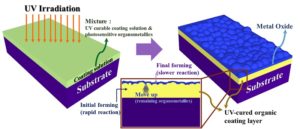
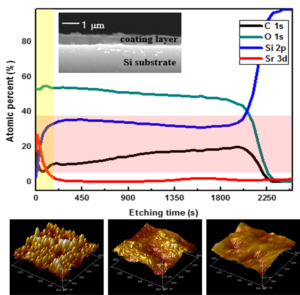 This study demonstrates suitable for exceptional hybrid film under UV exposure. A small quantity of the dispersive photochemical precursor Sr 2-ethylhexanoate was mixed and the composition altered from the surface to the bottom, forming an organic layer and a densely concentrated SrO surface layer. The surface-selective SrO strongly enhanced the surface flatness and hardness of the UV-curable organic coating film. Keywords: surface selective, hybrid bi-layer coating, one-pot synthesis, photochemical reaction, UV hard coating
Reference
Lee, Y.K., Park, C.S., Park, H.H. One-step Surface Selective Modification of UV-Curable Hard Coatings with Photochemical Metal Organics, Applied Surface Science 389 (2016) 882–888.
Department of Materials Science and Engineering, Yonsei University, Seodaemun-gu, Seoul 120-749, Korea.
Go To Applied Surface Science