Advances in Engineering Advances in Engineering features breaking research judged by Advances in Engineering advisory team to be of key importance in the Engineering field. Papers are selected from over 10,000 published each week from most peer reviewed journals.

Significance
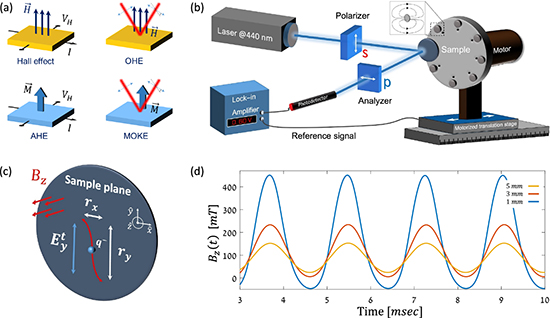
Understanding how light interacts with electron spins in metals has long been a nuanced challenge. Central to this area is the optical Hall effect (OHE), an optical analog to the classical Hall effect, in which light experiences a polarization rotation due to an applied magnetic field. While this phenomenon is readily observable in magnetic materials through the magneto-optical Kerr effect (MOKE), its counterpart in non-magnetic metals is far more elusive. The problem stems from the extremely weak signal associated with OHE at visible wavelengths, often buried under instrumental noise and material imperfections. This makes direct detection not only technically demanding but often scientifically ambiguous. Historically, studies of OHE have favored frequencies in the terahertz or infrared range, where the displacement of charge carriers under electromagnetic fields is larger and easier to observe. In contrast, visible light—despite its accessibility and high spatial resolution—offers only minuscule signals in non-magnetic systems due to the shorter interaction length and reduced carrier response. As a result, few experimental setups have succeeded in extracting meaningful optical Hall data from normal metals like copper or aluminum under visible illumination. Researchers have attempted various techniques, such as polarization modulation or multipass reflection geometries, but the gains in sensitivity have remained marginal and inconsistent across different materials. A significant technical bottleneck lies in the limitations of traditional MOKE setups. These often use low-amplitude, static magnetic fields or modest laser modulation schemes that fail to generate a strong enough transverse optical signal in non-magnetic samples. Moreover, the shot noise from laser light, imperfections in polarizer extinction, and parasitic signals from environmental sources further obscure the subtle optical signatures one seeks to isolate. The complexity intensifies when dealing with materials that exhibit high spin-orbit coupling (SOC), where spin-flip scattering processes might influence the interaction between light and electronic states but without leaving a straightforward optical trace.
To this account, new research paper published in Journal of Nature Communications and conducted by Dr. Nadav Am-Shalom, Amit Rothschild, Nirel Bernstein, Michael Malka, Benjamin Assouline, Professor Daniel Kaplan, Professor Tobias Holder, Binghai Yan, and Professor Amir Capua from the Hebrew University of Jerusalem together with Professor Igor Rozhansky from the University of Manchester, the researchers developed a novel MOKE technique, termed “Ferris MOKE,” which employs a rotating disc of permanent magnets to generate high-amplitude, modulated magnetic fields at visible wavelengths. This method significantly enhances sensitivity, enabling the detection of the optical Hall effect in non-magnetic metals that previously produced signals below conventional noise thresholds. Crucially, they uncovered that the optical noise correlates strongly with spin-orbit coupling strength, offering a new, contact-free approach to probing spin dynamics through electromagnetic fluctuations.
The researchers first designed and implemented an unconventional MOKE setup based on mechanical modulation of the magnetic field. Instead of relying on electromagnets or modulated light, which tend to offer limited sensitivity, they built a rotating disc embedded with permanent magnets. This spinning array generated a periodically varying out-of-plane magnetic field that could be tuned by adjusting the sample’s distance from the disc. The configuration allowed for large magnetic field amplitudes at relatively high modulation frequencies, enhancing the interaction between the incident light and the sample’s electronic structure. The laser, operating at 440 nm, was linearly polarized, and the transverse polarization induced by the magnetic field was detected using a sensitive photodiode and a lock-in amplifier. As an initial test, they measured permalloy (Py), a well-characterized ferromagnet, using both the Ferris MOKE and a conventional setup with laser modulation. In both cases, the detected voltage exhibited a quadratic dependence on the magnetic field strength, consistent with theory. However, at lower fields, the Ferris MOKE yielded a noticeably cleaner signal, attributed to its reduced noise floor. This early comparison validated the method’s sensitivity and set the stage for more demanding measurements on non-magnetic samples. When applied to a series of normal metals—copper, aluminum, gold, tantalum, and platinum—the technique revealed a small but clear magneto-optical response in each. Notably, the signal followed a parabolic trend with field strength, indicating the presence of an optical Hall effect even in materials with no net spin polarization. But what proved more intriguing was the unexpected correlation between the residual noise and the metal’s spin-orbit coupling strength. As they examined the data, they noticed that heavier elements like platinum and tantalum exhibited greater signal fluctuations, even after accounting for detector sensitivity and background effects. Afterward the authors compared the noise levels with known enhancements in Gilbert damping, a measure of spin dissipation, observed in bilayers containing the same metals. The linear relationship was striking. It suggested that what had previously been dismissed as random measurement noise could, in fact, be a subtle optical fingerprint of spin-related dynamics—particularly those tied to SOC. This observation not only confirmed the technique’s power but hinted at a deeper physical link between electromagnetic noise and spin relaxation.
In conclusion, the new study successfully improved detection limits and exposed a meaningful link between optical signal fluctuations and spin dynamics in non-magnetic metals. This shift in perspective, to viewing noise as a window into SOC, opens a novel conceptual path in solid-state physics. We believe the implications stretch further because the technique does not rely on net magnetization, it could be extended to ultra-thin films, non-magnetic 2D materials, and topologically non-trivial systems where spin textures exist without long-range order. Moreover, its compatibility with visible light makes it accessible, spatially precise, and suitable for integration with spectroscopic or imaging platforms. In future explorations, this method might offer a non-contact route for evaluating SOC strength, spin relaxation properties, or interface effects—without needing ferromagnetic components or complex spintronic architectures.


Reference
Am-Shalom, N., Rothschild, A., Bernstein, N. et al. A sensitive MOKE and optical Hall effect technique at visible wavelengths: insights into the Gilbert damping. Nature Communications 16, 6423 (2025). https://doi.org/10.1038/s41467-025-61249-4