 Advances in Engineering Advances in Engineering features breaking research judged by Advances in Engineering advisory team to be of key importance in the Engineering field. Papers are selected from over 10,000 published each week from most peer reviewed journals.

Significance
Organogelators are described as small molecule compounds that are able to gel solvents at low concentrations by forming fibrillar self-assemblies. Such an attribute has intensified their research with much attention being paid to the design and synthesis of a novel breed that would have functional properties. Nonetheless, there are still no well laid down rules regulating their design. As such, it has been hypothesized that phase diagrams of existing gelators should enable quantitative comparisons among them. Even though, mapping of these comparisons is limited within a narrow range of concentration with the sensitivity of the technique in use, i.e. differential scanning calorimetry and rheology, being the limiting factor and often makes the process tedious. Nuclear magnetic resonance, a highly promising technique, has seldom been implemented to map out phase diagrams. Worse off, no published work exists that highlights the relation between the nuclear magnetic resonance intensities measured at different temperatures in an organogel and its phase diagram.
Recently, French scientists at University of Strasbourg, Dr Elliot Christ, Dr. Dominique Collin, Engineer Jean-Philippe Lamps, Engineer Bruno Vincent and Dr. Philippe Mésini demonstrated that liquid nuclear magnetic resonance can be used to simplify and hasten the acquisition of phase diagrams. Specifically, they intended to show that their novel technique would generally simplify the acquisition of phase diagrams of organogels altogether. Their work is currently published in the research journal, Physical Chemistry Chemical Physics.
In brief, the research method employed commenced with the measurement of nuclear magnetic resonance intensities of three different organogels as a function of temperature. Next, differential scanning calorimetry thermograms and rheology images were recorded and captured, respectively. Lastly, the researchers compared the intensities below the melting temperature with the phasediagrams mapped by other techniques.
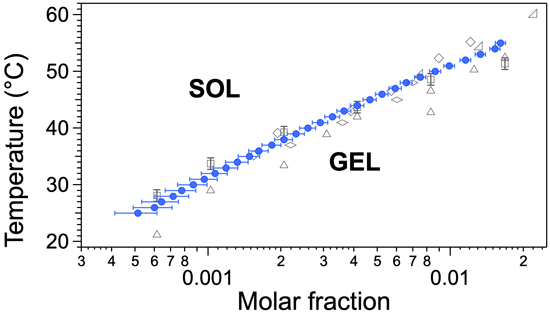
The authors observed that the measured intensities increased with increase in temperature until melting. Moreover, they noted that with the correct normalization, the intensities yielded the solubility as a function of temperature, which was seen to be adequate for mapping the phase diagrams. Furthermore, they proved their technique experimentally by superimposing the resulting phase diagrams with those mapped out by other techniques.
In summary, the study by University of Strasbourg scientists proved that visible signal corresponds to the soluble fraction of the gelator. Their work made it possible to draw the gel-to-sol boundary with a single sample and avoid the measurements of Tm on many samples, as required by other techniques.Their work further showed that their technique only depended on the signal/noise ratio of the nuclear magnetic resonance peaks, which in turn depended upon the accumulation time at each temperature. Altogether, they showed that the nuclear magnetic resonance intensities of a single sample related simply to the sol-gel boundary of its phase diagrams thereby making the acquisition of phase diagram of organogels quite easy.



Reference
Elliot Christ,Dominique Collin,Jean-Philippe Lamps Philippe J. Mésini. Variable temperature NMR of organogelators the intensities of a single sample describe the full phase diagram. Physical Chemistry Chemical Physics, 2018, volume 20, page 9644.
Go To Physical Chemistry Chemical Physics