 Advances in Engineering Advances in Engineering features breaking research judged by Advances in Engineering advisory team to be of key importance in the Engineering field. Papers are selected from over 10,000 published each week from most peer reviewed journals.

Significance
The increased effort being made in the development of Electric vehicles and the use of batteries in consumer electrics has led to an increase in demand for Lithium-ion batteries (LIBs). The reason why LIBs are the preferred type is because they have excellent electrochemical properties. Furthermore as the world moves from dependence on fossil fuels to batteries the use of LIBs will substantially increase. LiNi1/3Co1/3Mn1/3O2 which is an inexpensive cathode material is commonly used in making commercial LIBs due to its electrochemical and thermal capabilities.
As most materials, LIBs have limited cycle lifespan after which it can pose a problem because of its toxic metal contents and corrosive electrolytes. It can also be a source of large quantities of valuable metals. Ni, Co and Mn are the valuable metals which make up LIBs. Several processes and technologies developed for extracting and completely separating these metals have proven difficult. This has led researchers to focus on direct synthesis of LiNi1/3Co1/3Mn1/3O2 cathode material from spent LIBs. Of the two options available for the extraction, the method using Na2CO3 has proven to be better and less expensive.
Researchers led by Professor Jian-Guo Yu at East China University of Science and Technology came up with a new recycling process based on Na2CO3 co-precipitation method. This method was developed to be used to resynthesize LiNi1/3Co1/3Mn1/3O2 cathode material from spent LIBs. The process involved using of leachate which was obtained from spent LIBs as the feed solution for the production of a LiNi1/3Co1/3Mn1/3O2 precursor with uniformly spherical articles, which was then used to resynthesize the LiNi1/3Co1/3Mn1/3O2 cathode material. Their finding is published in the peer reviewed journal Ceramics International.
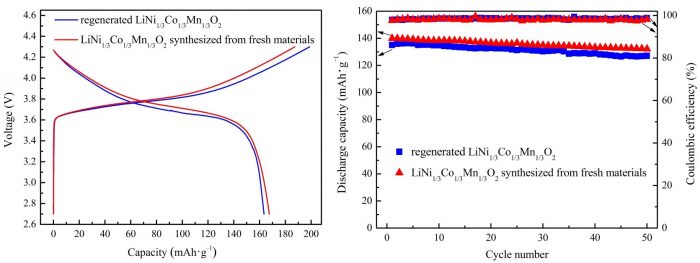
Using the Na2CO3 co-precipitation method the recovery efficiencies of Ni, Co and Mn were very high, with close to 100% efficiency. The results they obtained indicate that the structure of the regenerated LiNi1/3Co1/3Mn1/3O2 is in agreement with that of LiNi1/3Co1/3Mn1/3O2 synthesized from fresh materials by carbonate co-precipitation. Also these results indicate that the electrochemical performance of the regenerated LiNi1/3Co1/3Mn1/3O2 is comparable to that of LiNi1/3Co1/3Mn1/3O2 synthesized from fresh materials by carbonate co-precipitation. They also observed redox peaks are sharp and the voltage differences between the oxidation and reduction peaks are small, indicating that the regenerated LiNi1/3Co1/3Mn1/3O2 exhibits good electrochemical reversibility.
Professor Jian-Guo Yu and his colleagues: Dr. Li-Po He and Dr. Shu-Ying Sun have been able to show a simple, effective and inexpensive way to extract Ni, Co and Mn from spent LIBs. This will enhance the afterlife value of LIBs as a more efficient way of extracting the metals it contains has been found. The implication of this is that although spent LIBs has toxic properties they are now more valuable as the valuable metals which they contain can now be extracted in an inexpensive and effective way. Hence LIBs are not only useful during their active use but also useful after the spent lifecycle.


Reference
Li-Po He, Shu-Ying Sun, Jian-Guo Yu. Performance of LiNi1/3 Co 1/3 Mn 1/3 O2 prepared from spent lithium-ion batteries by a carbonate co-precipitation method. Ceramics International, Volume 44, Issue 1, January 2018, Pages 351-357
