Advances in Engineering Advances in Engineering features breaking research judged by Advances in Engineering advisory team to be of key importance in the Engineering field. Papers are selected from over 10,000 published each week from most peer reviewed journals.

Significance Statement
Organic-inorganic perovskite solar cells have shown dramatic developmental progress in recent years. Perovskite solar cells are easy to process and have high power conversion efficiency as well as the potential for low manufacturing cost. Perovskite solar cells could become a viable alternative to crystalline silicon photovoltaics. While the latter technology has been commercialized for large production, the deployment of perovskite solar cells has been limited by performance degradation.
Instabilities in devices as well as materials, particularly due to reactions with water, limit the lifespan of perovskite solar cells. A 25-30-year lifespan may be required for perovskite solar cells to effectively compete with other photovoltaics currently in the marketplace.
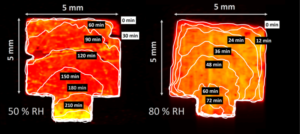
Researchers led by Professor Michael Heben from the University of Toledo in collaboration with Professor Michael Gräetzel at Ecole Polytechnique Fédérale de Lausanne and Professor Ullrich Steiner at Adolphe Merkle Institute in Switzerland performed in-situ laser beam induced current mapping on perovskite solar cells in a moist environment. The work was done to analyze and understand the degradation modes for the cells in humid air. Their effort was the first to spatially- and time-resolve perovskite degradation by laser beam induced current analysis. Their work is published in the journal Advanced Energy Materials.
The authors conducted the experiment in four stages where they observed interesting aspects as the degradation proceeded. By analyzing the findings thoroughly, they were able to understand the processes at every stage of development. At the initial stage, the external quantum efficiency map was not smooth over the entire sample area. Despite taking great care during the process, the authors recorded a large variation in the external quantum efficiency from about 60%-80% in regions they thought would defect free. Therefore, they proposed that there was still great potential of improving the functionality of the perovskite solar cells by enhancing the uniformity of the current collection.
The authors discovered a peak in quantum efficiency that appeared 5-10 minutes after the films were exposed to moisture. This was explained by passivation of recombination centers by water molecules at the interface between the perovskite and spiro-OMeTAD layers in the device. Water led to the improvement of the morphology and crystallinity of the films during the course of deposition, and led to improved device performance.
This study successfully investigated the evolution of the external quantum efficiency during the exposure of solar cells to water vapor. The outcomes of the tests proceeded through two stages that were controlled by water-induced carrier extraction and transport changes in the spiro-OMeTAD layer. During two other stages, there were changes in the perovskite material itself. The authors proposed phase equilibria within the PbI2-CH3NH3I-H2O system, consistent with their previous work (Song et al., Chemistry of Materials, 2015, 27, 4612), in order to understand the water-induced degradation and recommend a dehydration process prior to encapsulation to enhance device stability.








Reference
Zhaoning Song, Antonio Abate, Suneth C. Watthage, Geethika K. Liyanage, Adam B. Phillips, Ullrich Steiner, Michael Graetzel, and Michael J. Heben. Perovskite Solar Cell Stability in Humid Air: Partially Reversible Phase Transitions in the PbI2-CH3NH3I-H2O System. Advanced Energy Materials 2016, 6, 1600846.
Go To Advanced Energy Materials