 Advances in Engineering Advances in Engineering features breaking research judged by Advances in Engineering advisory team to be of key importance in the Engineering field. Papers are selected from over 10,000 published each week from most peer reviewed journals.

Significance
Most recently, fluidized beds have found applications in pharmaceutical industry, mainly for particles coating and granulation. Such applications involve the use of complex gas flow processes. Therefore, it is highly desirable to have a real time monitoring and control system so as to enable a bubbling stable fluidization and reduce the chance of defluidization due to agglomeration with high moisture contents particles. Recent technological advances have led to the development of the microwave tomography (MWT) technology which has been explicitly employed in medical sectors. This novel technology has a wide range of frequency and can be utilized in measuring materials with high permittivity and conductivity. This makes it a suitable candidate for monitoring fluidized bed coating and granulation processes. Unfortunately, little has been done about microwave tomography applicability in fluidized bed coating and granulation processes despite such promising attributes.
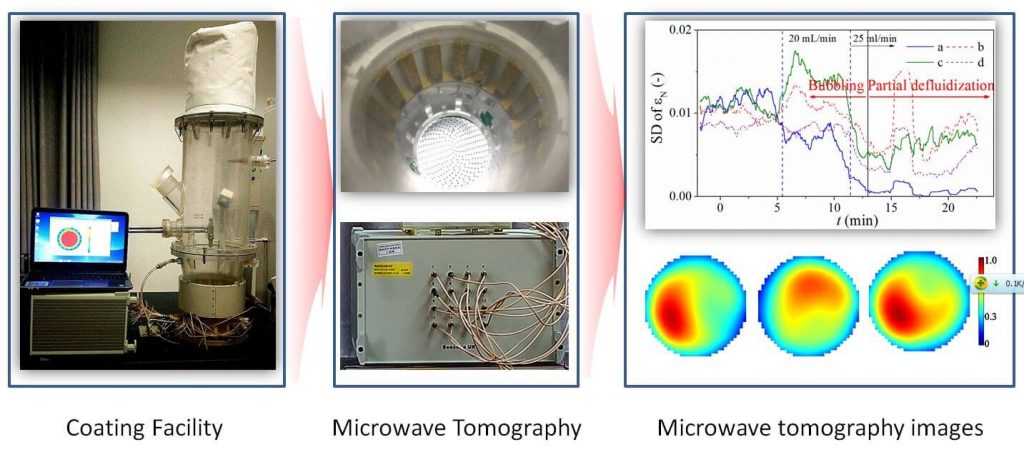
Recently, a team of researchers from the Institute of Engineering Thermophysics at Chinese Academy of Sciences leading by Professor Haigang Wang in collaboration with Professor Wuqiang Yang Prof. Zhipeng Wu at University of Manchester in the UK investigated the wet gas-solids flow characteristics in a fluidized bed with top-spray and bottom-spray systems based on the microwave tomography technology. They successfully employed the microwave tomography technology for the first time in a real dynamics gas-solids fluidized bed. Their work is currently published in the research journal, Chemical Engineering Science.
The research method employed entailed the design and application of a MWT system with 16 antennas in monitoring the wetting and coating processes in a lab-scale fluidized bed with top-spray and bottom-spray system. Next, the gas-solids flow characteristics of different types of fluidized bed, pellet and spraying liquid were analyzed and compared. Lastly, the standard deviation of normalized permittivity and the dominating frequency and the standard deviation of pressure signal were used and compared for the detection of defluidization of the bed.
The research team observed that for the top spray fluidized bed process, the changes in the flow regimes due to the variation in solids moisture and air velocity could be recorded and recognized by the MWT measurements. In addition, they noted that for cellulose pellets, the MWT measurement was applicable with the solids moisture even increased to 35%, and the measured normalized permittivity value followed the same trend with the solids moisture. Eventually, when the technology was employed in monitoring of wetting and coating experiments with bottom spray fluidized bed, it was revealed that both the types of pellets and spraying solutions could affect the flow regimes in fluidized bed.
In summary, the study presented for the first time, the successful application of MWT sensor to monitor the dynamic processes of two types of fluidized bed, and utilization of the dynamic calibration strategy for image reconstruction. Collectively, the result obtained show that MWT is available for online monitoring of gas solids flow with different moisture content. Altogether, their work is an excellent example that microwave tomography has clear advantages over single point based measurement technology for process fault diagnose.





Reference
H.Q. Che, H.G. Wang*, J.M. Ye, W.Q. Yang, Z.P. Wu. Application of microwave tomography to investigation the wet gas solids flow hydrodynamic characteristics in a fluidized bed. Chemical Engineering Science 180 (2018) 20–32.
Go To Chemical Engineering Science