Advances in Engineering Advances in Engineering features breaking research judged by Advances in Engineering advisory team to be of key importance in the Engineering field. Papers are selected from over 10,000 published each week from most peer reviewed journals.

Significance
Conjugated polyelectrolytes, or CPEs, are a class of materials that combine two very different but complementary features: a delocalized π-electron backbone, which gives them semiconducting and optical properties, and ionic side chains that make them soluble in polar solvents like water or alcohols. This unusual combination allows them to bridge the worlds of electronics and biology, which is why they’ve attracted so much attention for applications ranging from chemical sensing to light-based medical therapies and even in devices like organic LEDs. Within this broader category, polymers based on the poly(phenylene ethynylene) backbone (PPEs) have been particularly well studied. Their rigid, linear structure and relatively straightforward synthesis make them good candidates for exploring the relationships between molecular design and macroscopic properties. PPEs are also known for their strong fluorescence and predictable behavior in organic solvents. But when you take them out of that controlled environment and try to use them in water—which is essential for any biological or medical application—their behavior becomes a lot harder to manage. The biggest issue is aggregation. Because the PPE backbone is hydrophobic, and the side chains are hydrophilic and charged, these polymers tend to self-assemble in water into clusters or aggregates. This aggregation changes their optical properties dramatically. Fluorescence is often quenched, the emission spectra broaden, and the excited states decay through unwanted pathways. All of this limits how useful they are in environments where signal strength and clarity matter—like in a biosensor or a therapeutic context where light is used to activate a response. To address these limitations, researchers have traditionally relied on side chains bearing ammonium or imidazolium groups to improve water solubility. These groups help, but they’re not perfect—some degrade over time, others aren’t ideal for interacting with biological targets, and many don’t offer much flexibility when it comes to fine-tuning polymer behavior.
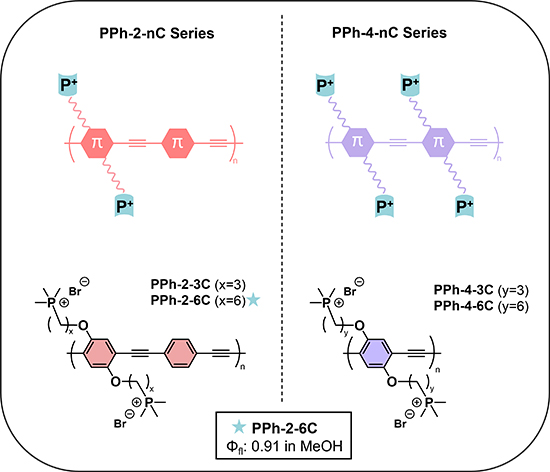
To this account, a new research paper published in Macromolecules Journal and conducted by Dr. Isai Barboza-Ramos, Habtom Gobeze, Daniel Wherritt, and led by Professor Kirk Schanze from the Department of Chemistry at University of Texas, San Antonio, investigated a different ionic functionality: phosphonium groups. These positively charged units are more chemically stable than many traditional choices and can be synthetically tuned by adjusting their substituents and linker lengths. More importantly, phosphonium-functionalized PPEs haven’t been studied nearly as extensively, so there’s real opportunity to uncover new structure–function relationships. To test this, they designed and synthesized four PPE-based polymers, carefully controlling the number of phosphonium groups per repeat unit—either two or four—and varying the alkyl linker length between three and six carbons. These were prepared through a Sonogashira-type AA/BB step-growth polymerization. The AA monomers carried the phosphonium functionalities, while the BB components bore ethynyl groups. Most of the reactions proceeded in a DMF/water solvent system, but one of the polymers, PPh-4-3C, began precipitating out early. That threw a wrench into the process and prompted a switch to an acetonitrile/water mixture, which turned out to be a smart move—it kept the polymer in solution and ultimately yielded a higher molecular weight product. This early hiccup underscored how sensitive these systems can be to reaction conditions.
The researchers used diffusion-ordered NMR spectroscopy (DOSY-NMR) as an alternative to measure the molecular weights of the ionic polymers because conventional gel permeation chromatography wasn’t suitable. By comparing their polymers to a set of PEG standards in methanol, they were able to establish a calibration curve and estimate diffusion-based molecular weights, which came in between about 6.6 and 30.2 kDa. While this method has its limitations, especially for semi-rigid chains like PPEs, the results were in reasonable agreement with previously reported systems and gave a good enough benchmark for what came next. Afterward, the researchers began to probe their photophysical properties. They recorded fluorescence and absorption spectra in both water and methanol and found in methanol, all four CPEs showed strong fluorescence with sharp emission bands while in water emission intensity dropped off sharply and the spectra broadened, pointing to aggregation-induced quenching. This is a known issue for CPEs, where hydrophobic backbones tend to clump in aqueous environments and disrupted exciton transport and introduced non-emissive trap states. Fluorescence lifetime measurements backed this up and the authors found that in methanol, lifetimes extended up to 700 picoseconds, while in water they dropped as low as 106 ps. To get a closer look at what was happening on ultrafast timescales, the team used femtosecond transient absorption spectroscopy. Upon excitation at 405 nm, they observed immediate formation of singlet excitons, seen as stimulated emission and broad excited-state absorption features. In methanol, these signals decayed smoothly over hundreds of picoseconds, but in water, the decay was much more abrupt—most of the signal vanished in under 60 ps. This kind of rapid quenching is consistent with strong aggregation, which creates efficient nonradiative pathways. Interestingly, the exact behavior differed between the four polymers. Those with fewer phosphonium groups or longer linkers tended to quench more aggressively, likely because the reduced charge density and increased flexibility made them more prone to forming aggregates.
The research team didn’t stop at the singlet state and followed up with nanosecond-to-microsecond transient absorption experiments to track longer-lived species. These revealed that the singlet excitons relaxed into triplet states that persisted on the order of tens of microseconds—an encouraging result given the importance of triplets in generating reactive oxygen species. They confirmed singlet oxygen production by detecting phosphorescence at 1272 nm in oxygen-saturated methanol, a signature that’s hard to misinterpret. The rate of singlet oxygen generation wasn’t uniform across the polymers, though. Interestingly, the variants with shorter linker chains oxidized an anthracene-based ROS probe more quickly, which the team attributed to a shorter diffusion path between the triplet-generating backbone and the probe. As a final layer of functionality, the group looked at how the polymers responded to pyrophosphate (PPi) which is a biologically relevant anion and observed strong fluorescence quenching when PPi was introduced to methanol solutions of the CPEs. But rather than showing a straightforward linear decrease as predicted by a typical Stern–Volmer relationship, the quenching response was sigmoidal which indicate that PPi was facilitating polymer aggregation, acting like a molecular crosslinker by binding to multiple phosphonium sites and pulling chains together. The quenching occurred extremely fast—within 20 picoseconds, based on time-resolved fluorescence measurements—implying a static mechanism rather than a dynamic one. Femtosecond transient absorption data reinforced this, showing a drop in amplitude that occurred too quickly to be resolved by the instrument’s time window. Polymers with shorter linkers showed more pronounced quenching, again likely due to their ability to pack more tightly upon PPi binding.
In conclusion, the work by Dr. Isai Barboza-Ramos and colleagues is an important advancement in the design of conjugated polyelectrolytes. By introducing phosphonium pendant groups to the PPE framework and systematically varying their number and linker length, they showed how fine molecular adjustments can have outsized effects on a polymer’s behavior espcially in terms of how it aggregates in solution, how efficiently it fluoresces, and how its excited states evolve. We think one of the most exciting implications, though, goes beyond sensing. These polymers turned out to be also effective photosensitizers and capable of generating singlet oxygen when exposed to light. Given their water solubility and stability, that makes them strong candidates for photodynamic antimicrobial therapy. The fact that the level of reactive oxygen species can be tuned through structural design only strengthens the case for their potential use in controlled, targeted treatments.



Reference
Barboza Ramos, Isai & Gobeze, Habtom & Wherrit, Daniel & Schanze, Kirk. (2024). Water-Soluble Poly(phenylene ethynylene)s that Contain Phosphonium Pendant Groups. Macromolecules 2024, 57, 7575−7585. 10.26434/chemrxiv-2024-4x2d0.