Advances in Engineering Advances in Engineering features breaking research judged by Advances in Engineering advisory team to be of key importance in the Engineering field. Papers are selected from over 10,000 published each week from most peer reviewed journals.

Significance
Membrane fouling is one of those stubborn problems that keeps making water filtration less efficient, shortens membrane lifespan, and drives up costs. It happens when unwanted particles—such as proteins, bacteria, and organic materials—stick to the membrane’s surface, clogging it up and making it less effective. This is a big deal in areas like desalination, water and wastewater treatment, and even medical applications, where clean water and reliable filtration are critical. For a long time, poly(ethylene glycol) (PEG) has been the go-to material for antifouling coatings. It is hydrophilic and bio-inert, which helps prevent contaminants from sticking. But PEG has some serious downsides. It tends to break down over time due to oxidation, meaning its effectiveness does not last as long as needed. On top of that, getting PEG to attach securely to membrane surfaces is not easy—it often requires complicated chemical processes that make large-scale application impractical. That is why researchers have been on the lookout for a better, more durable alternative. This is where poly(2-oxazoline)s (POX) come in. POX is gaining attention because it offers all the benefits of PEG—strong water compatibility and resistance to biological contamination—but with much greater stability under harsh conditions. Unlike PEG, POX does not degrade as quickly when exposed to oxidative environments, which makes it ideal for long-term use in filtration membranes. However, POX has not been widely adopted in membrane technology yet and most of the existing research has been focused on self-assembling POX systems or polymer brushes, both of which involve complex synthesis processes that limit their practicality.
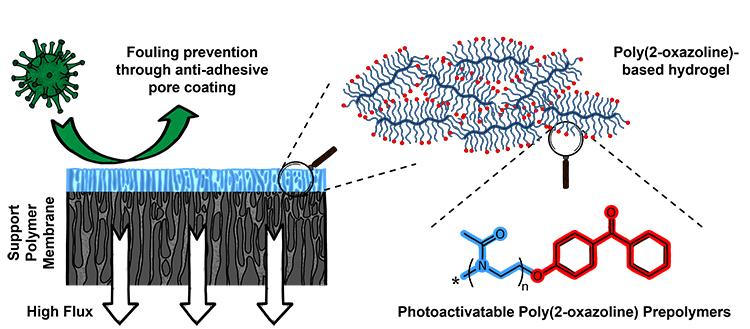
To this account, Dr. Peter Ohlemüller and Dr. Rupert Konradi from BASF SE in Germany came up with a game-changing approach. Their latest study, published in the European Polymer Journal, introduced a novel way to create antifouling POX-based hydrogels. They developed special photoactivatable POX macromonomers, which can form tough, highly effective hydrogel coatings using a method called CH-insertion cross-linking (CHic). What makes this method so exciting is that it removes the need for complicated chemical modifications of individual membranes. Instead, it allows POX to be directly coated and cross-linked onto membrane surfaces in a simple, scalable way.
The researchers took a creative approach to making poly(2-methyl-2-oxazoline) with defined functions at either end. Their goal? To create photoactivatable POX macromonomers. They kicked off the cationic ring-opening polymerization (CROP) with 4-vinylbenzyl chloride as an initiator and then stopped the polymerization process with hydroxybenzophenolate. This step gave the macromonomers a photoactivatable terminal group, meaning they could later be cross-linked with UV light. With this setup, the team was able to produce PMOXA macromonomers, which they then copolymerized with hydroxyl-functional PMOXA macromonomers. This process resulted in bottle brush prepolymers—branched polymer structures known for their excellent antifouling properties. The authors wanted to test how well the materials would work and so they applied the prepolymers as coatings to poly(ether sulfone) ultrafiltration membranes and then used UV light to trigger CH-insertion cross-linking (CHic) to form hydrogels and simultaneously attach them to the membrane surfaces. Next, they put the coated membranes through a series of tests to see how well they performed. They checked things like permeability, cross-link density, and how effectively the coatings prevented fouling. One key test measured pure water permeance (PWP), which determines how easily water flows through the membrane. The results showed that the POX hydrogel coatings maintained PWPs of around 100 kg⋅m-2⋅h-1⋅bar-1. To take things a step further, Dr. Peter Ohlemüller and Dr. Rupert Konradi wanted to see how well the coatings could resist bacterial buildup. They tested their materials against Staphylococcus aureus, a common bacteria known for causing fouling issues. The results were impressive: the coated membranes had far less bacterial adhesion compared to the uncoated ones. Interestingly, both bottle brush and star-shaped PMOXA hydrogels performed equally well, suggesting that the antifouling properties were built into the polymer itself, rather than depending on the specific structure. The researchers also took a deep dive into how different levels of cross-linking influenced the hydrogels. When they increased cross-linking, the coatings took up less water (lower swelling), which kept the coated membrane pores open wider allowing water to flow more freely. On the other hand, reducing the cross-link density increased swelling of the hydrogel coatings, which made the membrane less permeable to water. Their results show that these coatings can be fine-tuned to get the best of both worlds—strong antifouling properties without sacrificing filtration efficiency.
In conclusion, the research work of Dr. Peter Ohlemüller and Dr. Rupert Konradi demonstrated that POX-based coatings can be applied in a straightforward way using a UV-curing process. This novel method eliminates the need for complicated chemical grafting or difficult surface modifications. Thanks to the CHic cross-linking strategy, the coatings stick firmly to membrane surfaces which make them durable and long-lasting.
According to the authors, the new research could have a major impact on industries that rely on ultrafiltration. Water treatment facilities, medical device manufacturers, and bioprocessing companies could all benefit from these antifouling hydrogels. By preventing fouling, POX coatings can extend the life of filtration systems, cut down on maintenance costs, and improve water quality. Moreover, these coatings could be used for medical implants, diagnostic devices, biosensors, and cell culture materials and by this prevent contamination and boost biocompatibility.
For this type of polymerization normally all reagents are excessively purified, especially dried (elimination of traces of water). Reason for this?: Water can terminate the reaction to form hydroxyl-functional polymers. This is more and more important the longer the polymer chain should be as less and less terminator is used and water as a competing termination reagent becomes increasingly problematic. The authors only used 10-20 monomer units (degree of polymerization of 10-20). This is low enough that these tedious purification procedures can be avoided. They simply added molecular sieves to monomer and solvent which takes up most of the water and were able to neglect the rest. Then comes the trick: they polymerized these macromonomers in a second free radical polymerization to form these photoactivatable bottle brush prepolymers. By combining the two polymerization techniques they could increase the overall oxazoline monomer degree of polymerization in one prepolymer macromolecule to something on the order of 300 (we found the degree of polymerization of the second free radical polymerization of the macromonomers to be approx. 30; each macromonomer has 10 oxazoline units; see schematic drawing in the article). Best thing: Even if there was some hydroxyl termination of the macromonomers it doesn’t really matter since they anyways copolymerized with hydroxyl-functional macromonomers.
Beyond that, this research presents a practical and scalable approach for industrial use. The CHic process makes it possible to coat large areas using simple techniques like dip-coating, spin-coating, or spray application, followed by UV curing. This guarantees an even, reliable coating across various membrane types Moving forward, further research could focus on testing the long-term stability of these coatings, particularly their resistance to wear, oxidative damage, and fouling under various application conditions. Scientists could also explore ways to make these POX hydrogels even smarter—perhaps designing coatings that respond to pH changes or temperature shifts, making them useful in specialized filtration and biomedical applications.


Reference
Peter Ohlemüller, Rupert Konradi, Photoactivatable poly(2-oxazoline)s enable antifouling hydrogel membrane coatings, European Polymer Journal, Volume 213, 2024, 113097,