Advances in Engineering Advances in Engineering features breaking research judged by Advances in Engineering advisory team to be of key importance in the Engineering field. Papers are selected from over 10,000 published each week from most peer reviewed journals.

Significance
Conversion of solar energy into chemical energy through catalysts that mimic, and ideally surpass, the efficiency of natural systems is central to sustainable and decentralized chemical production. While photosynthesis in plants successfully channels light energy to drive water oxidation, its molecular machinery is exquisitely complex and evolutionarily optimized to avoid harmful byproducts like hydrogen peroxide. In contrast, engineered systems need not follow the same biological rules, opening space for more kinetically favorable and industrially useful alternatives. One such alternative is the direct photocatalytic oxidation of water into hydrogen peroxide (H₂O₂), a two-electron process that bypasses the energetically demanding four-electron oxidation to molecular oxygen. Despite its relative simplicity, this pathway remains underutilized due to several unresolved challenges. First, achieving selectivity for H₂O₂ over O₂ is nontrivial, as most semiconductor catalysts—especially titanium dioxide (TiO₂)—tend to favor complete water splitting or rapid H₂O₂ decomposition. Second, charge separation and transport within these photocatalysts is often inefficient, leading to recombination losses and low quantum yields. Finally, many existing materials either rely on scarce metals or require sacrificial agents that limit practical scalability.
New research paper published in Nanoscale Advances and conducted by Dr. Nurul Muttakin, Shelton Varapragasam, Rashed Mia, Mahfuz Swadhen, Michael Odlyzko, and led by Professor James Hoefelmeyer from the University of South Dakota. Investigated a fundamentally different catalyst architecture. Rather than modifying TiO₂ in isolation or introducing costly noble metals, they engineered a type-II heterojunction between TiO₂ and nickel oxide (NiO), two abundant and well-characterized metal oxides. This heterostructure is designed not only to facilitate efficient exciton separation but also to decouple oxidation and reduction processes spatially—channeling holes to NiO for water oxidation while directing electrons to TiO₂. By immobilizing these heteronanocrystals on inert silica supports and removing organic ligands, the researchers ensured that active sites remained exposed and stable during light-driven catalysis in aqueous media. What sets their study apart is the shift in design philosophy. Rather than pursuing maximal hydrogen evolution or full oxygen generation, their focus lies in selectively and efficiently generating H₂O₂ from water alone—without relying on oxygen reduction pathways. This conceptual pivot reflects a broader trend in photocatalysis: valuing the utility of partial oxidation products over traditional stoichiometric benchmarks. In doing so, the team sought to demonstrate that with the right nanoscale engineering, it is possible to turn water and light into a valuable chemical intermediate, offering a cleaner route to hydrogen peroxide that circumvents the limitations of conventional production methods.
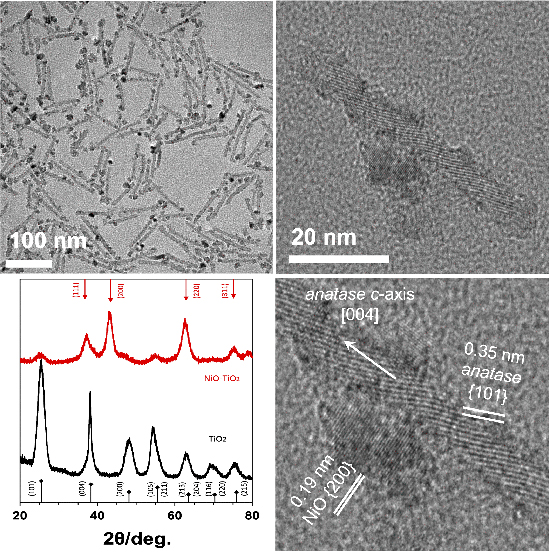
The research team began by synthesizing rod-shaped anatase TiO₂ nanocrystals via a non-hydrolytic sol–gel reaction, deliberately adopting anisotropic growth to promote directional charge transport. These nanorods, measuring around 45 nm in length and 3 nm in diameter, were then used as templates for the in-situ formation of NiO domains. Through the thermal decomposition of nickel nitrate in a coordinating solvent mixture, the team succeeded in creating NiO–TiO₂ heteronanocrystals where cubic NiO particles were intimately anchored onto the TiO₂ surface. This architectural arrangement—carefully confirmed via high-resolution TEM and PXRD—was not merely structural window dressing. It enabled a type-II band alignment, crucial for spatially separating photoexcited charge carriers. The holes were directed toward NiO, while electrons remained on the TiO₂ component. Supporting this configuration, HAADF-STEM imaging and elemental mapping clearly revealed distinct Ni-rich regions dispersed along the Ti-rich nanorods, providing visual proof of the heterointerface’s integrity. These characterizations were more than academic; they validated the premise that strategic material assembly could engineer directional electron flow under light activation. Moving beyond structural analysis, the team immobilized the heteronanocrystals on fumed silica to increase surface area and eliminate ligand interference. These supported catalysts were exposed to a Xe arc lamp in argon-purged water. What followed was notable: trace hydrogen gas was detected, but more importantly, the solution accumulated hydrogen peroxide over time—reaching a steady-state concentration of 52 µM. When silver nitrate was introduced as an electron scavenger, the reaction accelerated dramatically. Silver ions accepted photogenerated electrons, suppressing H₂O₂ back-reduction and driving up both the initial formation rate (to 9.1 μmol g⁻¹ min⁻¹) and the steady-state peroxide concentration (to 174 µM). The authors’ findings were rigorously validated using two independent colorimetric assays. Both the Pierce™ peroxide kit and the Ghormley triiodide method confirmed that the observed photoproduct was indeed hydrogen peroxide. Interestingly, control samples containing only TiO₂ or NiO lacked similar activity, reinforcing the notion that it was the engineered junction—rather than either component alone—that enabled the selective, efficient transformation.
In conclusion, the true significance of the new work by Professor James Hoefelmeyer and colleagues, the authors developed a novel photocatalytic material composed of silica-supported NiO–TiO₂ heteronanocrystals capable of efficiently converting water into hydrogen peroxide (H₂O₂) under light irradiation. By integrating p-type nickel oxide (NiO) with n-type anatase titanium dioxide (TiO₂) nanorods into a type-II heterojunction structure, they engineered a catalyst that promotes effective charge separation, minimizes recombination losses, and selectively facilitates two-electron water oxidation to H₂O₂—rather than the typical four-electron pathway to O₂. To enhance catalytic accessibility and surface reactivity, the heteronanocrystals were immobilized on high-surface-area fumed silica and thermally treated to remove passivating organic ligands. This final supported catalyst (SiO₂/NiO–TiO₂) demonstrated rapid and selective H₂O₂ production in aqueous solution under Xe lamp illumination, with significantly improved performance upon addition of silver nitrate as an electron scavenger.
By demonstrating that hydrogen peroxide can be selectively and efficiently generated from water alone, using only light and earth-abundant materials, this study opens the door to reimagining solar-driven chemistry. The synthesis of NiO–TiO₂ heteronanocrystals enabled a precise charge separation that minimized electron-hole recombination—a longstanding issue in TiO₂-based systems. More importantly, it identified NiO as a favorable site for catalyzing water oxidation without pushing the system toward full O₂ evolution, which often results in low efficiency or oxidative degradation of the catalyst itself. The implications extend well beyond academic interest. Hydrogen peroxide is a key oxidant with wide-ranging applications in disinfection, environmental remediation, and chemical synthesis. Current industrial production, however, is centralized, energy-intensive, and often reliant on hazardous organic intermediates. A decentralized, light-driven method for producing H₂O₂ directly from water could transform this supply chain, enabling safer and more sustainable access, especially in remote or resource-limited settings. Equally compelling is the mechanistic insight this study offers. By isolating a system where H₂O₂ formation dominates over both O₂ evolution and H₂ production, it challenges long-held assumptions about what photocatalytic water oxidation must accomplish. It reorients the field to consider not just how to split water, but why—and for which products. In doing so, the authors have laid the groundwork for new classes of photocatalysts that are not only efficient but purposeful in what they create.

Reference
Nurul Muttakin, Shelton J. P. Varapragasam, Rashed Mia, Mahfuz A. Swadhen, Michael Odlyzko, James D. Hoefelmeyer, Light driven water oxidation on silica supported NiO–TiO2 heteronanocrystals yields hydrogen peroxide. DOI: https://doi.org/10.1039/d4na00906a, Nanoscale Advances, Volume 7, Issue 7, 2025, Pages 1914-1922,