Advances in Engineering Advances in Engineering features breaking research judged by Advances in Engineering advisory team to be of key importance in the Engineering field. Papers are selected from over 10,000 published each week from most peer reviewed journals.

Significance
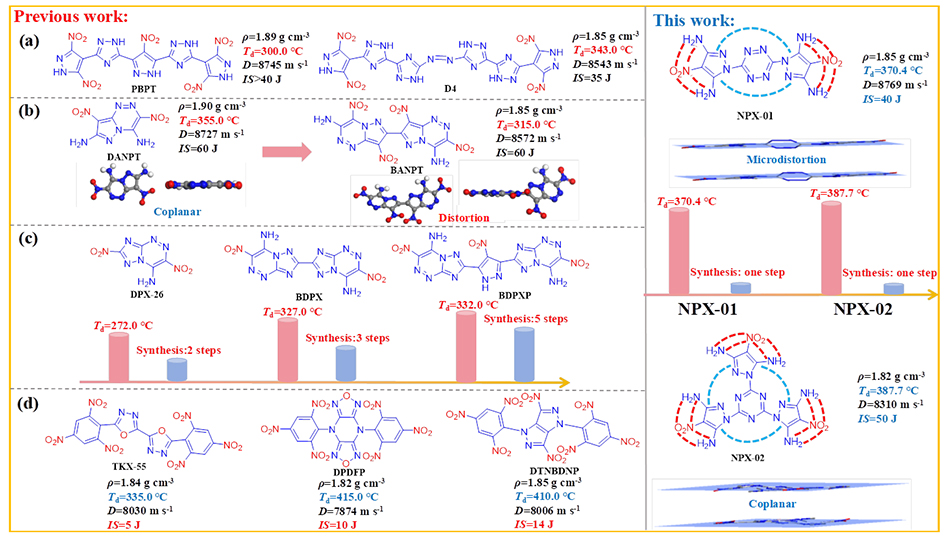
Finding materials that can handle extreme heat while still being safe and reliable has become a hot topic in areas like aerospace, hypersonic weapons, and deep oil drilling. Think about it: these technologies work in incredibly harsh environments, so they need materials that won’t break down under pressure—literally. Even though researchers have been tackling this for decades, the problem is far from solved. The hunt for new and better solutions is still on. One of the biggest headaches is figuring out how to strike the right balance. You want something that’s super stable in high heat, delivers a strong energetic punch, and is also safe to use. Materials like TATB and PYX have been the go-to options because they hold up reasonably well with decomposition temperatures around 360 °C. But they’re not perfect. They don’t pack enough energy for some modern needs, and they can be pretty tricky to make. The multi-step processes involved take time and money, making them less appealing for large-scale production. Safety is another major sticking point. Many traditional energetic materials are incredibly sensitive to things like impact or friction. That makes them risky to handle, store, or transport, especially when they’re used in critical applications like defense. This has pushed researchers to prioritize creating materials that are both powerful and less likely to go off accidentally. And then there’s the challenge of molecular design. Efforts to boost thermal stability often focus on using highly conjugated or fused-ring structures. While this can help, it also has downsides. These designs can make the molecules less stable overall or even reduce their detonation performance because of structural distortions. It’s a bit of a Catch-22, and scientists have been trying to find ways to improve one property without messing up another.
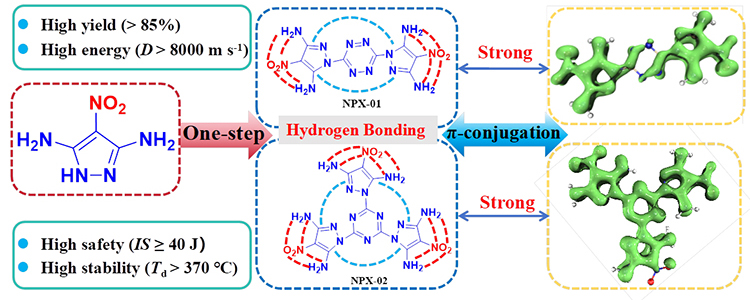
That’s where this new research comes in new research paper in Journal of Materials Chemistry A and conducted by PhD student Xiue Jiang, Dangyue Yin, Siwei Song, Professor Yi Wang, Mingren Fan, Ruihui Wang and Professor Qinghua Zhang from the School of Astronautics at Northwestern Polytechnical University explored a creative approach to developing materials that can withstand ultra-high temperatures. They focused on combining hydrogen bonding and extended π-conjugation in the molecular structure. The authors used hydrogen bonds to make the molecules more stable and π-conjugation to boost their energetic output with the ultimate goal was to create materials that aren’t just heat-resistant and efficient but are also safe and easy to produce at scale. To make these materials, NPX-01 and NPX-02, the authors used a simple, one-step process in a solvent called DMF. They combined a compound known as 3,5-diamino-4-nitropyrazole with other carefully chosen ingredients and heated the mixture. The results were impressive—high yields of 86–91%, which is pretty rare for this kind of chemistry. Even better, they didn’t need to spend hours on complex purification steps. This means the process could easily be scaled up for large-scale production, making it practical for real-world applications. After creating the materials, they took a close look at their structures using advanced imaging techniques. This part of the study revealed just how unique these compounds are. NPX-01 had a layered structure with neat rectangular spaces filled with perchlorates, while NPX-02 formed a wave-like pattern that also included water molecules. These intricate arrangements weren’t just for show—they played a huge role in making the materials stable and durable. The hydrogen bonds acted like strong glue, holding everything together even under stressful conditions. Then came the big test: how well these materials could handle heat. Using a technique called DSC, the researchers measured the temperatures at which the compounds started to break down. NPX-01 could withstand up to 370.4 °C, while NPX-02 held out until 387.7 °C. To put that into perspective, widely used materials like TATB and PYX break down at 360 °C. So, these new compounds didn’t just perform well—they outperformed the industry standards. They also analyzed how much energy it takes to trigger decomposition, and NPX-02 came out on top again, showing even greater stability. But the authors didn’t stop at thermal testing. They also wanted to see how powerful these materials were as explosives. Using computer models, they calculated the speed and force of detonation. NPX-01 had a detonation velocity of 8769 m s-1 and a detonation pressure of 29.5 GPa, while NPX-02 hit 8310 m s-1 and 25.7 GPa. These numbers are seriously impressive and even beat out PYX, a go-to material in this field. The secret lies in how the molecules are packed together and how their electrons move, creating a perfect balance of power and stability. Of course, safety is just as important as performance, especially with energetic materials. The team tested how these compounds reacted to things like impact and friction—situations that could cause dangerous accidents. Both NPX-01 and NPX-02 passed with flying colors. They could handle impact forces over 40 J and friction forces greater than 360 N, making them much safer than many traditional options. Using advanced analysis, the researchers found that these materials avoided problematic interactions, like oxygen-oxygen contacts, which often lead to instability in other compounds.
This study by Northwestern Polytechnical University scientists is a game-changer for creating heat-resistant energetic materials, offering practical solutions to some of the biggest challenges faced in aerospace, defense, and heavy industry. By combining two clever strategies—using hydrogen bonding to stabilize molecules and extending π-conjugation to boost thermal resistance and energy output—the researchers have completely reshaped how we approach this type of material design. What’s even better is that their method is refreshingly straightforward. We think one of the standout achievements of this research is the improved thermal stability of the new materials, NPX-01 and NPX-02. These materials can withstand higher decomposition temperatures than industry standards like TATB and PYX. That’s a big deal for environments where extreme heat is the norm, such as rocket engines or deep-drilling equipment. Materials in these situations have to endure intense heat and stress without breaking down, and these new compounds pass the test. By maintaining their structural integrity in such harsh conditions, NPX-01 and NPX-02 significantly boost the reliability and safety of advanced technologies. Another major limitation this study tackles is mechanical sensitivity, a long-standing issue that has made many energetic materials too risky to use. The new compounds are much less sensitive to impact and friction, offering a much safer alternative for industries where even the slightest mishap can have serious consequences. This reduced sensitivity doesn’t just make them easier to handle—it also means safer storage and transportation, which is a huge advantage for military applications. With these materials, munitions can be stored and deployed in a wider range of environments without as much worry about accidental detonation. Moreover, the performance of these materials is excellent and they deliver higher detonation velocities and pressures compared to existing options, opening up new opportunities for advanced explosives and propellants. This kind of performance is crucial for next-generation propulsion systems, particularly in cutting-edge fields like hypersonic vehicles and space exploration.



Reference
Xiue Jiang, Dangyue Yin, Siwei Song, Yi Wang, Mingren Fan, Ruihui Wang and Qinghua Zhang. Achieving ultra-high heat resistance of novel energetic materials through a hydrogen bonding and extended p-conjugation strategy. J. Mater. Chem. A, 2024, 12, 13231–13239