Advances in Engineering Advances in Engineering features breaking research judged by Advances in Engineering advisory team to be of key importance in the Engineering field. Papers are selected from over 10,000 published each week from most peer reviewed journals.

Significance
The application and demand for atmospheric pressure technological plasmas has increased significantly in recent years. Generally, such non-equilibrium low temperature plasmas have broad potential for application including thin film deposition and surface modification. This includes the large-scale commercial treatment of polymers to improve wettability and adhesion. The incorporation of plasma activation into an atmospheric pressure chemical vapour deposition (CVD) process enables the growth of thin films at significantly reduced substrate temperatures, offering the potential for low cost continuous deposition over large area and thermally sensitive substrates.
To date, the application of this promising technology to the production of functional inorganic materials has been limited due to compromised film properties compared to established vacuum-based processes. It is generally considered that instability and localized filaments, typical of a barrier discharge plasma operating at atmospheric pressure, could be a major factor resulting in inhomogeneous growth, pinholes and substrate damage. The generation of diffuse barrier discharges using commodity gasses at atmospheric pressure is the subject of much research with various approaches, such as audio frequency, modulated RF and pulsed DC described in the literature.
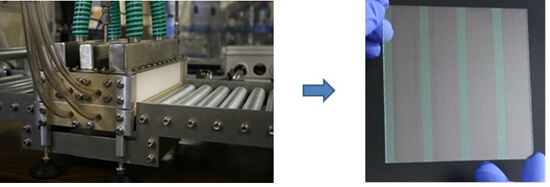
Dr. John Hodgkinson and Dr. Heather Yates from the University of Salford have recently demonstrated a bespoke roll-to-roll atmospheric pressure plasma enhanced CVD (AP PECVD) process for the production of TiO2-x over large areas at near ambient temperatures. Working in collaboration with a team of leading researchers at Centre Suisse d’Electronique et de Microtechnique (Dr. Arnaud Walter, Dr. Davide Sacchetto, Dr. Soo-Jin Moon and Dr. Sylvain Nicolay) they investigated the viability of the AP PECVD TiO2-x films as electron transport layers (ETL) in perovskite solar cells. Critically, to provide satisfactory charge separation and minimize series resistance, the ETL must be thin (sub 100 nm) compact, conformal and pinhole free. Whilst representing a considerable challenge, an atmospheric pressure process for the in-line deposition of ELT would be highly complementary to the online production of the transparent electrode, supporting the cost effective implementation of the highly promising perovskite technology. Their study is published in the research journal, Journal of Materials Chemistry C.
The authors found that the TiO2-x films produced by the AP PECVD process performed well in mesoporous perovskite devices with stabilised maximum power point efficiencies up to 13.57% observed for the 1cm2 cells, matching the sputtered reference material. This result may be indicative of a highly uniform and pinhole free film produced by the described AP PECVD process which is supported by the observation that the best performance was achieved by a film in the order of 40 nm thick, which also demonstrates improved fill factor and reduced hysteresis shown on the current density plots. In all cases, the AP PECVD films showed higher mean Voc with narrower distribution than the reference material, again suggesting a lack of pinholes providing high shunt resistance.
It is suggested that increases in perovskite cell efficiency may be obtained by further process optimisation and perhaps a reduction in ETL thickness. Hence, the described approach indicates the potential to enhance perovskite cell performance in addition to demonstrating the viability of an in-line AP PECVD process with clear advantages for cost effective large-scale production.


Reference
Hodgkinson, J., Yates, H., Walter, A., Sacchetto, D., Moon, S., & Nicolay, S. (2018). Roll to roll atmospheric pressure plasma enhanced CVD of titania as a step towards the realisation of large area perovskite solar cell technology. Journal of Materials Chemistry C, 6(8), 1988-1995.
Go To Journal of Materials Chemistry C