 Advances in Engineering Advances in Engineering features breaking research judged by Advances in Engineering advisory team to be of key importance in the Engineering field. Papers are selected from over 10,000 published each week from most peer reviewed journals.

Significance Statement
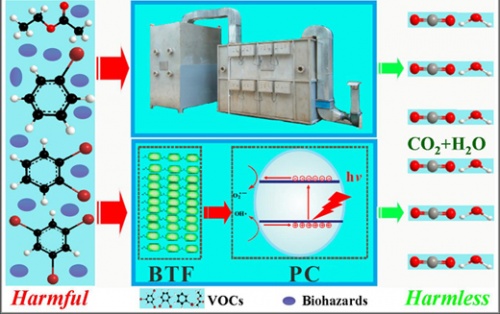
There is an ever-increasing production of municipal solid wastes (MSW) from all over the world. Similar with landfill, toxic odorous volatile organic compounds (VOCs) and biohazards were released during MSW compression and treatment process, especially in countries with high density population. Hence, in a recently published paper in Journal of Hazardous Materials 250 – 251 (2013) 147-154, a novel flow-through integrated biotrickling filter with photocatalytic (BTF-PC) reactor was developed to treat the real VOCs and biohazards emitted from MSW compression transfer station at a pilot scale. Before treatment, the VOCs and biohazards are very heavily polluted. Non-cancer risk of some individual VOCs were over the level of concern, and the cancer risk of some individual VOCs could even lead to “definite risk”. Biohazards concentration was located at level IV (polluted). During whole 60-day pilot-scale BTF-PC treatment, almost all VOCs were removed substantially and both potential risks were below the concern. Additionally, biohazards decreased dramatically and the air quality was also purified from polluted to cleanness after the treatment of this cost-effective combined technology. All results demonstrated that the integrated technology possessed high removal capacity and long stability for the removal of VOCs and biohazards at a pilot scale. Information related to these aspects should be of highly interest to researchers especially for engineer in the fields of biochemical, photocatalytic as well as environmental sciences. The efficient technology can be promisingly applied to the practical atmospheric pollution control. More information is available in this article at http://www.sciencedirect.com/science/article/pii/S0304389413000848. Similarity, the relative results on the semi volatile organic compounds (SVOCs) was also reported in a paper published on the journal Atmospheric Environment 76 (2013) 173-180. To learn more about the groups’ work, please visit our website: http://www.antaicheng-group.cn/web-china/index.html.
Journal Reference
J Hazard Mater. 2013 ;250-251:147-54.
Li G, Zhang Z, Sun H, Chen J, An T, Li B.
The State Key Laboratory of Organic Geochemistry and Guangdong Key Laboratory of Environmental Protection and Resources Utilization, Guangzhou Institute of Geochemistry, Chinese Academy of Sciences, Guangzhou 510640, China.
Abstract
Volatile organic compounds (VOCs) and biohazards air pollution in municipal solid waste transfer station were investigated. As compressor working, the concentrations of almost all quantified 14 VOCs (0.32-306.03 ug m(-3)) were much higher than those as compressor off (0-13.31 ug m(-3)). Comparatively, only 3 VOCs with extremely low concentrations could be detected at control area. Total microorganism was 7567 CFU m(-3) as compressor working, which was 1.14 and 6.22 times higher than that of compressor off and control area, respectively. Bacteria were the most abundant microorganism at all three sampling places. At pilot-scale, during whole 60-day treatment, for VOCs, the average removal efficiencies were over 92% after biotrickling filter-photocatalytic (BTF-PC) treatment. Although non-cancer and cancer risks of some VOCs were over the concern level before treatment, almost all VOCs were removed substantially and both potential risks were below the concern after BTF-PC treatment. Additionally, biohazard concentrations decreased dramatically and air quality was purified from polluted to cleanness after PC treatment. All results demonstrated that the integrated technology possessed high removal capacity and long stability for the removal of VOCs and biohazards at a pilot scale.
Copyright © 2013 Elsevier B.V. All rights reserved.
