Advances in Engineering Advances in Engineering features breaking research judged by Advances in Engineering advisory team to be of key importance in the Engineering field. Papers are selected from over 10,000 published each week from most peer reviewed journals.

Significance
Hazardous wastes have recently increased at an alarming rate, therefore, posing a great risk to the environment. As per the recent statistics, China alone recorded an increase in hazardous wastes by nearly half in just four years. However, the most surprising observation was the low amounts of hazardous wastes disposed by incineration. Unlike European countries that have successfully developed and deployed the use of hazardous waste incinerators, China is still lagging despite its numerous advantages.
With the growing popularity of hazardous waste incinerators, there is a growing demand for the reduction of the polychlorinated dibenzo-p-dioxins and dibenzofurans (PCDD/F) emissions. Based on the recent findings, the practical conditions of the full-scale hazardous waste incinerators are very much different from the commonly used laboratory-scale furnace thus necessitating the need for field study which reflects the actual PCDD/F emissions. This approach does not only provide emission reduction strategies but also aids to improve the corresponding control guidance that requires further investigation of the dominant PCDD/F formation pathways at different operating temperatures.
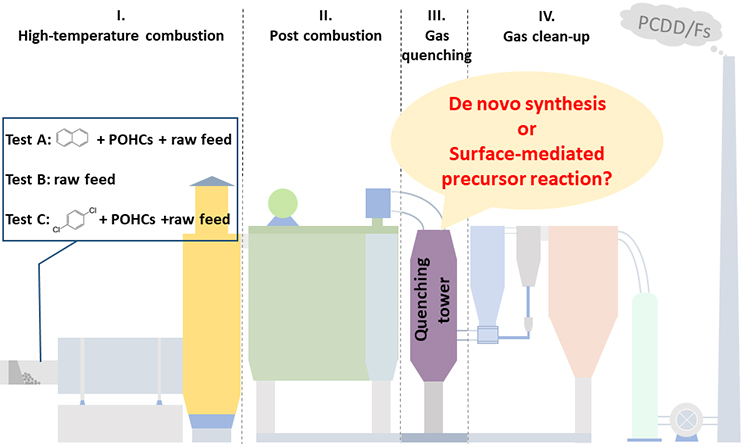
Recently, a joint effort by the Southern University of Science and Technology researchers Chen Wang and Professor Zuotai Zhang in collaboration with Dr. Jiyun Xu and Dr. Zongwei Cai from the Hong Kong Baptists University and Dr. Zhenzhou Yang from Peking University presented a different and new approach for controlling the formation and reduction of the PCDD/F emissions in full-scale hazardous waste incinerators. Specifically, they clarified the questions about the dominant formation mechanism and evaluated the suppression efficiency of the quenching tower under different operation conditions. The work is published in the Journal of Cleaner Production.
This study involved three different tests designed by adding different PCDD/F precursors in phenol-based raw materials. The resulting flue gas, bottom ash and fly ash were all collected and used in the determination of the formation pathways, emission characteristics and mass balance of the PCDD/F. The addition of the hazardous constituents helped in tracking the PCDD/F formation pathways to clarify the dominant formation mechanism.
Test A recorded low PCDD/F levels at 0.02 ng I-TEQ Nm-3 despite the addition of naphthalene and catalytic metals. However, as the experiment progressed, this level was seen to increase to 0.72 and 0.83 ng I-TEQ Nm-3 for tests B and C respectively with the addition of p-dichlorobenzene in test C. From the PCDD/F formation mechanism analysis, the dominant pathway in test A was reported to be high-temperature radical-molecule reaction while that for test B was identified as the memory effects in the air pollution control device that resulted in higher PCDD/F emissions.
A close examination of the PCDD/PCDF ratios indicated that the surface mediated-precursor reaction was the dominant formation mechanism in low-temperature stages. This was attributed to the abundance of the PCDD/F precursors. It was worth noting that the quenching tower failed to suppress the formation of PCDD/Fs as initially thought. On the other hand, the generated PCDD/Fs in the three tests was smaller as compared to the amount of destroyed through incineration. This confirmed that hazardous waste incinerators are harmless disposing sinks of PCDD/Fs as compared to their sources.
Professor Zuotai Zhang in a statement to Advances in Engineering highlighted the significance of their work in developing effective strategies for industrial control of PCDD/F emissions. For instance, he singled out strict regulation on the organochlorine content in feed materials, frequent cleaning of air pollution control devices and optimization injection rate of the activated carbon as key aspects of the control mechanisms.

Reference
Wang, C., Xu, J., Yang, Z., Zhang, Z., & Cai, Z. (2019). A field study of polychlorinated dibenzo-p-dioxins and dibenzofurans formation mechanism in a hazardous waste incinerator: Emission reduction strategies. Journal of Cleaner Production, 232, 1018-1027.