Advances in Engineering Advances in Engineering features breaking research judged by Advances in Engineering advisory team to be of key importance in the Engineering field. Papers are selected from over 10,000 published each week from most peer reviewed journals.

Significance
For high-temperature applications, ceramic matrix composites containing a continuous ceramic fiber fabric wave-transparent material have been seen to be quite promising. For their reinforcement, quartz fiber is so far the most common material owing to its exemplary thermal shock resistance and dielectric properties. However, it encounters a critical drawback in terms of undergoing crystallization at temperatures above 1100 °C which leads to severe strength degradation. Fortunately, recent technological advances have led to the development of aluminosilicate fibers such as Nextel™ 440, which possess desirable dielectric, mechanical, thermal properties, high structural stability and strength retention at relatively high temperatures. Composites composed of aluminosilicate fibers and nitride matrix have been hypothesized to be adequate to overcome the limits of silica fiber reinforced ceramic matrix composites. Unfortunately, little has been done to verify and ascertain this hypothesis into a fact with regard to the desirable attributes enlisted earlier.
To this note, scientists at National University of Defense Technology led by Professor Bin Li and Dr Duan Li from the Science and Technology on Advanced Ceramic Fibers and Composites Laboratory investigated the properties of Nextel™ 440 fiber reinforced nitride matrix (N440/Nitride) composites. They used the precursor infiltration and pyrolysis route to fabricate the reinforced matrix nitride composites. Their work is currently published in the research journal, Ceramics International.
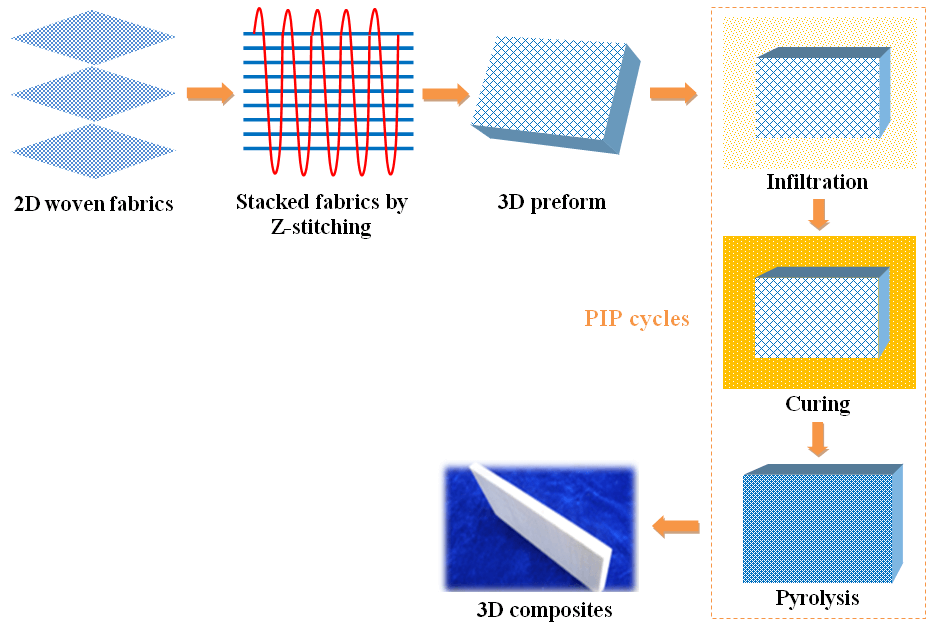
The research team looked in details on the structure, composition and mechanical strength of the Nextel™ 440 fiber. Next, they fabricated the N440/ Nitride composites using the precursor infiltration and pyrolysis route. Lastly, they systematically evaluated the mechanical, thermophysical and dielectric properties of the fabricated composites using various techniques.
The authors observed that original N440 fiber had a tensile strength retention rate of 35.1% at 1400 °C. Following various tests, they noted that the flexural strength of the N440/Nitride composites could achieve 76.0 MPa at room temperature thereby indicating a good fiber/matrix interface and toughness. Further investigations showed that even after heating to 1400 °C, the composites still possessed up to 67.4% of original flexural strength. It was also seen that the elevated temperatures caused strong fiber matrix connection and severe fiber degradation.
In a nutshell, Dr Duan Li, Professor Bin Li and colleagues study successfully presented the fabrication and rigorous testing of the Nextel™ 440 fiber reinforced nitride matrix (N440/Nitride) composites. In general, it was seen that the fabricated composite possessed an overall good performance with regard to thermal conductivity, specific heat, mechanical strength and overall structural stability. Regardless, it is still important to note that further improvement can be conducted by adjusting the porosity of the composites to acquire a lower ε and tan δ with balanced mechanical properties. Altogether, the excellent overall performance could enable the N440/Nitride composites utilization in advancing high-temperature wave-transparent applications.
Reference
Duan Li, Bin Li*, Yuanyi Zheng, Shitao Gao, Xuejin Yang. On the mechanical, thermophysical and dielectric properties of Nextel™ 440 fiber reinforced nitride matrix (N440/Nitride) composites. Ceramics International, volume 44 (2018) page 6137–6143.
Go To Ceramics International