 Advances in Engineering Advances in Engineering features breaking research judged by Advances in Engineering advisory team to be of key importance in the Engineering field. Papers are selected from over 10,000 published each week from most peer reviewed journals.

Significance Statement
Polymer electrolytes are promising materials for electrochemical device applications. Group of researchers led by Professor Takahito Itoh from Mie University in Japan carried out an investigation on the ionic conductivity, electrochemical properties, and the thermal properties of polymer electrolytes which composed of vinyl ethers with various ethyleneoxy EO chain lengths and lithium salt, as well as their cross-linked polymer electrolytes prepared by electron beam irradiation. The research work is now published in peer-reviewed journal, Ionics.
A lot of attention has been given to solid polymer electrolytes SPEs as electrolyte materials for all solid-state lithium batteries, according to Professor Takahito Itoh the leading author, this is due to their mechanical stability, safety, processability, and flexibility in cell design in comparison with liquid electrolytes and gel-type polymer electrolytes. Prior to this research, poly(ethylene oxide) PEO a typical solid polymer electrolyte has been observed to have good performance, moderate interaction with lithium ion, high electrochemical stability, easy fabrication, and as low-cost material. Due to the crystallization of the linear PEO chains, the PEO fail to conduct ionically at room temperature.
It is hard to obtain equilibrium between mechanical properties and ionic conductivity. This led the research team to focus on the cross-linking of the polymer electrolytes by electron beam EB irradiation, which is a clean and practical method and has an advantage to improve the mechanical property of the polymer electrolytes in a short time. The polymer were categorize as (poly-(1a–d)) of vinyl ethers with various EO chain length for experiment.
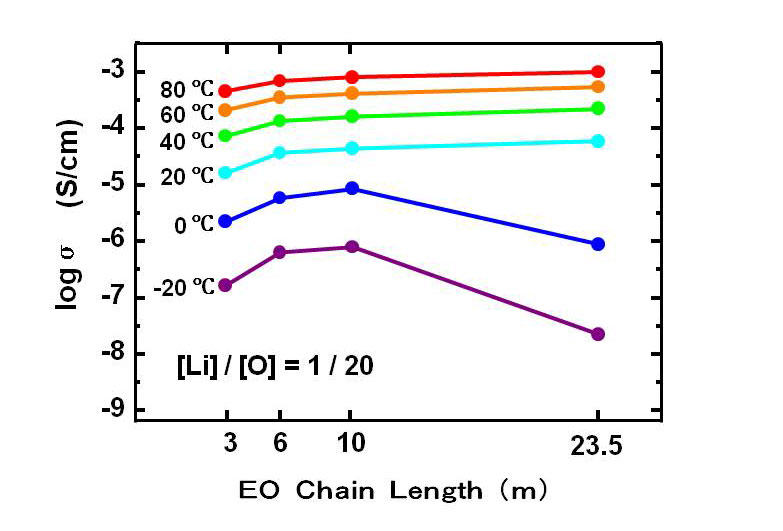
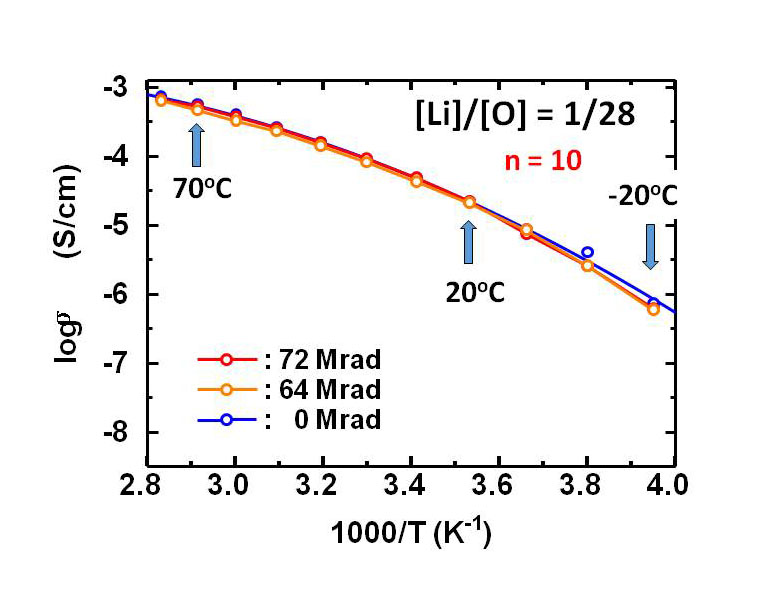
According to the team, poly-(1a–d) have melting temperature Tm ranging from −20 to 42 °C, and the melting points decreased with an increase in the pendant EO chain length and then increased at the longer pendant EO chain length, indicating that crystallization of the side-chain EO unit in the polymers takes place. The thermal property Tg increases linearly with increasing salt concentration, as a result of cross-linking formation of the coordinating oxygen atoms in the polymers to lithium cations, which limits the mobility of the polymer chain, resulting in a higher Tg. The ionic conductivity increases with increasing temperature as is typical of PEO-based amorphous polymer electrolytes. The gel fractions in the electrolytes polymer increases with an increase in the exposure dose of EB, which indicate an increase in the cross-linking density.
Investigations carried out by the authors on the ionic conductivity, electrochemical properties, and thermal properties were successful and the properties were obtained at various EO chain lengths, and the polymer electrolytes cross-linked by electron beam irradiation. The mechanical property of the polymer electrolyte can be improved by cross-linking with electron beam irradiation without affecting significantly ionic conductivity, thermal property, and electrochemical stability.

Journal Reference
Takahito Itoh, Katsuhito Fujita, Takahiro Uno, and Masataka Kubo, Polymer Electrolytes Based on Vinyl Ethers with Various EO Chain Length and their Polymer Electrolytes Cross-Linked by Electron Beam Irradiation, Ionics (2017) 23:257–264.
Division of Chemistry for Materials, Graduate School of Engineering, Mie University, Tsu, Japan.
Go To Ionics
