Advances in Engineering Advances in Engineering features breaking research judged by Advances in Engineering advisory team to be of key importance in the Engineering field. Papers are selected from over 10,000 published each week from most peer reviewed journals.

Significance
Globally, natural gas hydrates have been recognized as a potential energy resource owing to their abundant reserves, low environmental costs, and high efficiencies of energy supply. As such, their timely discovery and efficient exploration is pivotal for sustaining the global energy system. Gas production process from natural gas hydrate accumulations involving hydrate dissociation is accompanied by hydrate phase transition, gas migration, water flow, permeability, as well as heat and mass transfer. Specifically, permeability determines the multiphase flow property in hydrate bearing sediments (HBS), which is critical when evaluating natural gas production efficiencies and when carrying out reasonable exploitation projects. Unfortunately, noteworthy publications have highlighted that there still are extensive challenges on laboratory-scale researches of the permeability characteristic in hydrate sediments when considering hydrate saturation, porosity of the media, pore geometry, hydrate morphology, and fluid and rock properties. In addition, numerous numerical and experimental studies focusing on permeability measurement during the process of hydrate formation/decomposition have been published; nonetheless, permeability measurement remains a comprehensive multifactor process reflecting the seepage characteristics, which ought to be further investigated for different areas of application.
Nuclear magnetic resonance (NMR) is an effective geophysical technique that has been used to simultaneously assess porosity, permeability, and hydraulic radius in sediments or subsurface measurements as well to investigate clathrate hydrate. With the aim being to further undertake permeability measurements, researchers from the Dalian University of Technology in China, Yangmin Kuang (PhD candidate), Professor Lunxiang Zhang, Dr. Yongchen Song, Dr. Lei Yang and Professor Jiafei Zhao proposed to use nuclear magnetic resonance (NMR) measurement to observe the in situ formation and dissociation of tetrahydrofuran (THF) hydrate in porous media. Their work is currently published in the research journal, AIChE Journal.
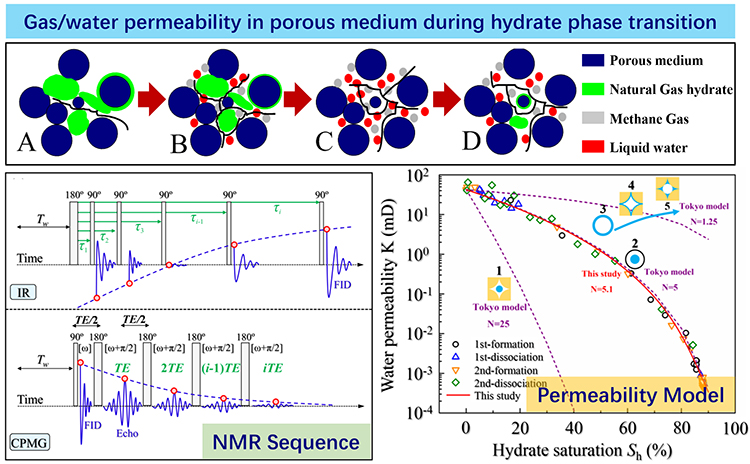
In their approach, relaxation characteristics of pore water and the dependence of free and bound water contents of hydrate saturation on the decomposition and formation process of hydrate were analyzed. Additionally, the hydrogen index of THF hydrate was evaluated. The research team then predicted the permeability of the hydrate-bearing sediments under different hydrate saturation conditions.
The authors reported that the relative free water and bound water consumption during hydrate phase transition could affect the seepage features of sediments. Moreover, the Tokyo model showed that the hydrate had a heterogeneous distribution of pore-filling and that was likely to evolve in larger pores.
In summary, the study investigated the formation and decomposition characteristics of THF hydrate in porous media as well as the state of pore size distribution in different porous media using low field NMR technology. The findings of this study showed that the growth habits of THF hydrate in porous media were mainly suspension type. In a statement to Advances in Engineering, Professor Lunxiang Zhang, the corresponding author pointed out that their work proved NMR as an efficient and direct technique for investigating the seepage characteristics during hydrate phase transition as well as pore fluid distribution in sediments.




Reference
Yangmin Kuang, Lunxiang Zhang, Yongchen Song, Lei Yang, Jiafei Zhao. Quantitative determination of pore-structure change and permeability estimation under hydrate phase transition by NMR. AIChE Journal. 2020; volume 66:16859.