 Advances in Engineering Advances in Engineering features breaking research judged by Advances in Engineering advisory team to be of key importance in the Engineering field. Papers are selected from over 10,000 published each week from most peer reviewed journals.

Significance
Topological states of matter are particularly intriguing classes of quantum phenomena. Their study combines quantum physics with topology, which is the branch of theoretical mathematics that studies geometric properties that can be deformed but not intrinsically changed. Topological quantum states first came in the scientific news 2016 when three scientists—Princeton’s Duncan Haldane, who is Princeton’s Thomas D. Jones Professor of Mathematical Physics and Sherman Fairchild University Professor of Physics, together with David Thouless and Michael Kosterlitz—were awarded the Nobel Prize for their work in uncovering the role of topology in electronic materials.
Most of what we have uncovered in the last decade has been focused on how electrons get these topological properties, without thinking about them interacting with one another. But by using a material known as magic-angle twisted bilayer graphene, Professor Ali Yazdani and his research team at Princeton Center for Complex Materials were able to explore how interacting electrons can give rise to rise to surprising phases of matter. They discovered that, under certain conditions, interacting electrons can create what are called “topological quantum states,” which, has implications for many technological fields of study, especially information technology. The remarkable properties of graphene were discovered two years ago when Pablo Jarillo-Herrero and his team at the Massachusetts Institute of Technology (MIT) used it to induce superconductivity—a state in which electrons flow freely without any resistance. The discovery was immediately recognized as a new material platform for exploring unusual quantum phenomena. This finding, which was recently published in the journal Nature, has implications for many technological fields of study, especially information technology.
The authors were intrigued by this discovery and set out to further explore the intricacies of superconductivity. But what they discovered led them down a different and untrodden path. The research team focused their investigation on twisted bilayer graphene. Indeed, this two-dimensional lattice of carbon atoms has great electrical conductor properties and is one of the strongest crystals known. Graphene is produced in a deceptively simple but painstaking manner: a bulk crystal of graphite, the same pure graphite in pencils, is exfoliated using sticky tape to remove the top layers until finally reaching a single-atom-thin layer of carbon, with atoms arranged in a flat honeycomb lattice pattern.
To get the desired quantum effect, the Princeton researchers placed two sheets of graphene on top of each other with the top layer angled slightly. This twisting creates a moiré pattern, which resembles and is named after a common French textile design. The angle at which the top layer of graphene is positioned: precisely 1.1 degrees which produces the quantum effect. The researchers generated extremely low temperatures and created a slight magnetic field. They then used a machine called a scanning tunneling microscope, which relies on quantum tunneling technique rather than light to view the atomic and subatomic world. They directed the microscope’s conductive metal tip on the surface of the magic-angle twisted graphene and were able to detect the energy levels of the electrons.
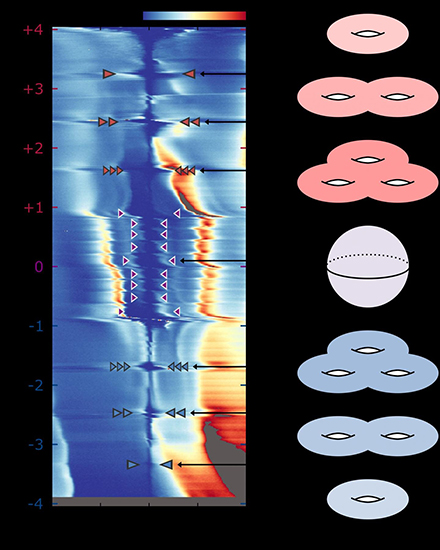
They found that the magic-angle graphene changed how electrons moved on the graphene sheet. It created a condition which forces the electrons to be at the same energy. When electrons have the same energy—are in a flat band material—they interact with each other very strongly. The researchers discovered, was the creation of unexpected and spontaneous topological states.
This twisting of the graphene creates the right conditions to create a very strong interaction between electrons and this interaction unexpectedly favors electrons to organize themselves into a series of topological quantum states. Specifically, they discovered that the interaction between electrons creates what are called topological insulators. These are unique devices that act as insulators in their interiors, which means that the electrons inside are not free to move around and therefore do not conduct electricity. However, the electrons on the edges are free to move around, meaning they are conductive. Moreover, because of the special properties of topology, the electrons flowing along the edges are not hampered by any defects or deformations. They flow continuously and effectively circumvent the constraints—such as minute imperfections in a material’s surface—that typically impede the movement of electrons.
Although the field of quantum topology is relatively new, it holds great potential for revolutionizing the areas of electrical engineering, materials science and especially computer science. The study has relevance to quantum computing, where topological quantum states can be utilized to make better types of quantum bits. Better understanding how quantum information can be encoded inside a topological phase have potential impact in advancing quantum information technologies. Yazdani and his research team will continue their research into understanding how the interactions of electrons give rise to different topological states.


Reference
Kevin P. Nuckolls, Myungchul Oh, Dillon Wong, Biao Lian, Kenji Watanabe, Takashi Taniguchi, B. Andrei Bernevig & Ali Yazdani. Strongly correlated Chern insulators in magic-angle twisted bilayer graphene. Nature volume 588, pages610–615(2020)