 Advances in Engineering Advances in Engineering features breaking research judged by Advances in Engineering advisory team to be of key importance in the Engineering field. Papers are selected from over 10,000 published each week from most peer reviewed journals.

Significance Statement
Experimental measurements involved in determining one of the parameters used for characterizing hazardous chemicals, minimum ignition energy, is known to be risky as a result of the high volatility of certain chemicals. There also exists some form of unpredictability in experimental measurements coupled with the exorbitant cost it portends during data processing.
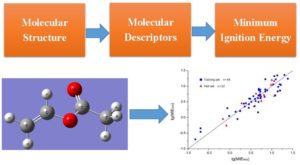
In order to provide another alternative, the use of a quantitative structure-property relationship (QSPR) model where physicochemical properties of substances can be mathematically expressed, affords an accurate modeled response of molecular structures. Hence, for the first time, the effectiveness of the quantitative structure-property relationship model can be applied in studying the minimum ignition energy of chemical substances. Researchers led by Professor Qingsheng “Sam” Wang from Oklahoma State University reported in the journal, Industrial & Engineering Chemistry Research the development of two quantitative structure-property relationship models involving multiple linear regression analysis and support vector machine to determine minimum ignition energy values of hydrocarbon fuels.
The authors showed that the multiple linear regression analysis had high goodness-of-fit with experimental data; excellent internal robustness was also achieved coupled with a sizable external predictive ability. Values at which the model can be optimized were also given.
The support vector machine analytical model also had similar features with that of the multiple linear regression model. The two models had comparable values for both the training set and test set, showing their tremendous capacity in overall sensing performance.
Depending on the experimental conditions, an appropriate model could be selected. The multiple linear regression model had better computability and better internal robustness and on the other hand, the support vector machine model possessed better goodness-of-fit and external predictive ability.
The quantitative structure-property relationship models developed in this study can certainly serve as an excellent alternative for determining the minimum ignition energy of hydrocarbon fuels, thereby eliminating any form of danger found in experimental measurements.




Reference
Wang, B.1,2, Zhou, L.2, Xu, K.1, Wang, Q.2,3 Prediction of Minimum Ignition Energy from Molecular Structure Using Quantitative Structure−Property Relationship (QSPR) Models, Industrial & Engineering Chemical Research 56 (2017) 47−51.
[expand title=”Show Affiliations”]- School of Resources and Civil Engineering, Northeastern University, Shenyang, Liaoning 110819, China
- Department of Fire Protection & Safety, Oklahoma State University, Stillwater, Oklahoma 74078, United States
- Department of Chemical Engineering, Oklahoma State University, Stillwater, Oklahoma 74078, United States
Go To Industrial & Engineering Chemical Research
