Advances in Engineering Advances in Engineering features breaking research judged by Advances in Engineering advisory team to be of key importance in the Engineering field. Papers are selected from over 10,000 published each week from most peer reviewed journals.

Significance Statement
Nowadays a lot of attention is paid to an emergent class of porous materials known as metal-organic frameworks (MOFs). Many of these materials have been already reported as excellent candidates for the separation of carbon dioxide, showing very good selectivities and high capacities. The terephthalate-based MOF MIL-53 is formed by metal-oxygen-metal chains that are interconnected by terephthalates resulting in one-dimensional channels with diamond shape. The material exhibits a pore contraction or expansion upon the adsorption of certain molecules, such as carbon dioxide, which is referred in literature as the breathing effect. The breathing effect has beneficial effects in the separation of carbon dioxide from methane. When the material is in the so-called narrow pore configuration the adsorption of methane is hampered and decent selectivities are reached. The incorporation of an amine functionality on the terephthalate modifies the breathing effect; the interaction of the amine with the bridging hydroxyl present in the metal-oxygen-metal chain leads to the presence of the narrow pore phase in the absence of adsorbate and to a wider pressure range where this phase is dominant. As a result of these two facts, NH2-MIL-53(Al) exhibits one of the highest selectivities towards carbon dioxide reported in the MOF field.
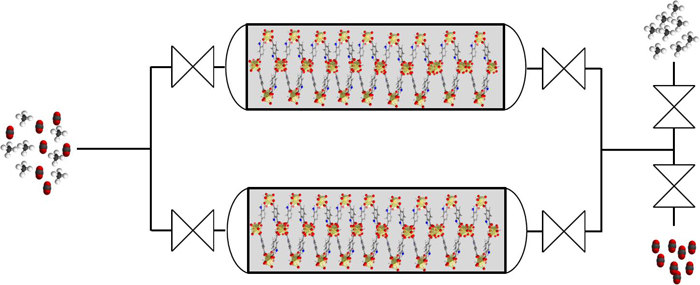
In this research, a vacuum pressure swing adsorption process, based on the utilization of the metal-organic framework NH2-MIL-53(Al), has been proposed based on a conceptual process design analysis that includes a technical evaluation and an economic study. The use of columns in parallel at high pressure combined with a recycle stream assures a high methane recovery. In the detailed design phase, the selected design alternative is further developed including equipment and unit design, process control, safety and economical evaluation. The design points to a separation process that provides a high quality product and can be operated in a cost effective way. The comparison with most applied technologies, amine scrubbing and membrane-based processes, shows that the proposed system is competitive thanks to its low operation costs due to its low energy demand, what demonstrates the large potential of NH2-MIL-53 (Al) as selective adsorbent for natural gas sweetening.

Journal Reference
Chemical Engineering & technology, Volume 38, Issue 7, 2015 , Pages 1183–1194.
Pablo Serra-Crespo1,2,Tim A. Wezendonk,Carlos1, Bach-Samario1,Nishanth Sundar1,Karlijn Verouden1,Matthijs Zweemer1,Jorge Gascon1,Henk van den Berg3,Freek Kapteijn1.
[expand title=”Show Affiliations”]- Catalysis Engineering – ChemE, Delft University of Technology, Delft, The Netherlands.
- Radiation and Isotopes for Health – RST, Delft University of Technology, Delft, The Netherlands.
- Faculty of Science and Technology, Process Plant Design, University of Twente, Enschede, The Netherlands.
Abstract
A preliminary study based on a conceptual process design methodology that includes a technical evaluation and an economic study has been carried out for the use of the metal-organic framework NH2-MIL-53(Al) as adsorbent for the separation of carbon dioxide from methane. Among the alternatives considered, a vacuum pressure swing adsorption was chosen in the detailed design phase. The combination of a design with columns in parallel and the possibility of recirculating some of the streams ensures a high degree of separation and a final product with high quality without compromising the operation costs. A comparison with the state-of-the-art technology, amine scrubbing, and with a process based on membranes demonstrates that the proposed process is competitive as a result of its low operation costs and the energy demand.
Go To Chemical Engineering & Technology