Advances in Engineering Advances in Engineering features breaking research judged by Advances in Engineering advisory team to be of key importance in the Engineering field. Papers are selected from over 10,000 published each week from most peer reviewed journals.

Significance
Additive manufacturing (AM) also known as 3-D printing, is the process of joining materials to make objects from 3D model data, usually layer upon layer, as opposed to subtractive manufacturing methodologies. In recent times, the printing of composites by AM, has become a hotbed of research, due to their superior mechanical performance, compared with parts fabricated using the polymer only. For example, the ability to print polymer composites using both short fiber/particle and continuous fiber filaments has demonstrated considerable potential for the fabrication of precision engineering components.
Woven fiber fabric is often utilized as reinforcing material in various small to medium scale applications. Such fabrics are typically formed from thousands of fiber tows threaded together on a loom to form a semi-rigid sheet, this is then cut to size and placed into a mold or forming plate to be impregnated with an appropriate resin or polymer, which is later subjected to post processing steps such as machining and water jet cutting. Some applications specifically require machining of composites to facilitate their integration into assemblies of both metal and composite materials, a process that often damages the fiber. As such, difficulties have been reported, for instance; the presence of exposed damaged fibers around the hole, as well as fiber path deformation, as the matrix material is burnt off. Overall, the potential for load distribution becomes reduced.
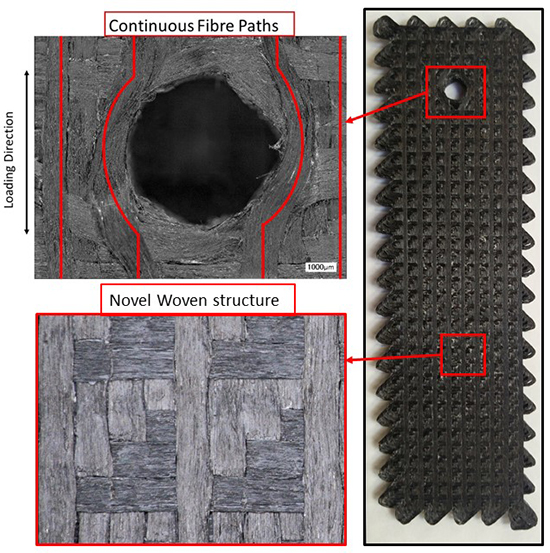
In their study reported in the journal, Composite Structures, Dr. Andrew Dickson and Professor Denis Dowling at University College Dublin developed a novel AM technique for the printing of woven multi-laminate composites. Their work was inspired by the fact that current industry standard machining techniques result in fiber discontinuity and damage, a shortcoming responsible for the suboptimal mechanical performance of composite components. Their target goal was to assess the performance of AM printed woven multi-laminate composites. Specifically addressed, was the use of selective fiber placement for optimization of internal fiber orientations, particularly around major stress risers such as a notch/hole. To this end, the performance of AM engineered notched structures was compared with machined equivalents for fastening applications. Through the use of bearing response testing, the printed structures load bearing capacity in both metal-composite (Double-shear) and composite-composite (Single shear) bolted joints were assessed.
This study demonstrated significantly reduced fiber damage and fastener travel were characteristic of the new process versus benchmark drilled specimens. In fact, when tested according to the approach detailed in ASTM D5961, which is the industry standard for fastening performance, the multi-laminate structures for fastening applications exhibited bearing strengths up to 63% higher in double, and 29% higher in single shear than the equivalent drilled/machined specimen representing the current industry standard for fastening performance. The improved mechanical performance was associated with the retention of a continuous fibre structure, within the composite obtained by printing rather than drilling holes. This technique demonstrated promise for avoiding fibre damage during manufacturing, a frequent problem for composite production.
In summary, woven multi-laminate carbon fiber reinforced composite structures were produced for the first time using an additive manufacturing technique. The printing technique was successfully demonstrated for the auto layup of woven multi-laminate structures containing apertures/holes, without the need for post-machining. It was concluded that the novel fiber placement technique has potential for application in aerospace and automotive industries, for increasing fastened composite assembly strengths and stiffness versus drilled techniques.



Reference
Andrew N. Dickson, Denis P. Dowling. Enhancing the bearing strength of woven carbon fiber thermoplastic composites through additive manufacturing. Composite Structures, volume 212 (2019) page 381–388.
Go To Composite Structures