Advances in Engineering Advances in Engineering features breaking research judged by Advances in Engineering advisory team to be of key importance in the Engineering field. Papers are selected from over 10,000 published each week from most peer reviewed journals.

Significance
Current dynamics in the oil extraction, refineries and marketing have somehow resulted in a sort of confusion in the oil and gas industry. Specifically, this can be attributed to numerous factors including lower crude oil slate, high concentration of sulphur and presence of heavy metals and contaminants. For instance, the rapid decline in the supply of group I base oil has attracted significant attention of researchers. Owing to their high value, development of effective alternative refinery technologies for upgrading the bottom of barrel to produce various oil products is highly desirable.
Among the established technologies to enhance the production of bright stock, solvent deasphalting method is widely used for residue upgrading due to its efficiency and relatively low costs. Generally, this process involves the use of solvents such as aliphatic solvent to separate deasphalted oils from components’ residue. For high-quality deasphalting oils extraction, recent studies have explored the feasibility of a solvent deasphalting process under various conditions. The solvent recovery process was identified as a great consideration in enhancing the solvent deasphalting process and reducing the total energy consumption. To this end, several solvent extraction columns have been developed to improve the product quality based on the overall cost, working principle, and intended application. However, regardless of remarkable achievements, the use of propane solvent system in deresining extraction process using extraction column with half-moon baffle internals have not been fully explored.
To this note, American Refining Group researchers: Dr. Prafulla Patil, Mike Kozminski and John Peterson cross-examined the emerging trends in using continuous propane deasphalting unit in enhancing the separation of deresining oils from the atmospheric crude residue as well as controlling the fouling problem emanating from the tower. Fundamentally, they investigated whether the outlined process would be of significant importance in the oil and gas industry in improving the bright stock quality and production. The work is currently published in the journal, Fuel.
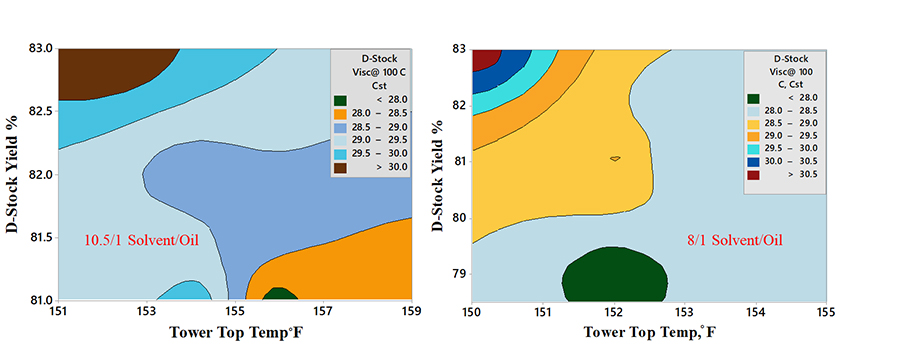
In brief, the research method employed entailed: first exploring the various propane solvent to oil ratio conditions i.e. 10.5/1 and 8/1, where the three researchers took into consideration the effects of the varying column bottom and top temperatures at constant column pressure. Next, they accessed the quality and production efficiency of the propane deresined oil (D-stock) based on the atmospheric crude cylinder stock. The feedstock (cylinder stock) used in this study is primarily derived from Pennsylvania grade crude oil and therefore does not contain an appreciable level of asphaltenes.
The authors observed significant improvement in the propane deresined oil production with no effects on the viscosity limits. This was attributed to the improved separation process, enhanced surface area and mass transfer. For instance, they recorded propane deresined oil production of up to 80-82% that was relatively higher as compared to that produced by the American Refining Group propane deresined oil yield of 68%.
In summary, Prafulla Patil and his colleagues successfully presented a new method on continuous propane deresining of atmospheric crude cylinder stock. In general, they noted that reduction of the overall operating cost could be achieved by decreasing the solvent to oil ratio. Consequently, the tower temperature was identified as the main parameter affecting the phase separation process. Altogether, the study provides vital information that will advance the production and quality of propane deresined oil.



Reference
Patil, P., Kozminski, M., & Peterson, J. (2019). Pilot plant study on continuous propane deresining of atmospheric crude cylinder stock. Fuel, 235, 17-22.
Go To Fuel