Advances in Engineering Advances in Engineering features breaking research judged by Advances in Engineering advisory team to be of key importance in the Engineering field. Papers are selected from over 10,000 published each week from most peer reviewed journals.

Significance
Recent technological advances in industries and the general society require composite materials processing of not only remarkable mechanical properties, but also exceptional functionalities. To this note, carbon nanotubes have become a material of great interest due to their dazzling properties. As a result, this has motivated many researchers to focus on ceramic composites containing carbon nanotubes with the aim of improving the matrix’s properties. Carbon nanotubes possess some unwelcoming properties such as chemical inertness and entanglement due to van der Waal forces, which inhibit their full exploitation. Consequently, the search for an enhancer of the carbon nanotube benefits that does not damage the nanotubes has intensified. Previously published work has highlighted on various acid treatment techniques that have been proposed. Colloidal method has emerged as the most auspicious. Unfortunately, colloidal technique incorporating carbon nanotubes acid treatment and aqueous solution pH control is yet to be fully exploited for the processing of zirconia/carbon nanotubes composites.
Inst. Ciencia de Materiales de Sevilla (ICMS, CSIC-Universidad de Sevilla) researchers in Spain: Dr. Rosalía Poyato, Dr. Gutiérrez Mora, Professor A. Munoz, Professor Ana Morales Rodríguez and Professor Ángela Gallardo López conducted a study whose main objective was to differentiate the benefits/disadvantages of the various colloidal processing routines employed in terms of optimizing multiwall carbon nanotubes distribution through the ceramic matrix. Their research approach entailed modifying the acid treatment to be applied to the nanotubes and also the use of an acid/basic pH during composite powder mixing. Their work is published in the research journal, Ceramics International.
The research techniques employed entailed preparation of zirconia polycrystals composites with 2.5% by volume of multiwall carbon nanotubes by spark plasma sintering of powders prepared using different colloidal processing routines. The processing routines employed involved subjecting the multiwall carbon nanotubes to two different acid treatments and ulterior composite powder mixing in aqueous solution with either basic or acid pH. Finally, the researchers analyzed the effects of each routine on the composites hardness, microstructure, electrical conductivity and fracture behavior.
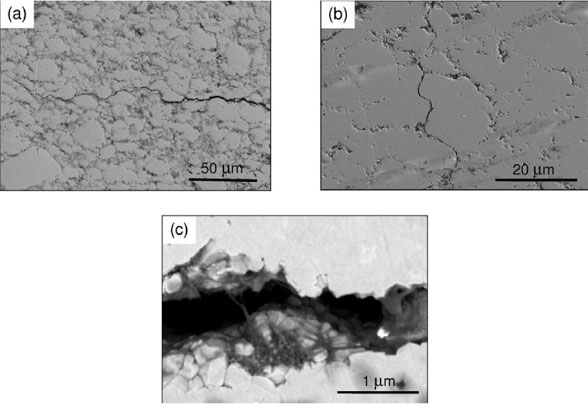
The authors observed that no multiwall carbon nanotubes damage during processing was detected by Raman spectroscopy. In addition, carbon nanotubes bundles were found in all the composites forming different patterns depending on the processing route. Moreover, the researchers noted that similar values of hardness were obtained for all the composites. The carbon nanotubes bundles were seen to act as fracture short paths. Furthermore, a similar anisotropic behavior was observed for the electrical conductivity.
Rosalía Poyato and colleagues study has elucidated on the effect of acid-treatment and colloidal-processing conditions on the room temperature mechanical and electrical properties of tetragonal zirconia polycrystals/multiwall carbon nanotubes ceramic nanocomposites. It has been seen that the studied nanocomposites show a rather homogeneous microstructure with most of the multiwall carbon nanotubes well dispersed at the zirconia grain boundaries. In addition, the remarkable electrical anisotropy observed in all the composites points to a preferential orientation of the carbon nanotubes bundles in the direction perpendicular to the Spark Plasma Sintering loading axis. Altogether, the results here direct that the best processing routine for obtaining highly conductive tetragonal zirconia polycrystals/multiwall carbon nanotubes composites with homogeneous microstructure is the one which combines multiwall carbon nanotubes stirring during the acid treatment and further powder processing by charge stabilization.





Reference
R. Poyato, A. Morales-Rodríguez, F. Gutiérrez-Mora, A. Muñoz, Á. Gallardo-López. Effect of acid-treatment and colloidal-processing conditions on the room temperature mechanical and electrical properties of 3YTZP/MWNT ceramic nanocomposites. Ceramics International, volume 43 (2017) pages 16560–16568
Go To Ceramics International